
Why Do Spiders Build Webs?Spiders are among the most fascinating creatures in the natural world. They belong to the class Arachnida and the order Araneae. Known for their eight legs and exceptional hunting abilities, many spiders also produce silk to build webs. This silk is one of nature’s most extraordinary materials, used for catching prey, creating shelters, and protecting eggs.
Not all spiders build webs. However, those that do depend on them for survival. In this guide, you’ll learn what spider webs are, why spiders build them, how they are made, and how to identify different types of spider webs.
What Is a Spider Web?
A spider web is a structure made from spider silk, a strong and flexible protein fiber produced in glands within the spider’s abdomen. The silk is released through tiny openings called spinnerets.
Different spiders produce multiple types of silk. Each type has unique properties:
- Sticky silk – used to trap prey
- Non-sticky silk – used for structural support
- Elastic silk – allows webs to stretch without breaking
This variety explains why spider webs come in so many shapes and designs.
Types of Spider Webs
Spiders are skilled builders. They construct different web types based on their species and hunting strategy. Here are the most common spider web types:
1. Orb Webs
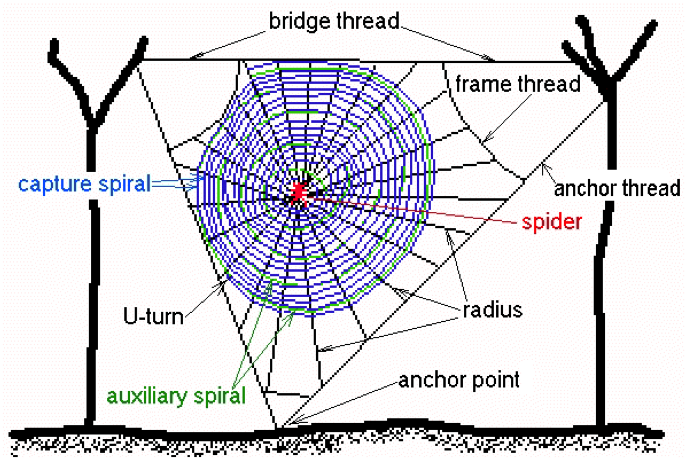
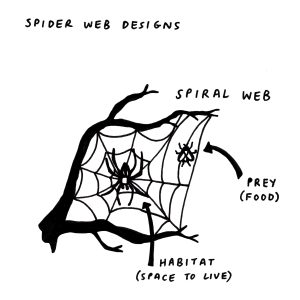
These are the classic wheel-shaped webs often seen in gardens. Built by orb-weaver spiders, they feature a circular frame with spiral sticky threads designed to catch flying insects.
2. Sheet Webs
Flat and dense, these webs form a horizontal layer. The spider typically waits underneath and attacks insects that fall onto the surface.
3. Tangle Webs (Cobwebs)
Irregular and messy in appearance, these webs are built by comb-footed spiders. Their chaotic structure helps entangle unsuspecting prey.
4. Funnel Webs
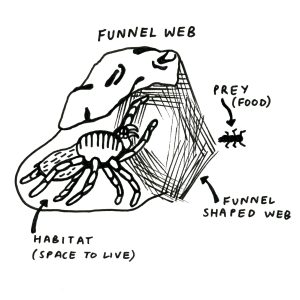
These webs form a tunnel-like structure with a hidden retreat. The spider waits inside and rushes out when vibrations signal trapped prey.
5. Lacy Webs
Delicate and decorative, these intricate webs are designed to catch very small insects.
Spider Web Identification Guide
Learning spider identification through webs is surprisingly effective. Each web type has distinct characteristics, including:
- Shape (circular, flat, tangled, funnel-like)
- Density (tight or loose structure)
- Texture (sticky or dry threads)
- Location (gardens, corners, shrubs, or ground level)
By observing these features, you can better understand which spiders are nearby and how they behave.
Why Do Spiders Build Webs?
The primary reason spiders build webs is survival. Webs serve several important functions:
1. Catching Food
Webs act as traps for insects such as flies and mosquitoes. Sticky silk strands capture prey, allowing spiders to conserve energy instead of actively hunting.
2. Providing Shelter
Some spiders use webs as a safe place to rest or hide from predators.
3. Protecting Eggs
Silk is often used to wrap and protect egg sacs, ensuring the next generation survives.
4. Communication and Vibration Detection
Webs transmit vibrations. When prey gets caught, the spider senses movement through the silk and responds quickly.
How Strong Is Spider Silk?
Spider silk is incredibly strong and flexible. It can absorb impact and resist breaking, even under pressure from wind or struggling prey. In fact, its strength-to-weight ratio rivals that of steel.
Because of this, engineers and scientists study spider silk to design stronger materials. Some bridge structures even mimic the tension and distribution patterns found in spider webs.
Spider Silk and Modern Technology
Spider silk has inspired innovations in multiple fields:
- Medical applications – such as sutures and tissue engineering
- Textiles – lightweight yet durable fabrics
- Adhesives – inspired by silk’s natural stickiness
Despite its strength, spider silk is thinner than a human hair, making it both efficient and versatile.
Learning from Spider Webs
For centuries, humans have been inspired by spider webs. Their combination of strength, flexibility, and efficiency has influenced design, architecture, and material science.
Scientists continue to study spider silk to understand its molecular structure. The goal is to recreate it synthetically for use in medicine, engineering, and everyday products.
Final Thoughts
Spiders are natural engineers. Their webs are not just tools for catching food—they are sophisticated structures designed for survival. From spider facts to advanced materials science, spider webs offer valuable insights into both nature and technology.
Understanding what spiders are and how they build their webs can deepen your appreciation for these remarkable creatures—and might even help you identify the spiders living around you.
What are spider webs made of? And how do they spin them?
Find out how web-spinning spiders do what they do and learn about the impressive, multipurpose material they use to catch their dinner.
Spiders make their webs from silk, a natural fibre made of protein.
Not only does spider silk combine the useful properties of high tensile strength and extensibility, it can be beautiful in its own right.
Silk is an amazing material,’ says Jan Beccaloni, our arachnid curator. Golden silk orb-weavers, which are found in warm regions around the world – but not the UK, unfortunately – spin webs with a lovely golden sheen.
UK spiders tend to produce silk that is white or has a bluish hue.
There are seven different silk glands, which produce silk with different characteristics and uses. For example cribellate silk is very woolly.
Jan adds, ‘Cribellate silk acts like Velcro, sticking to the legs and bristles of captured insects.’
Each type of silk gland is associated with a particular spinneret. No species has all seven, but orb-web weavers have five.
How do spiders make their webs?
Spiders have structures called spinnerets on their abdomen, usually on the underside to the rear. These are the silk-spinning organs. Different species have different numbers of spinnerets, but most have a cluster.
At the end of each spinneret is a collection of spigots, nozzle-like structures. A single silk thread comes out of each.
Although it looks a bit like an icing nozzle, the silk is pulled out by gravity or the spider’s hind leg. The silk is liquid when it’s inside the spider.
Before it is extruded out of the spinneret, cribellate silk first passes through a sieve-like structure called the cribellum. Spiders that make this type of silk also have a row of specialised leg bristles called the calamistrum, which combs the silk out and gives it the different, woolly texture.
Do all spiders make webs?
Although webs are the most well-known use for spider silk, not all spiders make webs to catch their prey. In fact, less than half of the 37 spider families in Britain do.
Other spiders, such as crab spiders in the family Thomisidae, are ‘sit and wait’ predators – for example Misumena vatia lurks on flower heads, waiting to ambushing visiting insects. Others, such as jumping spiders in the family Saltidae, actively follow their prey and catch it by leaping on it.
Some spiders even invade other webs to find their food. The pirate spiders, of which there are four UK species in the genus Ero, go onto another spider’s web and mimic the behaviour of its prey to lure the spider closer. When the web’s owner investigates, the pirate spider attacks.
Silk: a multipurpose material
However, even spiders that don’t make webs have uses for silk, including creating moulting platforms, sperm webs for males, and retreats.
Jan adds, ‘Jumping spiders, for example, make little silken cells in which to hide in during the day – a bit like a sleeping bag.’
Most spiders use silk to wrap their eggs.
Another common use for silk is as a drag line. Every so often a spider attaches a thread of silk to something, like an anchor, so that if it falls, it won’t fall too far and can drag itself back up to the previous position.
Ballooning is another spectacular use for silk, allowing the mass dispersal of spiderlings and small adults.
After climbing to a relatively high point, the spider points its abdomen skywards and pulls out one to several threads. When air or electrostatic currents carry the threads upwards, the spider follows. They can be carried many thousands of metres.
