
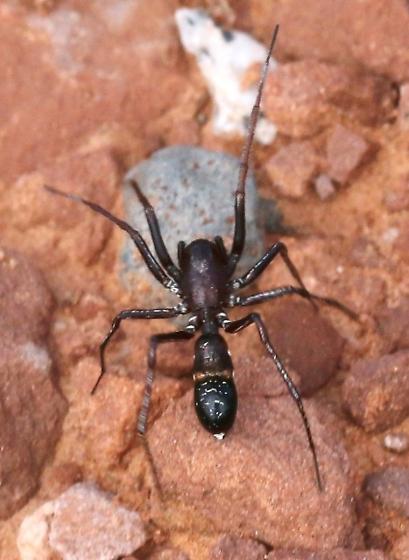
This insect appears almost like a fusion of an ant and a spider.
Spider ants are striking when encountered, yet they remain relatively uncommon in Sydney.
Identification
At first glance, as their name implies, spider ants strongly resemble spiders. Their slender bodies, elongated heads, and long, delicate legs contribute to this illusion, as does their tendency to lift their abdomens and dart away rapidly when disturbed.
Habitat
Spider ants inhabit urban environments, forests, woodlands, and heathlands. They are more frequently observed in wetter forested and mountainous regions.
Distribution
Spider ants occur across the entirety of Australia.
Behaviour and Adaptations
Spider ants typically nest at ground level, choosing soil or decaying wood, and their colonies tend to be smaller than those of many other ant species. They forage both by day and occasionally by night, collecting a broad range of plant and animal material. Their long, slender legs allow them to walk across the surface of water, and they are often the first ants to resume foraging after rain.

In addition to ordinary workers that tend the brood, forage, and guard the nest, spider ant colonies also include specialised workers adapted for food storage. During periods of scarcity, these individuals distribute stored liquid—held in their enlarged abdomens—to other members of the colony.
While searching for insects to photograph, I encountered what I initially assumed was an ant climbing a curry leaf tree. Yet as soon as I captured the first image, something seemed distinctly amiss. Its jaws appeared disproportionately large, and its eyes sat unusually close together. Only then did I realise it was not an ant at all—but a spider.
From its appearance, the ant-mimicking spider most closely resembled the ant species shown below, suggesting it imitates that particular model (identification, anyone?). These ants are exceptionally robust, and it is hard to imagine many predators capable of breaching their tough exoskeleton—though nature always finds exceptions.
Ant mimicry, or myrmecomorphy, is widespread among insects and particularly well developed in spiders. It is thought to serve two major purposes. The first is predation: mimicking ants allows spiders to approach ant colonies more easily. However, a far more compelling explanation is Batesian mimicry. Because ants are generally unpalatable and avoided by many birds and insects, creatures that convincingly imitate them may escape predation.
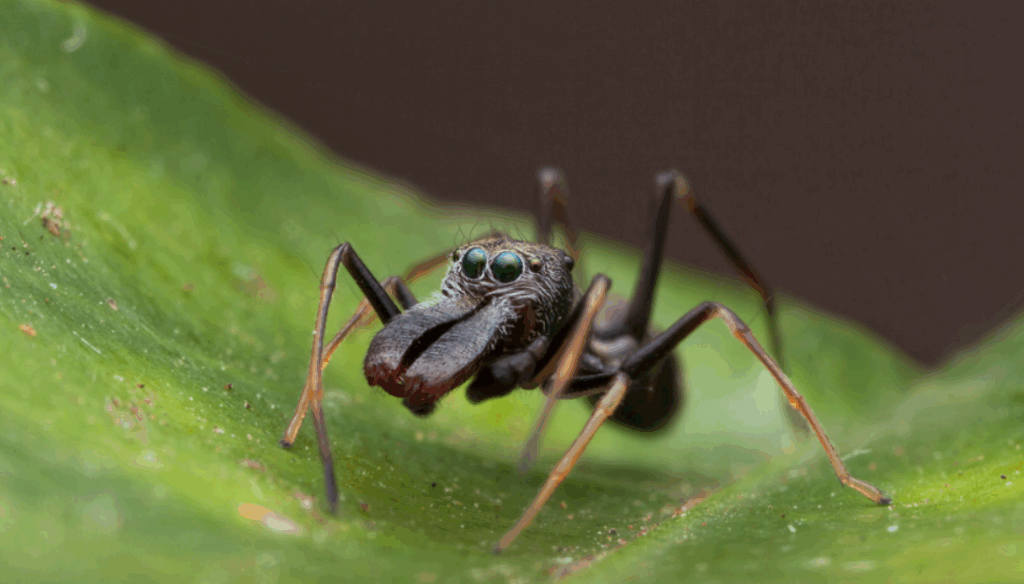
The curry leaf tree hosted none of the larger ant species it resembled, so this mimicry likely serves defence rather than hunting. Instead, the tree supported a much smaller ant species diligently tending tiny aphids on the leaves—far too small to serve as the spider’s model.
While the smaller ants busied themselves among the leaves, I noticed one individual seemingly motionless and feeding on an aphid. But when I shifted position for a frontal view, I realised I had been deceived once again. It was not an ant, but another ant-mimicking spider—this one imitating the longer ant species described earlier. The mimicry was not perfect, yet sufficient to deceive at first glance.
Roughly 80% of spiders that employ Batesian mimicry are believed to imitate ants, so I expect to encounter more of these remarkable creatures.
In the late 1990s, an observer in central Zambia reported another ant-mimicking spider near Manza Road. The spider closely resembled the local “soldier ants,” robust insects roughly 1.5–2 cm long, dull grey-black, and marching in compact columns. The spider positioned itself atop a small clod of soil near the colony’s burrow entrance. As ants passed on both sides, it periodically shifted its stance, seemingly tracking individuals. Then, in a sudden leap, it struck one ant, retreated immediately, and the ant collapsed almost instantly—a startlingly rapid kill.
The attack triggered an immediate defensive response. Nearby ants emitted faint hissing, broke formation, and began searching for the predator. The spider rotated in short, abrupt movements, facing each potential direction of attack, yet remarkably remained undetected. Once the ants retreated underground, the spider retrieved its prey and resumed feeding, likely consuming liquefied tissues through its fangs.
Ant mimicry often enables spiders to infiltrate nests, steal brood, or hunt ants while remaining unrecognised. They also benefit because many predators avoid ants due to their distasteful chemical defences. Some, like the jumping spider Synageles venator, mirror ants so convincingly that predators treat them as unpalatable.
Benefits and Risks of Mimicry
Spiders rank among the most proficient ant mimics, adopting both anatomical and behavioural adaptations. Their pedipalps may resemble ant mandibles; their legs are coloured and positioned to mimic antennae; and their abdomens are elongated to match the ants’ body shape. Yet mimicry comes at a cost: ant-specialist predators may mistake them for genuine ants, and the morphological changes that enhance mimicry often reduce the number of eggs a spider can produce.
Ultimately, life among ants is perilous for any organism, mimic or not.
Let us now examine how these exquisitely adapted spiders compare with their ant models. Many are jumping spiders, though one particularly striking example belongs to the genus Micaria—a species that is not only a superb ant mimic but also exceptionally beautiful when seen up close. Although it appears uniformly ant-like to the naked eye, magnification reveals a surprising richness of colour and detail.
