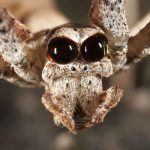
Net-casting spider family guide
Deinopidae Spiders: Net-Casting Spiders and Ogre-Faced Spiders
Deinopidae is a family of mostly nocturnal spiders known for holding a small capture net in their front legs and actively stretching it over passing prey. “Net-casting spider” is the broad common name for the family. “Ogre-faced spider” is most appropriate for Deinopis and Asianopis, whose greatly enlarged posterior median eyes create the familiar large-eyed appearance. Members of Menneus use net-casting too, but their eyes are usually much less exaggerated.
Direct answer: Deinopidae spiders are cribellate araneomorph spiders that hunt by manipulating a small woolly silk net rather than waiting in a large stationary capture web. Current classification recognizes three genera—Asianopis, Deinopis and Menneus—and 71 accepted species. They possess venom for subduing small arthropod prey, but the family is not recognized as medically significant to humans. [1]
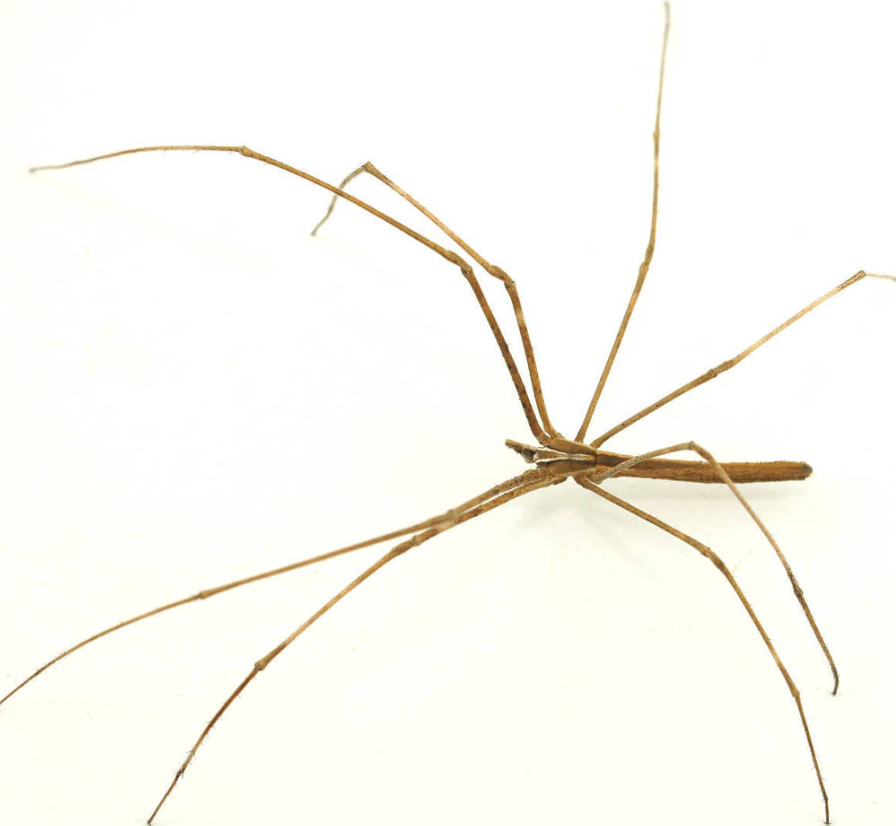
Deinopidae Spider Quick Facts
| Scientific family | Deinopidae C. L. Koch, 1850. |
|---|---|
| Accepted diversity | Three genera and 71 accepted species when checked in the World Spider Catalog in July 2026. [1] |
| Accepted genera | Asianopis—37 species; Deinopis—20 species; Menneus—14 species. |
| Common names | Net-casting spiders; ogre-faced spiders; some Menneus species are also called hump-backed net-casting spiders. |
| Number of eyes | Eight. Two posterior median eyes are greatly enlarged in Deinopis and Asianopis, while Menneus normally has much smaller posterior median eyes. |
| Capture method | Holds and stretches a small cribellate capture net over walking or flying prey. |
| Main activity period | Predominantly nocturnal or active under low-light conditions. Exact activity varies by species and environment. |
| Human danger | Venomous to prey, but not recognized as a medically significant spider family. |
Classification and Common Names
Deinopidae is an accepted spider family within Araneae. Its members are cribellate spiders, meaning they produce extremely fine dry capture fibres from a specialized spinning plate called the cribellum. A comb of specialized hairs called the calamistrum helps process these fibres into woolly capture silk.
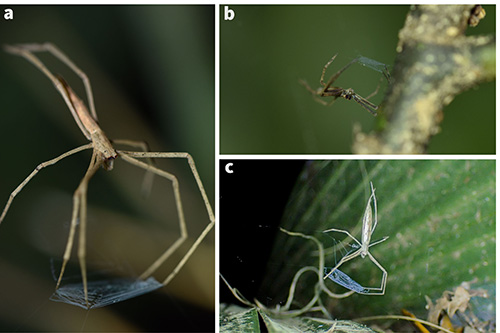
The family’s most useful general common name is net-casting spiders. The spiders do not throw a detached fishing net through the air. They remain attached to a sparse supporting framework and actively move a small silk capture net held between their anterior legs.
“Ogre-faced spider” refers to the striking appearance produced by the enlarged posterior median eyes of Deinopis and Asianopis. It should not be treated as an exact description of every Deinopidae spider because Menneus lacks the same exaggerated pair. [2]
Spelling note: Deinopidae and Deinopis are the accepted spellings. Older literature may use “Dinopidae” or “Dinopis,” but World Spider Catalog treats those forms as unjustified spelling changes rather than current names.
Deinopis, Asianopis and Menneus
Current classification divides Deinopidae into three accepted genera. Their boundaries have changed substantially, so older field guides and museum pages may use a former combination.
Now used mainly for Western Hemisphere species. The genus includes the extensively studied North and South American species Deinopis spinosa. Its members typically have very large posterior median eyes.
Established in 2020 and expanded in 2022. It now includes species from Asia, Africa, Madagascar, Australia, the Pacific and a limited number of Mexican or Central American lineages. Its members also commonly possess enlarged posterior median eyes.
Occurs in Africa, Australia and New Caledonia. These spiders retain the family’s net-casting behavior but normally lack the enormous posterior median eyes seen in the two ogre-faced genera.
A 2022 phylogenetic study transferred 24 species formerly assigned to Deinopis into Asianopis. This included Australian species such as the rufous net-casting spider, now Asianopis subrufa. Older publications may still call it Deinopis subrufa or use the masculine ending subrufus. [2] [3]
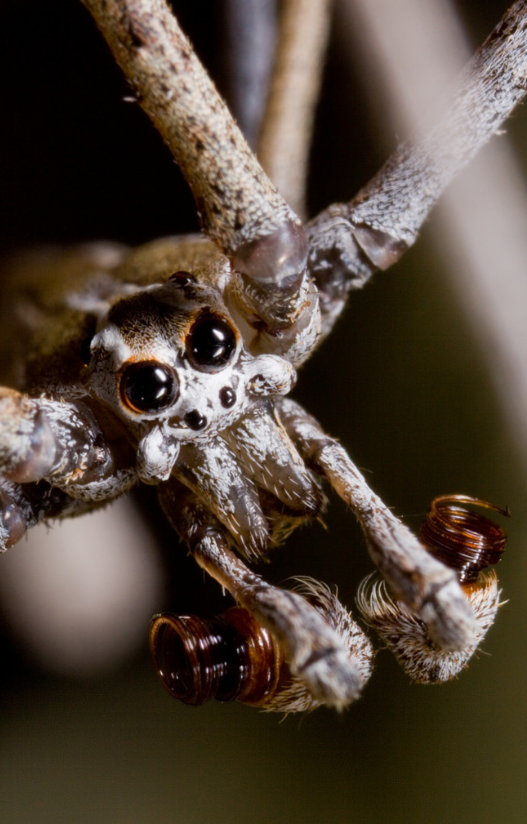
How to Identify a Deinopidae Spider
The strongest identification is based on several features together: body shape, eye arrangement, behavior, silk structure and geographic location. One feature alone may be misleading.
- A slender or elongated body, often resembling a dry twig.
- Long, narrow legs used to manipulate the capture net.
- A head-down or suspended hunting posture at night.
- A small rectangular or irregular woolly net held in front of the body.
- Eight eyes, with a conspicuously enlarged posterior median pair in many Deinopis and Asianopis.
- Smaller, less dramatic posterior median eyes in Menneus.
- Brown, grey, fawn, pinkish, greenish or mottled camouflage, depending on the species.
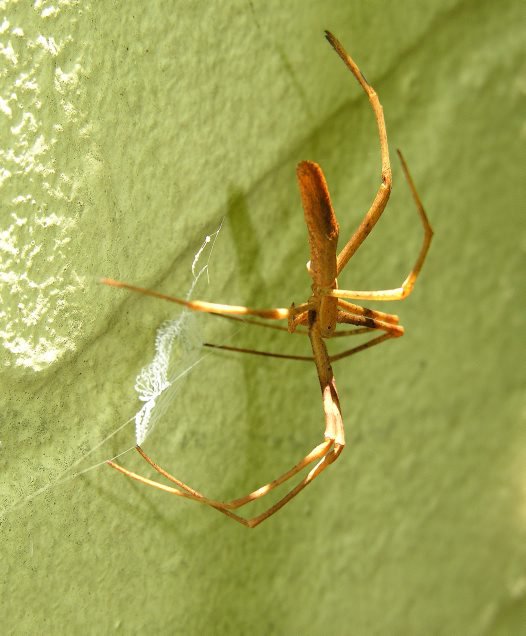
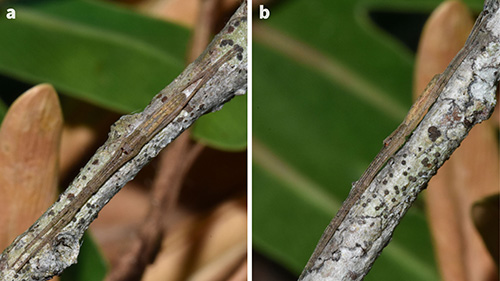
Many species rest with their legs aligned along the body during daylight, producing a stick-like silhouette. This posture is useful context, but unrelated spiders in Uloboridae, Tetragnathidae and other families may also appear long, narrow and twig-like.
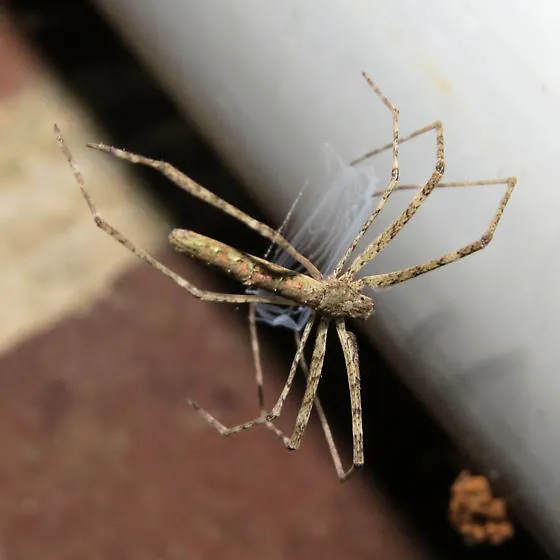
Identification limitation: A large-eyed spider is not automatically Deinopis, and a Deinopidae spider without obviously huge eyes may be Menneus. Use the Spiderpedia spider identification guide to combine anatomy, behavior, silk and distribution rather than matching one photograph.
Net-Casting Spider Eyes and Night Vision
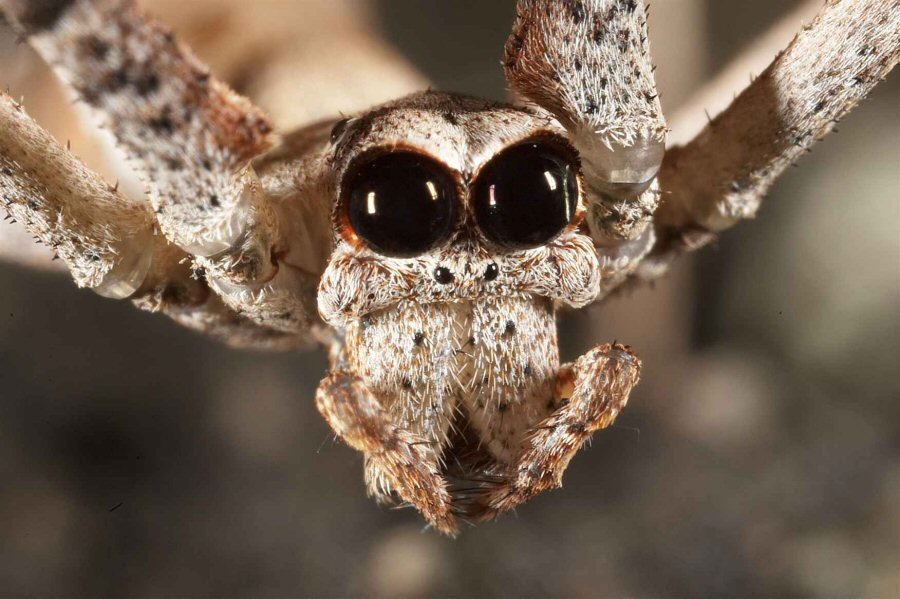
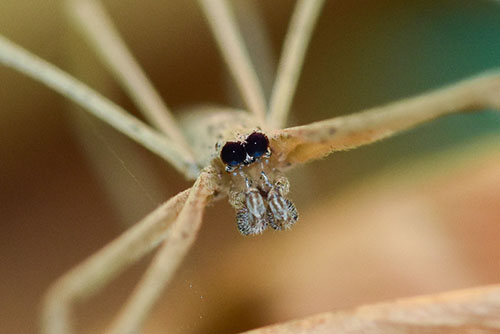
Deinopidae spiders have eight eyes. The famous “two-eyed” appearance is an illusion created when one pair is dramatically larger than the other six.
In Deinopis and Asianopis, the enlarged pair is the posterior median eyes. Although positioned toward the posterior part of the normal eye arrangement, they are oriented forward and contain large light-capturing structures suited to nocturnal vision. The remaining six eyes are smaller but still present.
Experiments with Deinopis spinosa showed that temporarily blocking the posterior median eyes sharply reduced the spider’s ability to capture walking prey. The treatment did not produce the same reduction in captures of flying prey, demonstrating that different sensory channels can support different attack modes. [4]
Menneus normally has significantly smaller posterior median eyes. A broad family-level phylogenetic analysis supported a reduction in posterior median eye size in the lineage leading to Menneus. This does not mean that Menneus is day-active or unable to hunt in dim conditions; observations show that it can hunt at similar low-light times, and the exact ecological reasons for the difference remain under investigation. [2]
See how many eyes spiders have for a broader explanation of principal eyes, secondary eyes and eye-number variation.
How the Handheld Capture Net Is Made
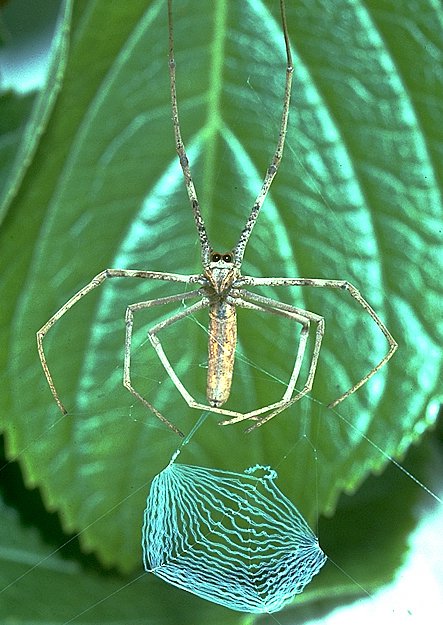
A net-casting spider first establishes a sparse support framework from which it can hang. It then constructs a much smaller capture net using cribellate silk. Unlike liquid glue-coated orb-web silk, cribellate capture silk is a dry, woolly composite of extremely fine fibres.
The spider manipulates the net with its anterior legs. In detailed observations of Deinopis spinosa, the first three pairs of legs participated in holding or controlling different sections of the net, while the rear legs and support silk helped suspend and stabilize the spider. [5]
The capture net is not simply dropped and abandoned. It is an actively manipulated extension of the spider’s legs. After a successful strike, the spider tightens the net around the prey, adds wrapping silk and bites to immobilize it.
Some observed ogre-faced spiders recycle unused silk by eating or retracting it before adopting a daytime resting posture. Older reports also describe individuals temporarily attaching an unused net nearby, but these observations should not be treated as a universal nightly routine for every species.
How Do Net-Casting Spiders Hunt?
Net-casting combines a stationary ambush position with an active strike. The spider waits suspended above a likely prey route, holds the net partially tensioned, and rapidly expands it when an animal enters range.
Forward or downward attacks on walking prey
In the best-studied Deinopis, walking insects beneath the spider are located primarily through night vision. The spider lunges toward the surface and expands the net downward and forward over the prey.
Some individuals place pale faecal spots on a leaf or other surface beneath the hunting position. These marks may provide a high-contrast visual target or help define the strike zone. This behavior has been reported for studied Deinopis and should not be stated as a required behavior of every Deinopidae species.
Backward or upward attacks on flying prey
A flying insect passing above or behind the spider can trigger a different motion. The spider rapidly swings or rotates backward while expanding the net away from the substrate, intercepting the airborne animal.
Classic behavioral experiments showed that vibratory stimuli alone could trigger these backward strikes. Later research demonstrated that D. spinosa can respond to airborne acoustic stimuli and use leg-based mechanosensory input to direct the attack. [5] [6]
Vision, Leg Mechanoreception and Airborne Vibration
Describing net-casting spiders as hunting “only by sight” or “only by vibration” is inaccurate. At least in the well-studied Deinopis spinosa, multiple sensory systems contribute different information.
The 2020 Current Biology study reported neural responses to a broad range of acoustic frequencies and behavioral responses at distances of at least two metres under experimental conditions. This does not mean the spider “hears” exactly as a human does. It has no eardrum or mammalian ear; airborne movement is converted into mechanical stimulation of sensory structures on the legs. [6]
Habitat and Global Distribution
Deinopidae has a broadly tropical and subtropical distribution, but the three genera do not have identical geographic ranges.
| Genus | Broad current distribution pattern | Important qualification |
|---|---|---|
| Deinopis | Primarily the Americas, including the Caribbean and parts of North, Central and South America. | Many African, Asian, Australian and Pacific species formerly placed here are now assigned to Asianopis. |
| Asianopis | Africa, Madagascar, Asia, Australia, New Guinea, Pacific regions and a limited number of Mexican or Central American lineages. | The name is geographically broader than “Asian” because later phylogenetic transfers expanded the genus. |
| Menneus | Africa, Australia and New Caledonia. | Individual species may have restricted national or regional distributions. |
Typical sites include forest understory, woodland, wetland margins, gardens, shrubs, palm vegetation and low branches. The spider needs suitable anchor points and an open space through which potential prey travel. Some species hunt close to the ground, while others use foliage or more elevated prey routes.
No single body size, habitat, climate or continental range applies to all 71 species. A habitat description for Florida D. spinosa, Australian A. subrufa or African Menneus should not be generalized to the entire family.
Explore the broader relationship between spiders and their environments in Spiderpedia’s spider habitat guide .
What Do Deinopidae Spiders Eat?
Deinopidae spiders feed on small arthropods that enter the reach of the handheld net. Documented or commonly observed prey includes:
- ants and other ground-walking insects;
- beetles and cockroaches;
- crickets and related orthopterans;
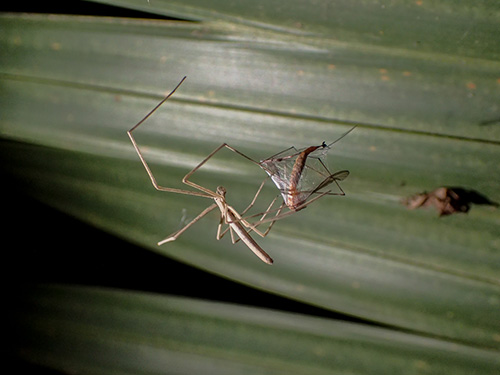
- moths, crane flies and other flying insects;
- small spiders and other suitable arthropods.
Prey composition depends on the hunting height, habitat, species, season and local availability. Studies of one population or species should not be converted into a universal Deinopidae diet.
Life History and Reproduction
Females of documented net-casting species produce silk egg sacs that may be suspended from low vegetation. In some Australian species, the sac is brown or flecked and may be disguised with plant debris. The exact construction, egg number, season and guarding behavior vary by species.
Juveniles begin producing small capture nets after leaving the egg sac and develop the adult hunting behavior as they grow. Males and females may become increasingly different in body proportions near maturity.
Do mature males stop net-casting?
This change is documented in studied Deinopis. Mature male D. spinosa cease net-casting, lose the calamistrum structures required to produce the capture snare, develop relatively smaller posterior median eyes and shift toward searching for females. Similar adult changes were reported in the Australian spider historically studied as Deinopis subrufa, now Asianopis subrufa. [7]
The evidence should not be rewritten as “all adult male Deinopidae stop eating or stop building nets.” Life-history behavior has not been studied equally across all three genera and every species.
Are Net-Casting Spiders Dangerous to Humans?
Deinopidae spiders possess venom and use it to immobilize invertebrate prey. This makes them venomous in the biological sense, but the family is not recognized as medically significant to humans. Australian Museum guidance does not consider net-casting spiders dangerous. [8]
That wording is more accurate than saying their venom “only works on insects” or guaranteeing that a bite could have no local effect. Published human-bite information is limited, and any spider with functional fangs may attempt a defensive bite if trapped or crushed against the skin.
Net-casting spiders do not use their handheld nets to attack people. Their capture equipment and behavior are adapted to small prey moving through a narrow hunting zone.
Safe handling: Leave an outdoor spider in place when practical. Do not hold an unidentified spider in bare hands. A spider found indoors can be isolated and relocated with a container and stiff card when this can be done without direct contact. Seek medical advice for severe, spreading or persistent symptoms after any suspected bite.
For wider context, see the Spiderpedia spider-bite and danger guide .
Frequently Asked Questions
What are Deinopidae spiders?
Deinopidae is a family of nocturnal cribellate spiders that actively hold and stretch a small woolly capture net over passing prey. Current classification recognizes Asianopis, Deinopis and Menneus.
Are all Deinopidae spiders ogre-faced spiders?
Not in the strict descriptive sense. The name fits Deinopis and Asianopis, which have greatly enlarged posterior median eyes. Menneus normally has much less prominent eyes.
How many eyes does a net-casting spider have?
Deinopidae spiders normally have eight eyes. Two posterior median eyes may be so large in Deinopis and Asianopis that the other six are easy to overlook.
What is the difference between Deinopis and Asianopis?
Both are large-eyed net-casting genera. Current taxonomy retains Deinopis mainly for Western Hemisphere species and places many Eastern Hemisphere species, plus some Mexican and Central American lineages, in Asianopis.
What is the difference between Menneus and Deinopis?
Menneus has significantly smaller posterior median eyes and occurs in Africa, Australia and New Caledonia. It still uses a handheld net, so large eyes are not required to recognize the family’s hunting behavior.
How do net-casting spiders make their nets?
They produce fine fibres from the cribellum and comb them with the calamistrum into woolly dry-adhesive silk. The resulting small net is held and manipulated by the anterior legs.
How do net-casting spiders catch ground prey?
Studied Deinopis uses its enlarged posterior median eyes to detect walking prey, then lunges downward or forward while spreading the capture net over the animal.
How do they catch flying insects?
Airborne sound and vibration can stimulate mechanosensory organs on the legs. The spider responds with a backward or upward strike that places the net in the flight path.
Can ogre-faced spiders hear?
They do not have ears like mammals. Research on Deinopis spinosa shows that metatarsal organs on the legs can detect airborne acoustic stimuli and trigger prey-capture behavior.
Are net-casting spiders dangerous?
Deinopidae spiders are venomous to their small prey but are not recognized as medically significant to humans. They should still be observed without bare-handed handling.
Do mature male net-casting spiders still make nets?
Mature males stop net-casting in studied Deinopis, including D. spinosa. The same result should not automatically be assigned to every species in the family.
Continue Exploring Spiderpedia
Authoritative Sources
Taxonomic numbers and accepted combinations were checked against World Spider Catalog Version 27 in July 2026. Family-wide statements are separated from conclusions based specifically on Deinopis spinosa or other individually studied species.
- World Spider Catalog — Deinopidae: current accepted genera and species counts .
- Chamberland, L. et al. (2022). Biogeography and eye size evolution of the ogre-faced spiders. Scientific Reports 12: 17769 .
- World Spider Catalog — Current combination and distribution of Asianopis subrufa .
- Stafstrom, J. A. & Hebets, E. A. (2016). Nocturnal foraging enhanced by enlarged secondary eyes in a net-casting spider. Biology Letters 12: 20160152 .
- Coddington, J. A. & Sobrevila, C. (1987). Web manipulation and two stereotyped attack behaviors in the ogre-faced spider Deinopis spinosa. Journal of Arachnology 15: 213–225 .
- Stafstrom, J. A. et al. (2020). Ogre-faced, net-casting spiders use auditory cues to detect airborne prey. Current Biology 30: 5033–5039 .
- Stafstrom, J. A., Michalik, P. & Hebets, E. A. (2017). Sensory-system plasticity in a visually specialized nocturnal spider. Scientific Reports 7: 46627 .
- Australian Museum — Net-casting spiders: identification, behavior, diet, reproduction and human danger .
- Australian Museum — How spiders see the world, including the eight eyes of Deinopidae .
- University of Florida IFAS — Deinopis spinosa identification, hunting, senses and life-history review .
- Coddington, J. A., Kuntner, M. & Opell, B. D. (2012). Systematics of the spider family Deinopidae with a revision of Menneus. Smithsonian Contributions to Zoology 636 .
- Getty, R. M. & Coyle, F. A. (1996). Observations on prey capture and anti-predator behavior of ogre-faced spiders in Costa Rica. Journal of Arachnology 24: 93–100 .
- Web-construction behavior of Deinopis cf. cylindracea. Journal of Arachnology .
Editorial note: Images retained from the two original Spiderpedia pages are captioned conservatively at family or net-casting-spider level unless the original specimen and locality support a current genus or species identification.