Sheet-web weavers are tiny spiders in the family Linyphiidae, a large group found across much of the world. They matter because they are easy to overlook, yet they are some of the most common small predators in gardens, fields, and woodland edges, where they help control insects.

Quick answer
Sheet-web weavers are very small spiders that build flat or slightly curved silk sheets close to grass, shrubs, leaf litter, or low vegetation. Most are harmless to people, rarely noticed, and helpful because they feed on small insects such as aphids, flies, and springtails.
Overview
Sheet-web weavers are not a single spider species but a large family of spiders called Linyphiidae. With thousands of described species worldwide, they are one of the most diverse spider families.
Most are tiny, usually less than 6 mm long, so people often notice the web before they notice the spider. Their webs are usually horizontal or gently curved sheets of silk, sometimes with extra threads above them that help intercept flying or jumping prey.
These spiders are especially common in grassy places, hedgerows, woodland edges, low shrubs, fence lines, and crop fields. Because they are abundant and feed on many small insects, they play an important role in local ecosystems.
Identification
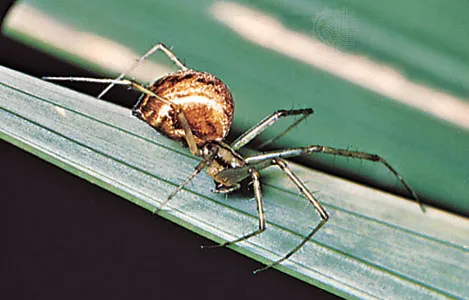
The easiest way to identify a sheet-web weaver is by its web.
Look for these signs:
- a thin, sheet-like web stretched across grass, low plants, or shrubs
- a spider hanging underneath the sheet rather than sitting on top
- a very small body, often brown, gray, tan, or dark-colored
- a delicate overall build rather than a large, heavy-bodied appearance
Some species make simple flat sheets. Others build more elaborate designs, including bowl-shaped or hammock-like webs. A good example is the bowl and doily weaver, which creates a more complex two-part web.
Because many sheet-web weavers are so small and similar in color, exact species identification often requires close examination. For most readers, web shape, size, and habitat are the most useful field clues.

Habitat
Sheet-web weavers prefer places where they can anchor silk between stems, twigs, leaves, or ground-level structures.
You are most likely to find them in:
- gardens and lawns
- grassy fields and meadows
- woodland edges and understory plants
- shrubs and low tree branches
- leaf litter and ground vegetation
- farmland and crop fields
They are especially noticeable on cool or damp mornings, when dew makes their webs stand out. In some habitats, dozens of webs may appear across one patch of grass.
Behavior
These spiders spend much of their time waiting beneath the web for vibrations. Instead of chasing prey over long distances, they rely on the web to do the first part of the work.
A typical sheet-web has two functional parts:
- the silk sheet itself, where prey may fall or become trapped
- a network of threads above the sheet that disrupts flying or jumping insects
When an insect hits the upper threads and drops onto the web, the spider rushes out from below and pulls the prey through the silk.
Many sheet-web weavers build or repair their webs at night. Since silk production is costly, they often keep the same web for several days rather than rebuilding it constantly.
Another notable behavior in this group is ballooning. Spiderlings, and sometimes even adults, release fine silk into the air and let the wind carry them to new places. This helps them spread quickly into suitable habitats.
Diet
Sheet-web weavers are carnivores like all true spiders. They mainly feed on small arthropods that blunder into the web.
Common prey includes:
- aphids
- flies
- springtails
- leafhoppers
- tiny beetles
- other small spiders or insects
Because many species live in fields and gardens, they can be valuable natural pest controllers. In agricultural settings, they are often considered beneficial rather than harmful.
Are they dangerous?
Sheet-web weavers are not considered dangerous to people.
They are very small, not aggressive, and unlikely to bite unless directly handled or trapped against skin. Even then, they are not known as medically significant spiders.
For most people, the main thing to know is that these spiders are harmless household or garden neighbors that help reduce small insect populations.
Life cycle
Most sheet-web weavers live for about a year, though some species may live for a shorter period. Females lay eggs in silk sacs, which may be hidden in the web, attached nearby, or placed in sheltered ground cover.
The young hatch as tiny spiderlings that resemble miniature adults. As they grow, they molt several times before reaching maturity. In some species, adults or eggs can survive through colder months, and a few continue feeding even in cool weather.
Why they matter
Although they are easy to miss, sheet-web weavers are among the more important small predators in many habitats. Their large numbers, wide distribution, and steady feeding make them a meaningful part of insect control in both natural and managed landscapes.
In gardens, fields, and forest understories, they quietly help keep ecosystems balanced.
- Quick facts box
Quick Facts: Sheet-Web Weavers
- Common name: Sheet-web weavers, money spiders
- Family: Linyphiidae
- Size: Usually under 6 mm
- Web type: Flat, sheet-like web, often with extra threads above
- Where found: Grass, shrubs, woodland edges, fields, gardens, leaf litter
- Main prey: Aphids, flies, springtails, leafhoppers, other tiny arthropods
- Temperament: Shy and non-aggressive
- Danger to humans: Not considered dangerous
- Best clue for identification: A small spider hanging beneath a horizontal silk sheet