Introduction
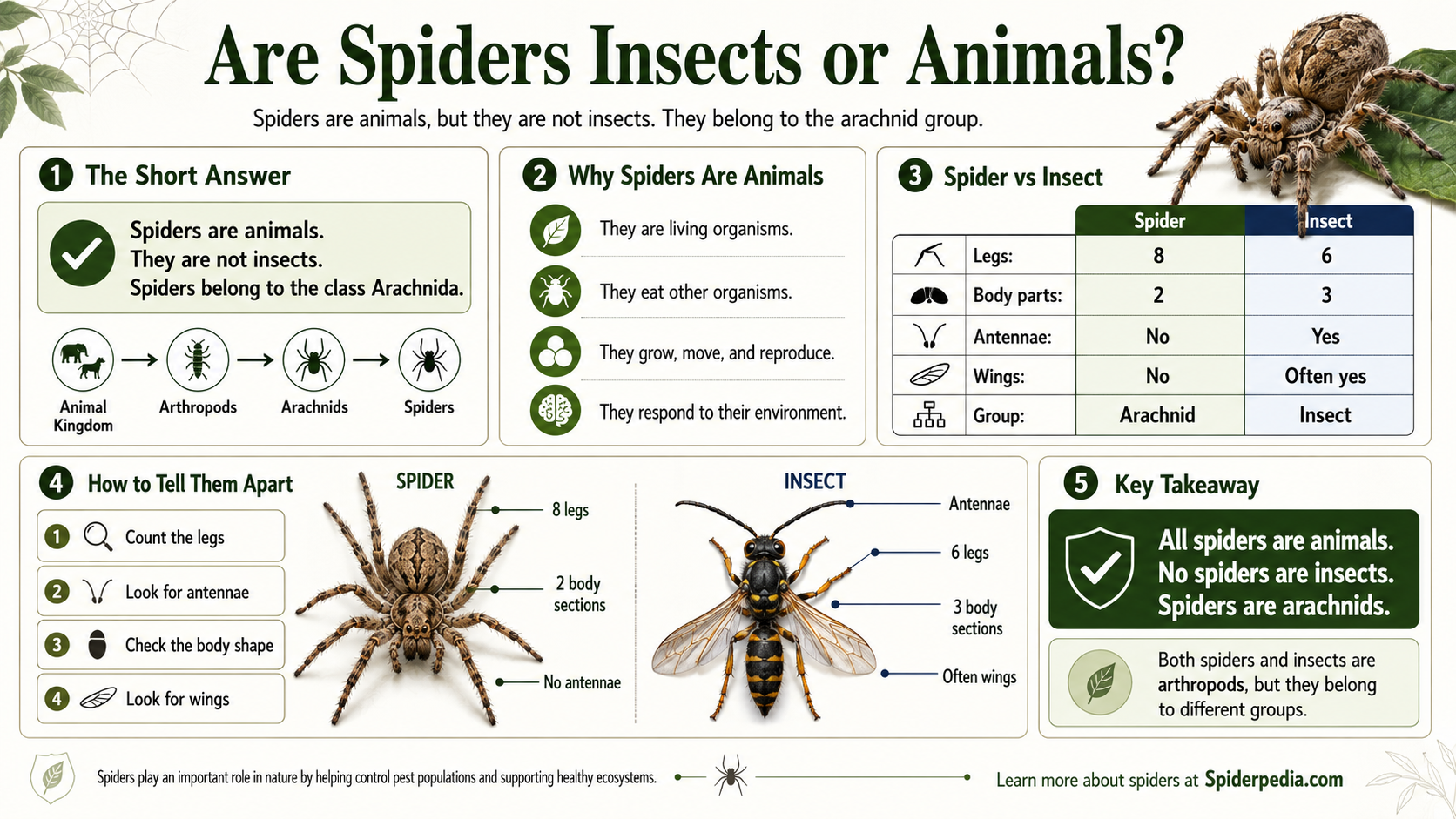
Spiders are animals, but they are not insects. More specifically, spiders belong to a group of animals called arachnids, while insects belong to a different group called insects.
This can be confusing because spiders and insects are often found in the same places: gardens, basements, forests, sheds, and homes. They are also both commonly called “bugs” in everyday language. But scientifically, spiders and insects are not the same kind of creature.
The easiest way to remember it is this:
All spiders are animals. No spiders are insects. Spiders are arachnids.
The Short Answer: Spiders Are Animals, Not Insects
Spiders are part of the animal kingdom because they are living organisms that move, feed on other organisms, grow, reproduce, and respond to their environment.
But within the animal kingdom, there are many different groups. Mammals, birds, reptiles, fish, insects, and arachnids are all animals, but they are not the same type of animal.
Spiders belong to the class Arachnida, which also includes scorpions, ticks, mites, harvestmen, and related species. Insects belong to the class Insecta, which includes ants, bees, beetles, butterflies, flies, grasshoppers, and many others.
So the correct classification is:
- Kingdom: Animalia
- Phylum: Arthropoda
- Class: Arachnida
- Common group: Spiders
Why Spiders Are Animals
Spiders are animals because they meet the basic biological traits of animals. They are multicellular, they cannot make their own food like plants do, and they rely on other organisms for energy.
Most spiders are predators. They feed on insects and other small animals, using venom, silk, speed, or ambush behavior depending on the species. Some spiders build webs, while others actively hunt on the ground, on plants, or inside homes.
Although spiders may look very different from mammals, birds, or reptiles, they are still animals. The animal kingdom includes a wide range of life forms, from whales and owls to beetles, crabs, worms, and spiders.
Why Spiders Are Not Insects
Spiders are often mistaken for insects because they are small, have jointed legs, and belong to the broader group known as arthropods. However, spiders and insects have several clear differences.
The most important differences are body structure, number of legs, antennae, wings, and mouthparts.
Spiders Have Eight Legs
One of the easiest ways to tell spiders from insects is by counting the legs.
Spiders have eight legs. Insects have six legs.
This is one of the most reliable beginner-friendly differences. If the animal has eight legs and a spider-like body, it is probably an arachnid, not an insect.
Spiders Have Two Main Body Parts
Spiders have two main body sections:
- Cephalothorax — the front section, where the legs and eyes are attached
- Abdomen — the rear section, often where silk-producing organs are located
Insects have three main body sections:
- Head
- Thorax
- Abdomen
This body-part difference is one of the key reasons spiders and insects are classified separately.
Spiders Do Not Have Antennae
Insects usually have antennae on their heads. These antennae help them sense smell, touch, movement, and chemical signals.
Spiders do not have antennae. Instead, they use other sensory structures, including leg hairs and specialized organs that help detect vibration, air movement, and nearby prey.
Spiders Do Not Have Wings
Many insects have wings, although not all insects can fly. Bees, flies, butterflies, moths, beetles, dragonflies, and many other insects have wings at some stage of life.
Spiders do not have wings. They cannot fly in the same way insects do.
Some young spiders can travel through the air by releasing silk threads and being carried by wind, a behavior called ballooning. However, this is not true flight and does not make them insects.
Spiders, Insects, and Arthropods: What Is the Difference?
Spiders and insects are both arthropods. Arthropods are animals with jointed legs, segmented bodies, and external skeletons called exoskeletons.
This larger group includes:
- Spiders
- Insects
- Scorpions
- Ticks and mites
- Centipedes and millipedes
- Crabs, lobsters, and shrimp
This is why spiders and insects can look somewhat similar. They share some broad arthropod features, but they belong to different classes within that group.
A simple way to understand it:
Animal → Arthropod → Arachnid → Spider
For insects:
Animal → Arthropod → Insect → Butterfly, beetle, ant, bee, fly, etc.
Spiders vs. Insects: Easy Comparison Table
| Feature | Spiders | Insects |
|---|---|---|
| Animal? | Yes | Yes |
| Scientific class | Arachnida | Insecta |
| Number of legs | 8 | 6 |
| Main body parts | 2 | 3 |
| Antennae | No | Yes |
| Wings | No | Sometimes |
| Examples | Orb-weaver spiders, wolf spiders, jumping spiders | Ants, bees, beetles, flies, butterflies |
Are Spiders Bugs?
In everyday conversation, people often call spiders “bugs.” This is understandable, but it is not scientifically precise.
The word bug is used casually to describe many small creatures, including spiders, insects, centipedes, and other crawling animals. But in strict biological terms, “true bugs” are a specific group of insects in the order Hemiptera, such as aphids, cicadas, shield bugs, and water striders.
So, casually, someone might call a spider a bug. Scientifically, a spider is not a bug, and it is not an insect. It is an arachnid.
Are Spiders Related to Insects?
Yes, spiders and insects are related in a broad sense because they are both arthropods. They share distant evolutionary ancestry and have some similar features, such as jointed legs and exoskeletons.
However, they are not close enough to be classified in the same class. Spiders are arachnids. Insects are insects.
This is similar to saying that cats and whales are both mammals, but they are very different types of mammals. Spiders and insects are both arthropods, but they are different types of arthropods.
How to Tell If You Are Looking at a Spider or an Insect
For most readers, the fastest way to tell the difference is to look at the body and legs.
Count the Legs
If it has eight legs, it may be a spider or another arachnid.
If it has six legs, it is probably an insect.
Look for Antennae
If the animal has clear antennae, it is not a spider. It is likely an insect or another arthropod.
Look at the Body Shape
Spiders usually have a rounded or oval abdomen and a front body section where the legs attach. Insects usually have a more clearly divided head, thorax, and abdomen.
Look for Wings
If the animal has wings, it is not a spider. Spiders do not have wings at any life stage.
Common Animals Mistaken for Spiders
Some small animals are often confused with spiders because they have long legs or live in similar places.
Harvestmen
Harvestmen, sometimes called “daddy longlegs,” are arachnids, but they are not true spiders. They usually have a single-looking oval body and very long thin legs. Unlike spiders, they do not produce silk and do not have venom glands like true spiders.
Ticks and Mites
Ticks and mites are also arachnids. Like spiders, adult ticks usually have eight legs. However, they have very different body shapes and lifestyles.
Insects with Long Legs
Some insects, such as crane flies, can be mistaken for spiders because of their long, delicate legs. But they have six legs, wings, and a different body structure.
Why the Difference Matters
Knowing whether spiders are insects or animals is more than a vocabulary question. It helps readers understand how spiders live, hunt, reproduce, and fit into ecosystems.
Spiders play an important ecological role because many species help control insect populations. They feed on flies, mosquitoes, moths, beetles, ants, and many other small creatures.
Understanding that spiders are arachnids also makes it easier to identify them correctly and avoid unnecessary fear. Most spiders are not aggressive toward humans and prefer to avoid contact. While some species can bite if trapped or handled, most spiders found around homes are not medically dangerous.
Are Spiders Dangerous Because They Are Arachnids?
No. Being an arachnid does not automatically mean an animal is dangerous.
Spiders do use venom to subdue prey, but most spider venom is designed for small animals, not humans. Many spider bites are mild, and many suspected “spider bites” are actually caused by other skin irritations or insects.
A small number of spiders can be medically significant in certain regions, such as widow spiders or recluse spiders. However, the average house spider, cellar spider, jumping spider, or garden orb-weaver is not something to panic about.
The best approach is calm observation. Avoid handling unknown spiders, use a cup-and-card method for removal when appropriate, and seek medical advice if a bite causes severe pain, spreading symptoms, or signs of an allergic reaction.
FAQ
Are spiders insects?
No. Spiders are not insects. Spiders are arachnids, while insects belong to a different scientific class called Insecta.
Are spiders animals?
Yes. Spiders are animals. They belong to the animal kingdom, just like insects, birds, reptiles, fish, mammals, and many other living creatures.
What is the difference between a spider and an insect?
Spiders have eight legs, two main body parts, no antennae, and no wings. Insects have six legs, three main body parts, antennae, and often wings.
Are spiders bugs?
In casual language, people often call spiders bugs. Scientifically, spiders are not true bugs. True bugs are a specific group of insects.
What group do spiders belong to?
Spiders belong to the class Arachnida. This group also includes scorpions, ticks, mites, and harvestmen.
Why do people think spiders are insects?
People often think spiders are insects because both are small arthropods with jointed legs and exoskeletons. They also live in many of the same environments, such as gardens, forests, basements, and homes.
Do all arachnids have eight legs?
Most adult arachnids have eight legs, including spiders, scorpions, ticks, and mites. Some immature stages may look different, especially in mites and ticks.
Do spiders have wings?
No. Spiders do not have wings. Some young spiders can travel by ballooning on silk threads, but this is not the same as flying.
Conclusion
Spiders are animals, but they are not insects. They are arachnids, a separate group of arthropods with eight legs, two main body parts, no antennae, and no wings.
The difference is easy to remember: insects have six legs, while spiders have eight. Both spiders and insects are important parts of the natural world, but they belong to different scientific groups.
For readers trying to identify small creatures around the home or garden, this simple distinction is a useful first step toward understanding spiders more clearly and calmly.