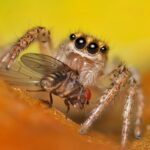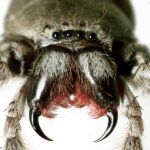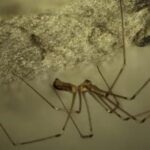
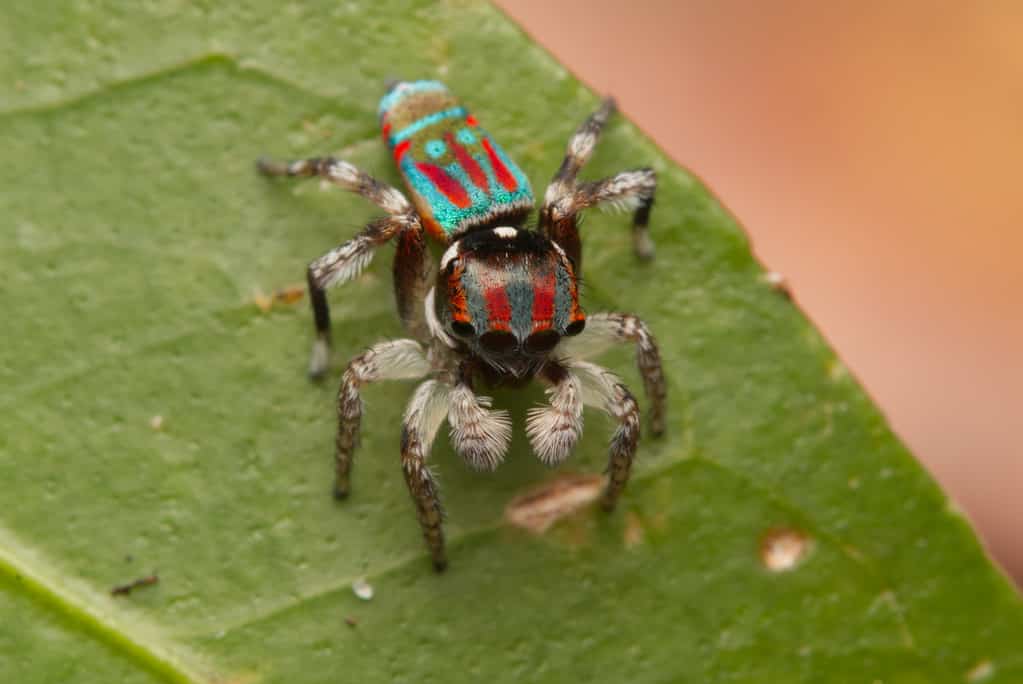
Spiders normally have eight walking legs, arranged as four pairs. All eight attach to the prosoma, also called the cephalothorax, rather than the abdomen. An individual spider may be missing one or more legs after injury or self-amputation, but its species still has the normal eight-legged spider body plan.
The clearest scientific answer is therefore:
- A normal spider has eight walking legs.
- The legs are arranged as four pairs.
- All four pairs attach to the front body region.
- Pedipalps are not counted as walking legs.
- A spider with a missing leg is still a spider.
Spiders belong to the order Araneae within the class Arachnida. Their eight-legged structure distinguishes them from insects, which normally have three pairs of legs, but leg count alone is not enough to identify an animal as a spider. Other arachnids can also have four pairs of legs.
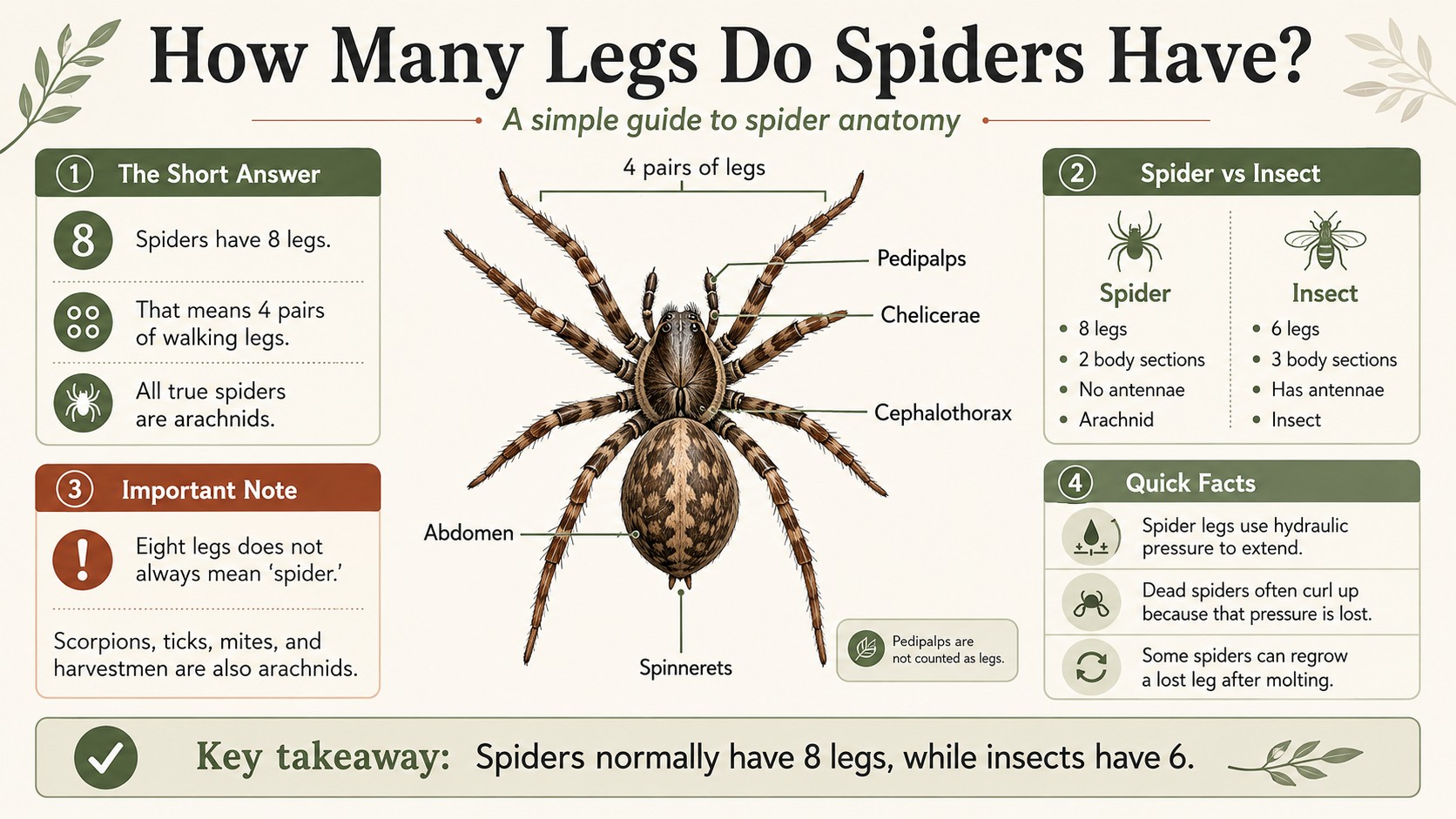
Where Are a Spider’s Eight Legs Attached?
All eight walking legs are attached to the spider’s prosoma, the front body region also commonly called the cephalothorax.
A spider has two principal body regions:
- Prosoma or cephalothorax: The front region bearing the eyes, chelicerae, pedipalps and four pairs of walking legs.
- Opisthosoma or abdomen: The rear region containing many internal organs and the spinnerets used to release silk.
The walking legs do not grow from the abdomen. This differs from an insect’s body plan, in which the six legs attach to the thorax, the middle of three main body regions.
Each spider walking leg is jointed and normally consists of seven principal sections: coxa, trochanter, femur, patella, tibia, metatarsus and tarsus. The coxa is the section closest to the body, while the tarsus is near the tip of the leg.
Chelicerae, Pedipalps and Walking Legs
Several appendages extend from the front of a spider, but they do not all count as legs.
Chelicerae
The chelicerae are the first pair of appendages near the mouth. In spiders, each chelicera carries a fang. In most species, the fangs are used to deliver venom into prey.
Chelicerae are feeding structures, not legs. They help the spider grasp or pierce prey and begin feeding.
Pedipalps
The pedipalps are the second pair of appendages. They sit behind the chelicerae and in front of the first pair of walking legs.
Pedipalps may look like two short legs, especially when viewed from above, but they are not a fifth pair of walking legs. They are used in sensing and food handling. In sexually mature male spiders, the ends of the pedipalps are modified into reproductive structures used to transfer sperm.
Walking legs
Behind the pedipalps are four pairs of true walking legs. These are the eight appendages counted when answering the question “How many legs does a spider have?”
The arrangement from front to back is therefore:
- One pair of chelicerae
- One pair of pedipalps
- Four pairs of walking legs
The American Museum of Natural History identifies the chelicerae as the first appendage pair and the pedipalps as the second. The four pairs behind them form the spider’s walking legs.
Do Spiders Have Ten Legs?
No. Spiders have eight walking legs, not ten.
A spider may appear to have ten legs when its two pedipalps are mistaken for an additional pair. Pedipalps are leg-like appendages, but their anatomy and functions differ from those of walking legs.
The correct count is:
- Eight walking legs
- Two pedipalps
- Two chelicerae
Pedipalps can touch surfaces and assist with sensing, but their ability to perform some leg-like actions does not make them walking legs anatomically.
Spider vs. Insect
Spiders and insects are both arthropods, meaning they have jointed appendages and an external skeleton. However, they belong to different biological groups and have different body plans.
| Feature | Spider | Insect |
|---|---|---|
| Biological group | Arachnida | Insecta |
| Walking legs | Eight, arranged as four pairs | Six, arranged as three pairs |
| Main body regions | Two: prosoma and abdomen | Three: head, thorax and abdomen |
| Where legs attach | Prosoma or cephalothorax | Thorax |
| Antennae | None | Normally one pair |
| Pedipalps | Present | Absent |
| Wings | Absent | Present in many adult insects, but not all |
Counting the legs is a useful first step. An adult animal with six legs is an insect or another hexapod, not a spider. An animal with eight legs may be a spider, but additional features must be checked.
Does Having Eight Legs Prove an Animal Is a Spider?
No. Eight legs are an arachnid clue, not a complete spider identification.
Many adult arachnids have four pairs of legs, including:
- Scorpions
- Harvestmen
- Ticks
- Mites
- Pseudoscorpions
- Whip spiders
- Vinegaroons
A true spider can be distinguished by a combination of characteristics rather than leg count alone. These include two principal body regions connected by a narrow pedicel, chelicerae ending in fangs, pedipalps and silk-producing spinnerets.
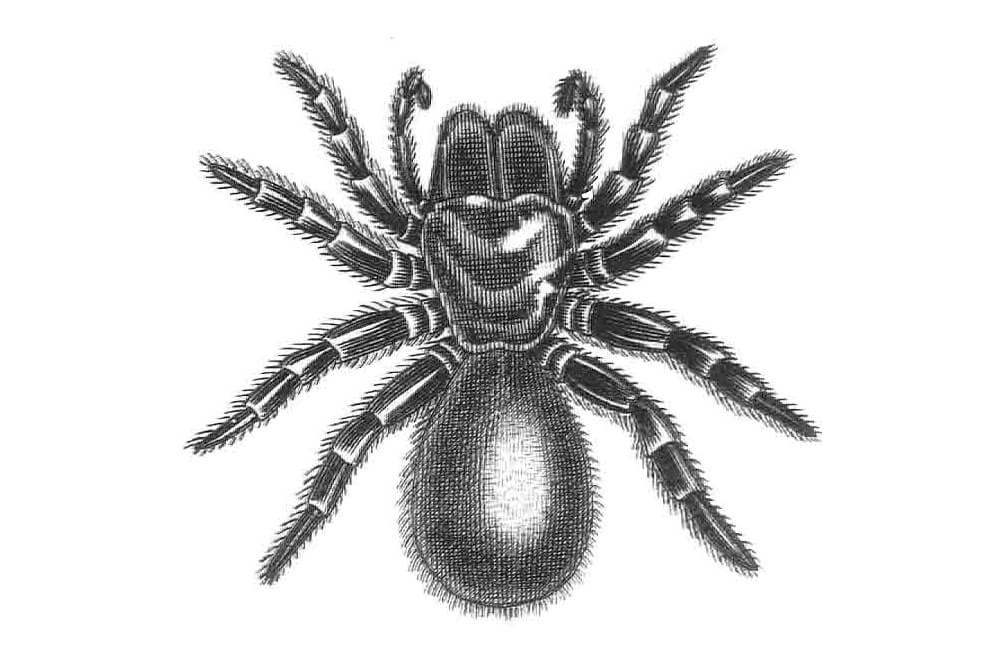
Harvestmen, for example, may have eight legs but do not have the same divided body shape or silk-producing anatomy as spiders. Scorpions also have eight walking legs, but their enlarged claw-like pedipalps and segmented tail make their body plan very different.
The Burke Museum therefore recommends thinking in terms of four leg pairs rather than simply eight individual legs. Individual appendages can be lost, while the underlying arrangement of paired appendages remains the defining anatomical pattern.
Why Do Spiders Have Eight Legs?
Spiders have four pairs of walking legs because this is part of the body plan inherited through their arachnid and chelicerate ancestry.
It is misleading to say that spiders were deliberately given eight legs for a particular purpose or that evolution selected eight as a perfect number. Evolution does not plan body structures toward a predetermined goal.
Instead, ancestral body plans are inherited and modified over time. Natural selection can change leg length, strength, proportions, sensory structures and behavior in different spider lineages, while the basic arrangement of four walking-leg pairs remains.
Different spiders therefore use the same basic eight-legged body plan in very different ways. A jumping spider, orb-weaver, crab spider and burrowing tarantula may have legs with different proportions and specialized structures, even though all retain four pairs of walking legs.
What Do Spiders Use Their Legs For?
Spider legs are multifunctional structures. They support the body, produce movement and collect information about the surrounding environment.
Their major functions include:
- Walking and running: Coordinated leg movements allow spiders to move over soil, vegetation, bark, walls and webs.
- Climbing and gripping: Claws, hairs and adhesive structures help many species hold onto silk or uneven surfaces.
- Supporting the body: The legs distribute weight and maintain posture while the spider rests, hunts or builds a web.
- Sensing vibrations: Mechanosensory hairs and slit-like sensory organs detect vibrations transmitted through webs, plants and the ground.
- Detecting air movement: Specialized hairs can respond to small movements in the surrounding air.
- Capturing and controlling prey: Legs help position, restrain or direct prey toward the chelicerae.
- Handling silk: Web-building spiders use their legs to measure, guide and manipulate silk while constructing or repairing a web.
- Courtship and communication: Some spiders tap, wave or vibrate their legs as part of mating displays.
Not every species uses its legs in exactly the same way. Web-building spiders rely heavily on silk-borne vibrations, while active hunters may depend more on touch, vision, rapid running or jumping.
Research on spider sensory biology shows that mechanical signals can provide information about prey, predators, potential mates and the spider’s own body position.
How Do Spider Legs Move?
Spider leg movement combines muscle action, internal hydraulic pressure and the mechanical properties of the joints and exoskeleton.
Hydraulic pressure is especially important for extending major joints in the middle and distal portions of the legs. The spider increases pressure in its hemolymph—the circulating fluid inside its body—and transmits that pressure from the prosoma into the legs. The resulting change in joint volume helps straighten the leg.
However, spider movement should not be described as completely hydraulic.
Major joints such as the femur–patella and tibia–metatarsus joints lack conventional extensor muscles and depend strongly on hydraulic extension. By contrast, the proximal joint complex near the body is operated by muscles. Flexor muscles, joint mechanics and hydraulic pressure work together during locomotion.
Studies of large running spiders have also found that muscular action can make a major contribution to force production. Hydraulic pressure extends specific joints, but it is not necessarily the sole source of propulsion in every spider, leg or movement.
Can Spiders Have Fewer Than Eight Legs?
An individual spider can have fewer than eight legs.
Leg loss may occur because of:
- Predator attacks
- Fights with other animals
- Accidental trapping or injury
- Problems during molting
- Attempts to escape after a leg has been seized
- Voluntary leg loss, known as autotomy
Autotomy is a controlled form of self-amputation found in a number of spider species. Losing a trapped or badly damaged leg may allow a spider to escape an immediate threat.
A seven-legged or six-legged spider does not become a different type of animal. Its species still has the normal anatomical pattern of four leg pairs.
Leg loss can nevertheless affect running speed, climbing, prey capture, web building, mating behavior or other activities. The effect depends on which leg was lost, the spider’s lifestyle and its ability to adjust its gait. Research shows that spiders can alter their movement patterns after losing a leg, although compensation does not mean the missing leg has no biological cost.
Can Spiders Regrow Lost Legs?
Some spiders can regenerate a missing leg, especially while they are still young and have additional molts remaining.
A new leg develops beneath the existing exoskeleton and emerges during a later molt. The first regenerated leg may be shorter or thinner than the original. It may become larger and more functional after one or more additional molts.
Regeneration depends on several factors:
- The spider’s species
- Its developmental stage
- The location and severity of the injury
- The number of molts remaining
- Its physical condition and access to food
A spider that no longer molts generally cannot replace a missing leg. Because regeneration is associated with molting, it is primarily seen in spiderlings and other immature spiders. Some spider groups continue molting later in life, so age alone is not an absolute rule.
Research on web-building spiders and juvenile tarantulas has documented both leg regeneration and behavioral adjustment after leg loss. The ability is real, but it should not be presented as immediate or guaranteed for every spider.
Frequently Asked Questions
How many legs does a spider have?
A normal spider has eight walking legs arranged as four pairs. All eight are attached to the prosoma or cephalothorax.
Do all spiders have eight legs?
Eight legs are part of the normal spider body plan. An individual may have fewer because of injury, predation, a molting problem or autotomy.
Do spiders have ten legs?
No. The two appendages that can look like an extra pair of legs are pedipalps. Spiders have eight walking legs plus two pedipalps.
Are pedipalps legs?
Pedipalps are paired appendages, but they are not classified as walking legs. They assist with sensing and feeding, and adult males use modified pedipalps during reproduction.
Can a spider survive with seven legs?
Many spiders can survive after losing one leg and may adjust their gait. Survival and performance depend on the species, the leg lost, the spider’s age and whether other injuries occurred.
Can spiders regrow their legs?
Young spiders with molts remaining may regenerate a lost leg during later molts. The replacement can initially be smaller than the original. Spiders that no longer molt generally cannot regrow a missing leg.
Do baby spiders have eight legs?
A normally developed free-living spiderling has four pairs of walking legs, just like an adult spider. Its legs grow and change proportions as it passes through later molts.
Why do dead spiders curl their legs inward?
When a spider dies, it can no longer actively maintain the hydraulic pressure used to extend major leg joints. Flexor muscles and passive joint mechanics then draw the legs inward, producing the familiar curled posture.
Does eight legs always mean an animal is a spider?
No. Scorpions, harvestmen, ticks, mites and other arachnids can also have four pairs of legs. Body shape, pedipalps, chelicerae and spinnerets provide additional identification clues.