How Long Can Spiders Live Without Food?
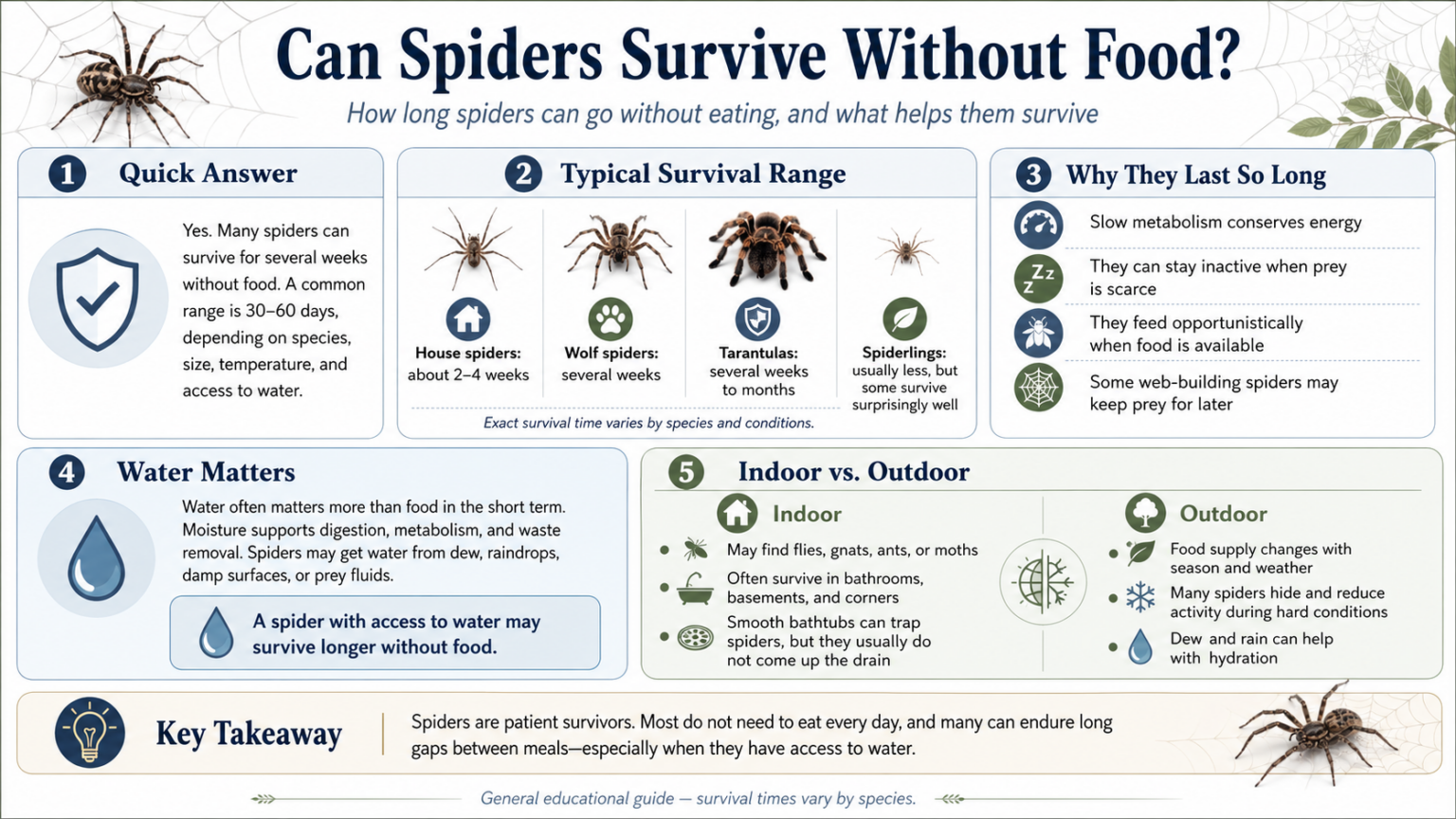
Spiders can remain alive for a period without capturing new prey, but there is no fixed number of days that applies to every spider. Survival depends on the species, body size, age, molting and reproductive state, temperature, activity level, previous nutrition and, especially, access to water.
There Is No Universal Spider Starvation Timeline
More than one factor determines how long a spider can go without eating. Even two individuals of the same species may survive for different periods if one recently consumed a large meal and the other was already in poor condition.
Statements such as “all house spiders live for several weeks without food” or “all spiders survive for one or two months” are too broad. The order Araneae includes tens of thousands of species with very different sizes, life histories, habitats and hunting strategies.
Laboratory starvation results also cannot be transferred automatically to a spider in a home or garden. A controlled experiment may use a known species, life stage, temperature, humidity and water supply. A wild or indoor spider may drink, capture very small prey or change its activity without being observed.
Fasting, Starvation and Normal Food Refusal Are Different
These terms are often used as though they mean the same thing, but they describe different biological situations.
| Term | Meaning | What it does not automatically mean |
|---|---|---|
| Fasting | A period in which the spider does not consume food. It may be voluntary, seasonal, experimental or associated with molting. | It does not necessarily mean that the spider is weak, dying or experiencing irreversible damage. |
| Starvation | A prolonged nutritional deficit in which stored energy becomes depleted and normal maintenance, growth or reproduction is impaired. | It is not simply the first day on which a spider fails to catch prey. |
| Food refusal | The spider does not accept available prey. This can occur before molting, after a large meal, during reproductive activity or under unsuitable environmental conditions. | Refusal alone does not identify the cause or prove that the spider is starving. |
| Prey deprivation | A research or ecological condition in which new animal prey is unavailable. | It may not exclude access to water, sugar sources or previously captured food unless the study states this explicitly. |
A scientific study may describe an animal as “starved” because food was withheld for a defined experimental period. That use of the word does not necessarily mean the spider was close to death. The methods section must be checked to understand the duration, water supply, temperature and purpose of the treatment.
What Determines How Long a Spider Can Live Without Food?
A factors table is more useful and scientifically defensible than a list assigning one survival time to every house spider, wolf spider, jumping spider or tarantula.
| Factor | Why it matters | Important limitation |
|---|---|---|
| Species | Species differ in body design, prey ecology, energy storage, behavior and tolerance of environmental stress. | A result for one wolf spider, orb-weaver or tarantula cannot be assumed to apply to all related spiders. |
| Body size and reserves | A recently fed spider with substantial lipid and other energy reserves may tolerate food shortage differently from a thin or poorly nourished individual. | Larger size alone does not guarantee a particular fasting duration. |
| Life stage | Spiderlings, growing juveniles and adults allocate energy differently to growth, maintenance and reproduction. | “Baby spider” and “small adult species” are not interchangeable categories. |
| Molting state | A spider approaching a molt may reduce activity and stop accepting prey even when food is available. | Premolt refusal is not a reliable measure of starvation tolerance. |
| Reproductive state | Courtship, mate searching, egg production and egg guarding can change activity and energy allocation. | Adult males and females may behave differently, even within the same species. |
| Temperature | Spiders are ectothermic, so environmental temperature affects their physiology, movement, digestion and energy use. | Cooler is not always safer; excessively low or high temperatures can impair function or cause stress. |
| Activity level | A roaming spider searching for prey or mates may expend more energy than an individual remaining in a retreat or web. | Foraging style is only one part of the total energy budget. |
| Water availability | Hydration affects hemolymph volume, ion balance, excretion, digestion and other physiological processes. | Survival with water cannot be compared directly with survival when both food and water are absent. |
| Previous diet | The quantity and nutrient composition of earlier meals influence the reserves available during subsequent food deprivation. | Two spiders fed different prey may begin a fast in different physiological conditions. |
| Humidity and shelter | Dry air, airflow and exposed resting sites may increase water loss, while a protected retreat may reduce environmental stress. | High humidity is not universally suitable for every species. |
Without Food Is Not the Same as Without Food and Water
A spider deprived of prey but given drinking water is experiencing a different challenge from one deprived of both food and water. These situations should never be combined into a single survival estimate.
Spiders lose water through respiration, excretion and the body surface. They may replace it by drinking free water, contacting droplets or obtaining fluids from prey. The relative importance of each source varies among species and habitats.
Research on the New Zealand mygalomorph Porrhothele antipodiana showed that removing drinking water from unfed spiders produced progressive body-mass loss and altered hemolymph ion concentrations and excretory function. Feeding dehydrated spiders replaced some fluid, but full regulation was restored only after drinking water became available again.
This does not establish one dehydration limit for all spiders. It does demonstrate why access to water must be reported when discussing how long a spider survived without food.
Bathrooms sometimes provide water droplets as well as tiny prey, but a spider in a bathtub may also have fallen onto the smooth surface and become trapped. See why spiders appear in bathrooms for a separate explanation of moisture, prey and entry routes.
Hunting Spiders and Web Builders Do Not Use Energy Identically
Spiders use a wide range of foraging strategies. Some remain on a web or beside a retreat and wait for vibrations. Others roam, stalk prey or perform short bursts of rapid movement.
Web-building and sit-and-wait spiders
These spiders may spend long periods relatively still, but web production, repair, prey handling, reproduction and escape behavior still require energy. A starving orb-weaver may also alter its web investment rather than simply remaining inactive.
Active hunting spiders
Cursorial spiders may search, stalk or chase prey and can therefore face different activity costs. Recent comparative research has found higher resting metabolic rates in some active hunters than in closely related web-building species.
This contrast is useful, but it should not be turned into a universal rule that every web-building spider always survives longer than every hunter. Body condition, temperature, species and behavior can outweigh a simple web-versus-hunter label.
For more information about web-based foraging, read why spiders build webs .
Adults, Juveniles and Spiderlings Face Different Constraints
Adult spiders
Adults primarily allocate energy to maintenance and reproduction rather than ordinary body growth. However, adult females producing or guarding eggs and mature males searching for mates may have very different energy demands.
Growing juveniles
Juveniles must obtain enough nutrients for growth and repeated molts. Food limitation may delay development, reduce body condition or affect the ability to complete later life stages, even when the juvenile does not die immediately.
Spiderlings
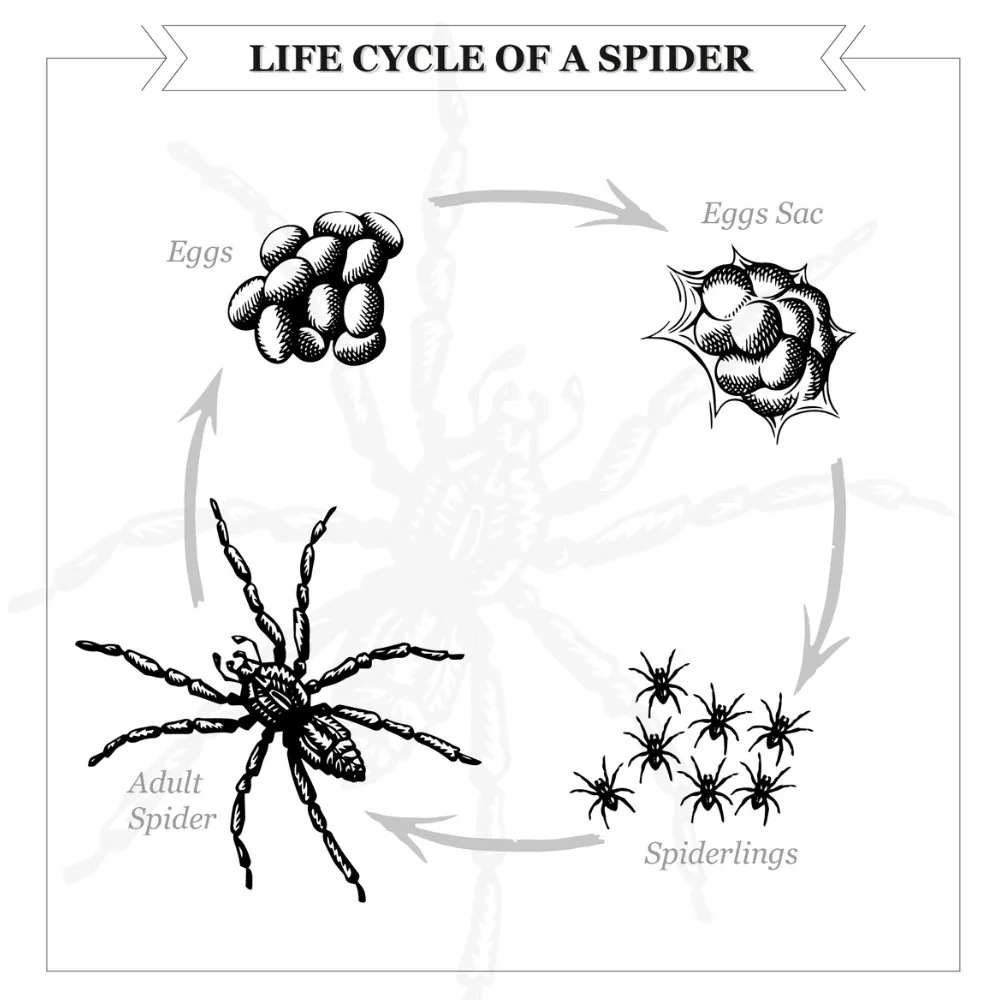
Newly emerged spiderlings are small and have limited absolute reserves. They may begin life with maternally supplied resources and, in some species, remain near siblings or an egg sac before dispersing. Their small size can also make them vulnerable to water loss.
It is therefore unsafe to take a fasting observation from a large adult tarantula and apply it to a newly dispersed spiderling. Life stage must be reported in any meaningful comparison.
Premolt Food Refusal Is Not the Same as Starvation
Spiders grow by molting, or shedding the old exoskeleton. Many reduce activity and stop accepting prey before a molt. Food refusal may continue while the new exoskeleton and fangs harden after the molt.
A classic captive study of the Arizona blond tarantula Aphonopelma chalcodes documented premolt fasting in several individuals. The observation is useful because it shows that an extended refusal to eat can be associated with a normal developmental event.
It does not prove that every tarantula, every juvenile or every house spider can safely go without food for the same period. The study involved a particular species under captive observation and examined molting behavior rather than a universal starvation limit.
Possible premolt clues can include:
- Reduced movement or increased use of a retreat
- Repeated rejection of prey
- Changes in coloration or abdominal appearance in some species
- Silk preparation around a molting site
- A recent pattern consistent with that species’ molt cycle
- Temporary vulnerability after the old exoskeleton is shed
These clues are not identical in all spiders. A spider that is inactive because of dehydration, injury, extreme temperature or pesticide exposure may also refuse food.
Temperature Changes the Meaning of a Fast
Spiders are ectothermic. In simple terms, their body temperature and many physiological rates are strongly influenced by the surrounding environment rather than being maintained at a nearly constant level through internally generated heat.
Within a species’ functional temperature range, warmer conditions often increase movement, digestion and metabolic demand. Cooler conditions may reduce activity and energy use. This is one reason starvation results obtained at different temperatures cannot be compared without caution.
However, “cooler means a spider lives longer” is not a safe general rule. Temperatures below or above a species’ suitable range can disrupt movement, digestion, development and survival. Acclimation, habitat and species-specific thermal tolerance also matter.
Can House Spiders Survive Without Food Indoors?
An indoor spider may go for a period without a successful capture, but it is often impossible to know when it last ate. Homes contain small prey that people rarely notice, including tiny flies, moths, gnats, mosquitoes, springtails, mites and other arthropods.
Web remains, wrapped prey or discarded exoskeletons may reveal feeding, but their absence does not prove that the spider has received no food. Hunting spiders may consume prey away from a permanent web, while small captured animals may leave little visible evidence.
Indoor microclimates also vary. A spider beside a humid basement wall, window, plant pot or bathroom may have different access to water and prey from one trapped in a sealed, dry room.
For a detailed discussion of likely indoor prey, read what house spiders eat .
How Long Can a Tarantula Go Without Food?
There is no single fasting period for all tarantulas. “Tarantula” refers to a large family containing many species with different adult sizes, habitats, growth rates, reproductive states and environmental requirements.
Some captive tarantulas are observed refusing prey before a molt or after a substantial meal. These observations are often used online to claim that every tarantula can go for a certain number of weeks or months without eating. That conclusion is not justified without identifying the species, life stage, hydration status, temperature and reason for food refusal.
Tarantula fasting should also not be generalized to cellar spiders, jumping spiders, orb-weavers, wolf spiders or newly emerged spiderlings. Their body sizes, energy reserves and natural histories are different.
This page explains general spider biology and is not a species-specific tarantula husbandry schedule. Captive care decisions should be based on reliable information for the identified species and individual.
How Often Do Spiders Need to Eat?
Spiders do not follow one universal daily or weekly feeding schedule. Wild spiders feed when suitable prey is encountered or captured. The interval between meals can change with prey abundance, season, body condition, temperature, growth and reproduction.
A web builder may wait through several unsuccessful prey encounters, while an active hunter may alter its search behavior when hungry. Recently fed spiders may also reject additional prey.
Feeding frequency should therefore be described as an outcome of species biology and environmental opportunity, not as a fixed rule for the entire order Araneae.
The broader Spider Diet guide explains how prey and hunting methods differ among spider groups.
How Long Does It Take for a Spider to Starve?
Starvation is a process rather than a timer that starts with one missed meal. During food deprivation, a spider may draw on stored nutrients, alter activity and change the fuels used to support metabolism.
Research on the wolf spider Pardosa prativaga found that metabolism declined during starvation and that the composition of previously consumed prey affected the spider’s stored lipid and protein balance. Spiders with greater lipid stores were better prepared for prolonged food deprivation than spiders beginning the experiment with a different reserve profile.
As deprivation continues, possible consequences include:
- loss of body mass or abdominal condition;
- changes in activity and prey-searching behavior;
- reduced investment in growth or reproduction;
- greater vulnerability during molting;
- use of protein after more accessible reserves decline;
- eventual loss of normal physiological function.
The point at which these changes become severe is species- and condition-specific. Death is not the only biologically important outcome; delayed growth, unsuccessful molting or reduced reproduction may occur before a study reaches a mortality endpoint.
Frequently Asked Questions
Can spiders survive without food?
Yes. Spiders can tolerate periods without capturing new prey, but there is no universal duration. Species, size, age, temperature, activity, previous nutrition and access to water all affect the outcome.
How long can a spider live without food?
It cannot be answered accurately with one number for all spiders. A valid estimate would require at least the species, life stage, hydration conditions, temperature and prior feeding state.
How long can a house spider live without food?
There is no single “house spider” starvation time. The term may refer to unrelated web-building or hunting species. Indoor spiders may also capture tiny insects that residents never notice.
How long can a tarantula go without food?
Tarantulas vary by species, age, sex, size and molting state. Extended food refusal has been observed in some captive individuals, especially around molting, but it should not be converted into a universal number for all tarantulas.
Can spiders live without food and water?
Removing both food and water creates a more severe condition than withholding prey while drinking water remains available. Dehydration affects hemolymph balance, excretion and feeding, so the two situations should not be compared as though they were the same.
Is water more important than food to a fasting spider?
During a short food shortage, dehydration may become the more immediate stress in hot or dry conditions. The relative importance still depends on species, humidity, temperature, body size and whether the spider obtains fluid from prey.
Do spiders stop eating before molting?
Many spiders reduce feeding or reject prey before a molt. The length and visible signs vary by species and life stage. Premolt refusal is not the same as demonstrating a maximum starvation-survival time.
Can spiderlings survive without food?
Some spiderlings begin life with internal reserves, but their small size, growth demands and vulnerability to water loss make it unsafe to apply adult fasting observations to them. Species and stage must be known.
Do spiders need to eat every day?
No universal daily requirement applies to all spiders. Wild spiders experience irregular prey capture, and feeding frequency changes with species, temperature, body condition, growth and reproductive activity.
Does a warmer room make a spider starve faster?
Warmer conditions within a species’ normal range can increase metabolic activity, but the outcome is not predictable from room temperature alone. Extreme heat can also increase water loss and cause additional stress.
Is a spider starving if it refuses food?
Not necessarily. Refusal may occur before molting, after a large meal, during reproductive activity or because environmental conditions are unsuitable. Persistent abnormal behavior must be interpreted in the context of the identified species.
Related Spiderpedia Guides
Scientific References
- Overgaard, J. and Wang, T. Metabolic Transitions During Feast and Famine in Spiders. In: Comparative Physiology of Fasting, Starvation, and Food Limitation. Springer, 2012. View source
- Jensen, K. et al. Metabolic consequences of feeding and fasting on nutritionally different diets in the wolf spider Pardosa prativaga. Journal of Insect Physiology, 2010. View source
- Butt, A. G. and Taylor, H. H. Regulatory responses of the coxal organs and anal excretory system to dehydration and feeding in Porrhothele antipodiana. Journal of Experimental Biology, 1995. View source
- Minch, E. W. The molting sequence in Aphonopelma chalcodes. Journal of Arachnology, 1977. View source
- Nagel, K. et al. Leaving the web: testing the link between predation style and resting metabolic rate using closely related spiders with contrasting lifestyles. Journal of Insect Physiology, 2025. View source
- Piñanez Espejo, Y. M. G. et al. Is spider resting metabolic rate more strongly associated with foraging strategy or habitat use? Ecology, 2025. View source
- Townley, M. A. et al. Changes in composition of spider orb web sticky droplets with starvation and feeding. Journal of Experimental Biology, 2006. View source
- Uiterwaal, S. F. and DeLong, J. P. Body condition helps explain metabolic-rate variation in wolf spiders. View source