
If you have ever looked closely at a spider and wondered, how many eyes do spiders have, the short answer is this: most spiders have eight eyes. That said, spiders are a lot more interesting than the simple “eight eyes” fact you usually hear.
Some spiders have six eyes. Some have four. A few have two. And certain cave-dwelling species have no functional eyes at all. Even more surprising, having more eyes does not always mean better vision. In fact, many spiders do not see very well and rely much more on vibration, touch, and movement than on sharp sight.
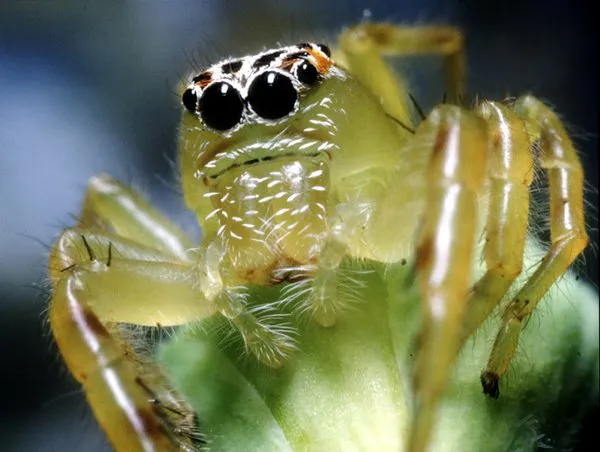
Once you dig into how spider eyes work, the topic becomes much more fascinating. Those tiny eyes are not just extra decoration. They are built for very specific jobs, from spotting motion in dim light to tracking prey with remarkable precision.
How many eyes do spiders have?
Most spiders have eight eyes, usually arranged in two rows on the front of the body. This is the typical pattern people associate with spiders, and it is true for many familiar kinds, including jumping spiders, wolf spiders, orb weavers, and cobweb spiders.
But not all spiders follow that pattern.
Depending on the species, a spider may have:
- eight eyes
- six eyes
- four eyes
- two eyes
- no eyes at all
So if someone asks, “Do spiders always have eight eyes?” the best answer is no, but eight is the default number for most species.
This variety is one reason spider eyes are so useful in identification. In many cases, scientists look not only at the number of eyes, but also at their arrangement, spacing, and shape.
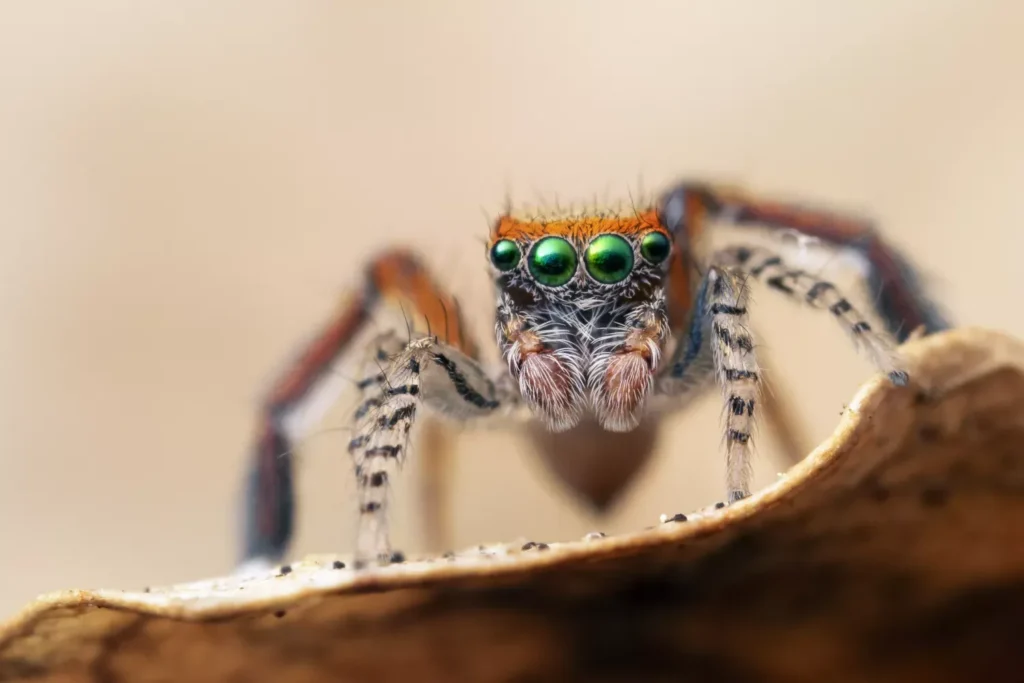
Why do spiders have so many eyes?
The next obvious question is: if humans do fine with two eyes, why do spiders need so many?
A big part of the answer is body design. Spiders cannot turn their heads the way we do. Their eyes are fixed in place, so having several eyes positioned across the front and sides of the body helps them detect what is happening around them.
Those extra eyes help spiders:
- notice movement quickly
- judge the direction of prey
- detect nearby danger
- improve their field of view
- function better in low light
In other words, spider eyes are less about having “better” vision in a human sense and more about covering different visual tasks at once. Some eyes are best for detail. Others are better at detecting motion. Some are adapted for darkness.
It is a very different visual system from ours, but it suits the way spiders live.
Do all spider eyes work the same way?
Not at all. Spider eyes are usually divided into primary eyes and secondary eyes, and they do different jobs.
Primary eyes
The primary eyes are the forward-facing eyes, often called the principal eyes. These are the eyes that form more detailed images. In some spiders, especially jumping spiders, they are excellent for focusing on prey, judging distance, and even tracking movement with surprising accuracy.
Secondary eyes
The secondary eyes are usually smaller and fixed in place. They do not all work the same way, but many are especially useful for sensing movement and expanding the spider’s awareness of its surroundings.
Some secondary eyes also have a reflective layer called a tapetum, which helps them gather and reflect light in dim conditions. This is why certain spiders, especially night-active ones, seem to have glowing eyes when a flashlight hits them.
So while spiders may have multiple eyes, those eyes are not redundant. They are specialized.
Why do so many spiders still have poor vision?
This is one of the most surprising things about spiders. Even though most of them have eight eyes, many spiders do not see very well.
For a lot of species, vision is only one part of how they experience the world. They rely heavily on:
- vibrations traveling through webs or surfaces
- touch through sensitive hairs on the body and legs
- changes in light and shadow
- chemical and taste-like cues
That is why many web-building spiders can react so quickly to prey without needing sharp eyesight. They feel the movement first.
So when people imagine spiders as tiny animals with excellent all-around vision, that is usually not accurate. In many cases, they are far more tuned to motion and vibration than to fine detail.
Which spiders have the best eyesight?
Not every spider has poor vision. A few groups depend on eyesight much more than others, and their eyes are adapted for that lifestyle.
Jumping spiders
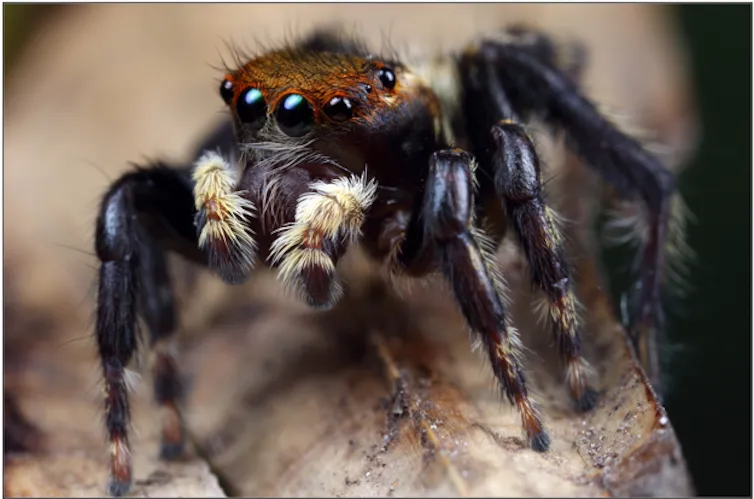
Jumping spiders are probably the best-known example. They are active hunters and do not simply wait in webs for food to arrive. Their large front eyes help them see shapes clearly, judge distance, and track prey before they leap.
Their vision is so good that it plays a major role in hunting, recognizing rivals, and even courtship.
Wolf spiders
Wolf spiders also make good use of vision, especially in low light. Their larger posterior eyes help them detect movement during dusk or nighttime hunting. If you shine a light in the right place, their eyes can reflect it back with a noticeable glow.
Net-casting spiders
Net-casting spiders, sometimes called ogre-faced spiders, are especially striking. In some species, two of the rear eyes are dramatically enlarged. These oversized eyes are adapted for exceptional night vision, helping the spider track prey in darkness and throw its little net accurately.
They look almost unreal, but they are a brilliant example of how spider eyes evolve around a hunting strategy.
Can spiders have fewer than eight eyes?
Yes, and this is where the topic gets even more interesting.
Some spider families commonly include species with six eyes, such as certain recluse spiders, spitting spiders, and some cellar spiders. Others may have four eyes or two eyes. And species that live in caves or underground environments may lose their eyesight over time because vision is not very useful in complete darkness.
That loss of eyes is not a flaw. It is an adaptation.
If a spider spends generation after generation living where there is no light, maintaining complex eyes may simply waste energy. In those cases, evolution favors other senses instead.
So while “eight-eyed spider” is common, the real picture is much more flexible.
What are the main types of spider eyes?
Spider eyes are often described by their position.
The central front eyes are commonly referred to as AME (anterior median eyes). These are usually the main image-forming eyes.
The side and rear eyes include:
- ALE – anterior lateral eyes
- PLE – posterior lateral eyes
- PME – posterior median eyes
These labels matter in arachnology because the arrangement of the eyes can help identify spider families. For everyday readers, the important point is simple: different eyes sit in different positions because they do different jobs.
Some face forward for detail. Some sit to the sides for motion. Some are especially useful in low light.
What spider eyes tell us about spider life
One of the nicest things about studying spider eyes is that they reveal how a spider lives.
A jumping spider’s big front eyes tell you it is an active visual hunter.
A wolf spider’s reflective eyes suggest it is adapted for dim conditions.
A cave spider with reduced eyes tells a story about darkness, energy, and evolution.
A net-casting spider’s enormous eyes reveal just how important night vision is to its survival.
That is really the key to answering the question how many eyes do spiders have. The number matters, but the bigger story is what those eyes are for.
Spiders do not have multiple eyes just to have more. They have them because each one can contribute to a different part of survival.
Final thoughts
So, how many eyes do spiders have?
Usually eight, but not always. Some have six, four, two, or even none. And despite all those eyes, many spiders do not actually see very clearly. Instead, they combine limited vision with incredibly sensitive touch, vibration detection, and motion sensing.
That mix is what makes spiders so successful. Their eyes are not built like ours, but they are perfectly suited to the lives spiders lead.
FAQ
Do all spiders have 8 eyes?
No. Most spiders have eight eyes, but some species have six, four, two, or no eyes at all.
Why do spiders have so many eyes?
Spiders cannot turn their heads like humans can, so multiple eyes help them detect movement, watch for predators, and locate prey from different directions.
Can spiders see well?
Some can, but many cannot. A lot of spiders rely more on vibration, touch, and changes in light than on sharp eyesight.
Which spiders have the best vision?
Jumping spiders are famous for having some of the best vision among spiders. Wolf spiders and net-casting spiders also have strong visual adaptations for hunting.
Do spider eyes glow in the dark?
Some do appear to glow when light hits them. This happens because certain spiders have a reflective layer in their eyes that helps with low-light vision.
Can blind spiders survive?
Yes. Spiders that live in caves or underground may have reduced eyesight or no functional eyes, and they survive by relying on other senses.