
North American indoor spider guide
House Spider Identification: Common Spiders Found Indoors
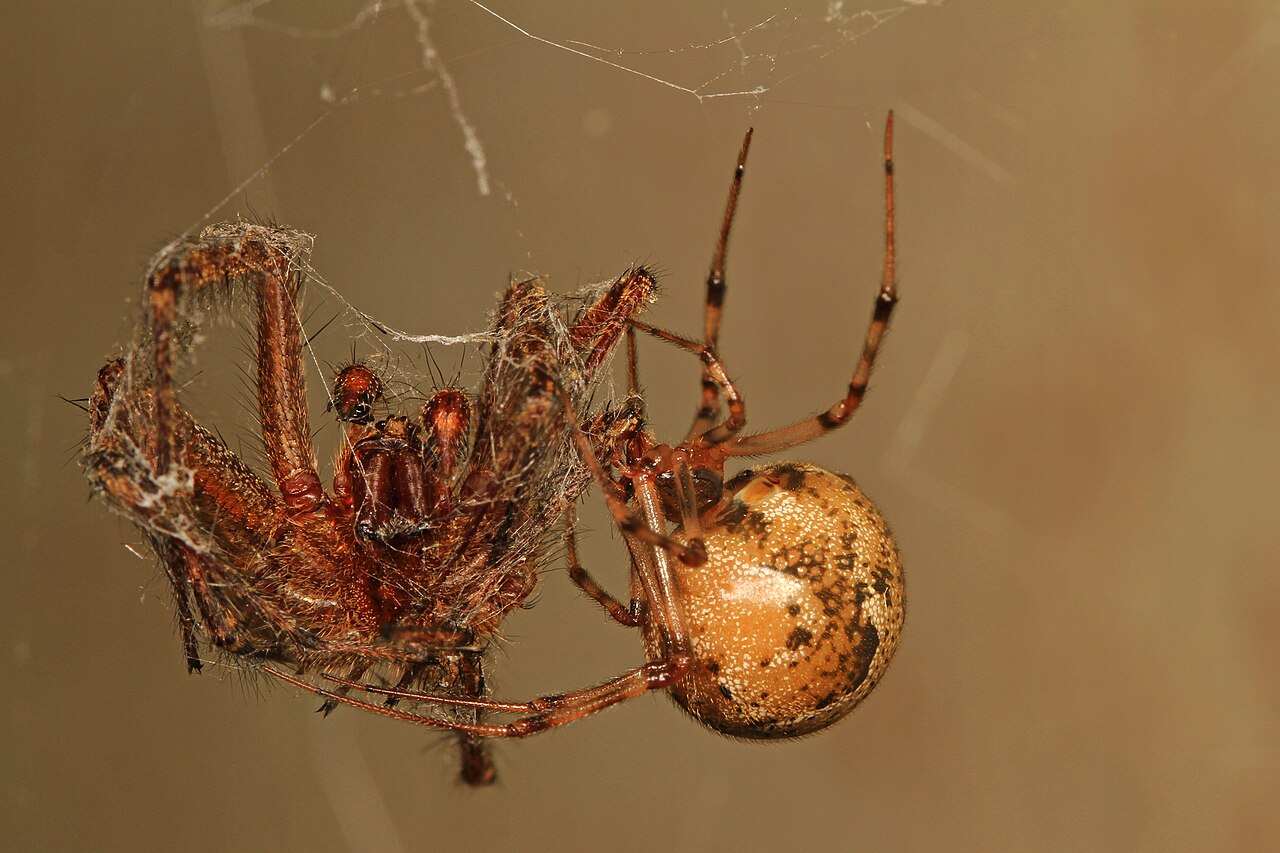
The everyday phrase house spider describes where a spider was noticed, not one universal taxonomic group. In North America, “common house spider” often refers specifically to Parasteatoda tepidariorum. In Britain, house-spider guides commonly focus on Tegenaria and Eratigena funnel weavers. In Australia, the same general phrase may be used for unrelated spiders such as the black house spider, Badumna insignis. Those regional meanings should not be combined as though they describe one species.
Some spiders can feed, mature and reproduce inside buildings. Others live around foundations, window frames, sheds or exterior walls. Wolf spiders, grass spiders, parson spiders and many jumping spiders are often outdoor hunters that enter accidentally or while searching for mates. Finding one—or even several over a season—does not automatically demonstrate an indoor “infestation.”
House Spider Identification at a Glance
Use this table to narrow the possibilities. Body length excludes the legs and is approximate; groups containing many species vary substantially.
| Spider or group | Body shape | Typical color | Web type | Common indoor location | Status indoors | Best clue | Risk level |
|---|---|---|---|---|---|---|---|
| American house spider Parasteatoda tepidariorum | Small; rounded abdomen; slender legs | Tan, gray-brown or mottled brown | Irregular tangled cobweb | Corners, basements, windows, under shelves | True indoor resident | Rounded patterned abdomen in a dusty-looking tangle web | Low concern |
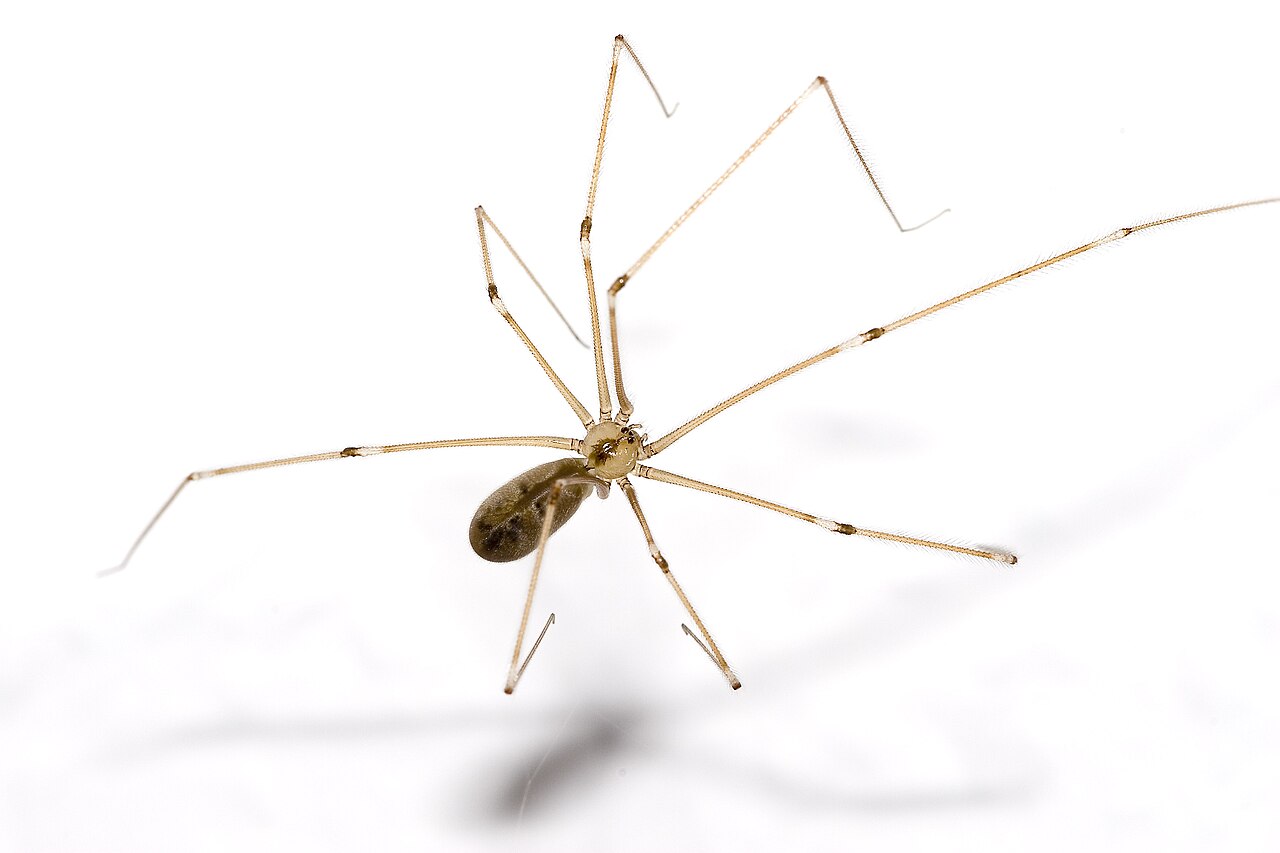
| Cellar spiders Pholcidae | Tiny body; extremely long thin legs | Pale tan, gray or yellowish | Loose three-dimensional web | Ceiling corners, basements, garages, crawl spaces | Many species are indoor residents | Hangs upside down and may vibrate rapidly | Low concern |
| Domestic house spider Tegenaria domestica | Elongated funnel-weaver body; long legs | Brown with patterned abdomen | Sheet leading to a funnel retreat | Basements, garages, wall gaps, storage areas | Building-associated resident | Sheet web plus funnel and visible spinnerets | Low concern |
| Giant house spiders Eratigena species | Large-looking, long-legged funnel weaver | Brown to gray-brown | Sheet and funnel retreat | Lower walls, basements, garages, sheds | Regional building resident; males wander | Large leg span, funnel web and appropriate western range | Low concern |
| Southern house spider Kukulcania hibernalis | Female robust and dark; male slender and long-legged | Dark brown to black female; tan-brown male | Woolly cribellate web from a crevice | Window frames, eaves, brick holes, wall crevices | Lives around and sometimes inside buildings | Crevice web; male has long pedipalps and no recluse eye pattern | Low concern |
| False widows Steatoda species | Rounded, often glossy abdomen | Brown, purplish brown or nearly black; variable pale markings | Tangled cobweb | Garages, sheds, cupboards, corners, window recesses | Some species are building residents | Widow-like shape without a confirmed widow pattern | Usually low concern; avoid handling |
| Yellow sac spiders Cheiracanthium species | Slender body; front legs often relatively long | Pale yellow, cream, greenish or light tan | Small resting sac, not a prey-catching web | High walls, ceilings, curtains, folded material | Indoor resident or seasonal visitor, depending on species | Pale nocturnal hunter with a silken daytime retreat | Generally low concern; do not handle |
| Parson spiders Herpyllus species | Elongated ground-spider body | Dark gray or black with a white dorsal mark | No capture web | Floors, baseboards, closets, storage rooms | Usually an accidental visitor | White necktie- or cravat-like stripe on a fast ground hunter | Low concern |
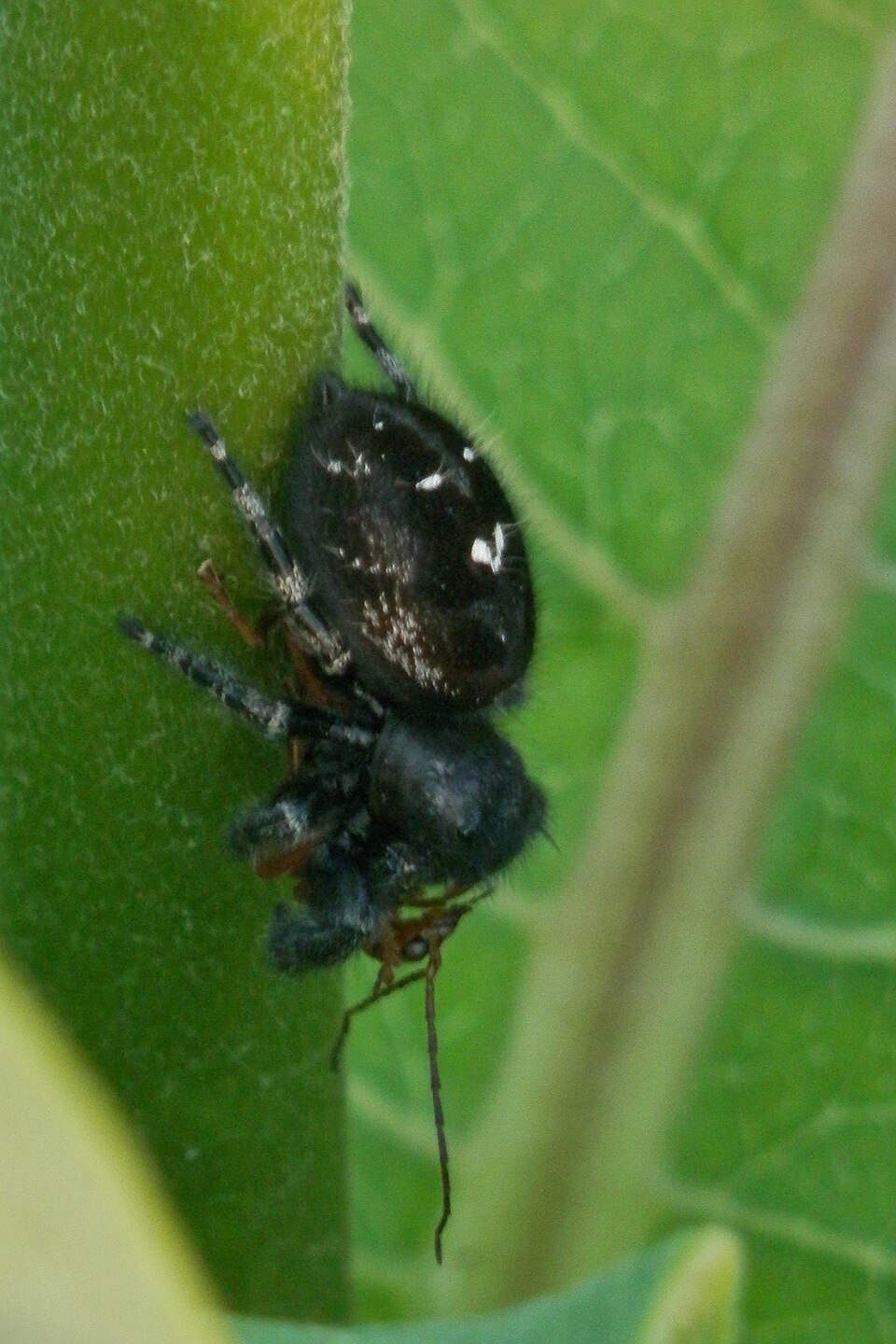
| Jumping spiders Salticidae | Compact body; sturdy front; conspicuous forward-facing eyes | Black, gray, brown or patterned | No capture web; small silk retreat | Sunny windows, walls, doors, houseplants | Usually a visitor; some use buildings regularly | Turns to look, stalks and jumps | Low concern |
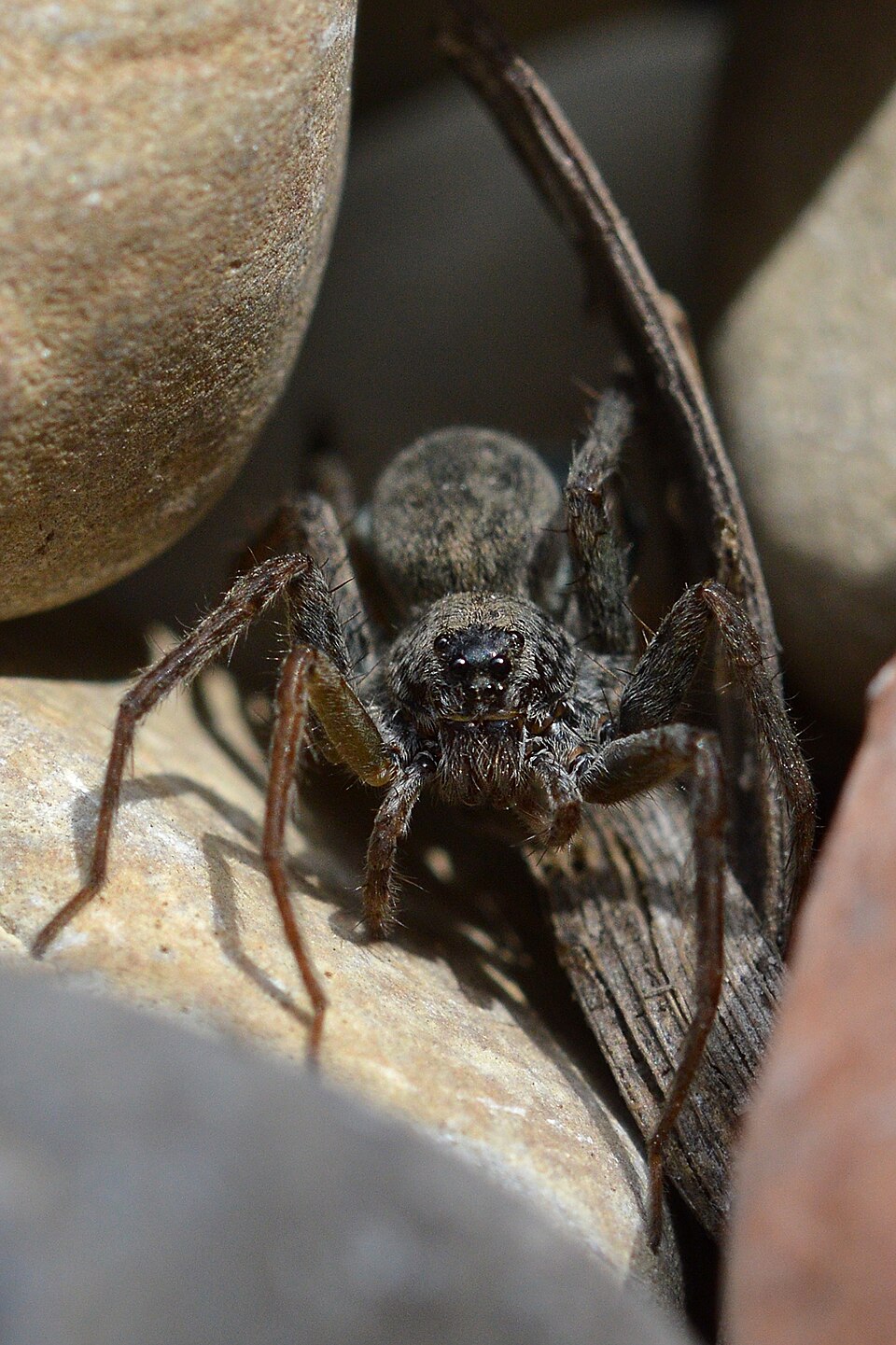
| Wolf spiders Lycosidae | Robust, hairy, ground-running body | Brown, gray or mottled | No capture web | Floors, garages, basements, near doors | Usually an accidental outdoor wanderer | Large reflective eyes; no long spinnerets | Low concern; avoid handling |
| Grass spiders Agelenopsis species | Elongated body with two long visible spinnerets | Brown or gray-brown with longitudinal stripes | Horizontal sheet with funnel retreat outdoors | Near doors, window wells, garages, floors | Usually an outdoor visitor | Long tail-like spinnerets distinguish it from a wolf spider | Low concern |
| Woodlouse spider Dysdera crocata | Elongated body; large projecting jaws | Red-orange front body and legs; pale gray abdomen | No capture web; silk retreat | Basements, damp ground-level rooms, near stored pots or wood | Usually an accidental visitor | Red-orange cephalothorax plus pale abdomen and large chelicerae | Low concern; may bite if trapped |
| Spitting spiders Scytodidae | High domed front body; thin banded legs | Pale tan with dark spots or bands | No capture web | Walls, ceilings, basements, quiet rooms | Some species live around buildings | Slow movement and unusually domed, spotted cephalothorax | Low concern |
| Widow spiders Latrodectus species | Adult female with rounded abdomen; males and juveniles slimmer | Variable; adult females may be glossy dark with red/orange ventral marks | Strong irregular tangle web, often low and sheltered | Garages, sheds, crawl spaces, outdoor furniture, woodpiles | Regional building-associated spider | Verified ventral marking, web, anatomy and geographic range | Regional medical concern |
| Recluse spiders Loxosceles species | Plain, slender brown spider with unbanded-looking legs | Tan to brown | Irregular retreat silk; no capture web | Undisturbed storage, boxes, closets and sheltered voids in range | Regional indoor resident or visitor | Correct range plus six-eye pattern and expert-confirmed anatomy | Regional medical concern |
Step 1: Record Where and When You Found It
Before comparing colors or markings, record the country, state or province, nearest city and date. Geographic range can eliminate many incorrect identifications before close anatomical details are considered.
- Brown recluse: Loxosceles reclusa is centered in the south-central and parts of the Midwestern United States. Other recluse species occur mainly in limited southwestern areas. A generic “brown spider” found far outside a documented range is more likely to be another group.
- Widow spiders: Several Latrodectus species occur in North America, but the species, markings and frequency differ by region.
- Giant house spiders: Introduced Eratigena house spiders are especially relevant in the Pacific Northwest and nearby southwestern Canada, not as a default explanation for every large brown spider across the continent.
- Southern house spider: Kukulcania hibernalis is most expected in warmer southern regions and around suitable buildings.
Season also matters. Adult males of several web-building species leave their retreats to search for females, producing a temporary increase in spiders crossing floors. That pattern does not necessarily mean the species is breeding throughout the living space.
Step 2: Observe Exactly Where the Spider Was Found
Room location is supporting evidence, not proof. The same basement may contain a resident cellar spider in a web, a funnel weaver beside a foundation gap and a wolf spider that entered through a door.
Ceiling corners
Cellar spiders are strong candidates when the spider has extremely long legs and hangs in a loose web. American house spiders and other cobweb spiders may occupy quieter corners. A pale yellow sac spider may leave a small silk retreat where a wall meets the ceiling.
Basements and crawl spaces
Look for cellar spiders, American house spiders, domestic funnel weavers and other building-associated spiders. False widows or widows may occur in sheltered sites within their ranges, but a dark cobweb spider requires closer identification.
Bathrooms
Cellar spiders may live in quiet upper corners. Yellow sac spiders, jumping spiders and ground hunters may also appear. Moisture can support small prey, but the room alone does not identify the spider. See why spiders appear in bathrooms.
Garages and sheds
These transitional spaces can support cobweb spiders, funnel weavers, cellar spiders and crevice weavers. Regionally, giant house spiders or widows may also be present. Check the web and surrounding habitat before naming the spider.
Window frames
American house spiders and other cobweb spiders may build where insects collect. Jumping spiders hunt visually on sunny glass and walls. Southern house spiders use crevices around frames in warmer regions.
Closets and storage boxes
Ground spiders, sac spiders and cobweb spiders may use undisturbed storage. Recluse spiders are possible only where the appropriate Loxosceles species occurs; a closet location does not prove recluse identity.
Floors and baseboards
Fast-moving spiders here are often hunting spiders or wandering males: wolf spiders, parson spiders, woodlouse spiders, grass spiders, jumping spiders or funnel weavers. Speed does not indicate medical importance.
Exterior doors and walls
Jumping spiders, grass spiders, crevice weavers and many outdoor species use these surfaces. A spider near a porch light may be following insects attracted to the light rather than responding directly to the bulb.
Bathtubs and sinks
A spider in a smooth basin may have fallen from a wall or entered while wandering. Its presence does not show that it came up a drain, and it does not identify the species. Some spiders struggle on smooth surfaces; others can climb them.
Step 3: Check the Web
A web can be more informative than color, but first confirm that the spider is actually occupying it. Empty webs remain after a spider dies or moves. Several spiders can build in adjacent corners, and a wandering hunter may cross an old web without being its maker.
- Messy tangled cobweb: Often made by comb-footed spiders in the family Theridiidae, including the American house spider, false widows and widow spiders. Structure, location and the spider itself are still needed.
- Loose cellar web: A thin, irregular three-dimensional web occupied by a very long-legged spider suggests Pholcidae. The spider may hang upside down and vibrate when disturbed.
- Funnel or sheet web: A flat or slightly curved silk sheet leading to a tube-like retreat points toward an agelenid funnel weaver such as Tegenaria, Eratigena or an outdoor Agelenopsis.
- Small silk retreat: A compact sac in a fold, corner or wall junction may be a resting shelter made by a sac spider or another hunter. It is not necessarily a prey-catching web.
- No capture web: Jumping spiders, wolf spiders, parson spiders and woodlouse spiders hunt without a capture web. They still use silk for draglines, egg sacs or retreats.
For a broader explanation of silk structures, see why spiders build webs.
Step 4: Observe Body Shape and Behavior
Common Indoor Spiders in North America
American House Spider
Scientific name: Parasteatoda tepidariorum (family Theridiidae).
Recognition: A small cobweb spider with slender legs and a rounded abdomen. The abdomen may be gray, tan or brown with mottling or pale chevrons; individuals vary, and males are smaller and leggier.
- Body size
- Adult females are commonly about 5–6 mm; males are smaller.
- Web or hunting method
- Irregular three-dimensional tangle web used to catch small arthropods.
- Typical indoor location
- Window corners, basements, garages, crawl spaces, under shelves and in other quiet sites.
- North American range
- Widespread; the species is cosmopolitan and strongly associated with buildings.
- Resident or visitor?
- True indoor resident capable of completing its life cycle in buildings.
- Common lookalikes
- Steatoda false widows, juvenile widows and other small Theridiidae.
- Safety note
- Low concern. Avoid unnecessary handling, as with any unidentified spider.
- Best clue
- A small rounded spider occupying an irregular cobweb in a quiet structural corner.
Cellar Spiders
Taxonomic group: Family Pholcidae. “Cellar spider” covers many species rather than one universal species.
Recognition: A very small, pale body carried on extremely long, delicate legs. True cellar spiders have the two body sections of a spider, unlike harvestmen, whose body appears fused into one oval unit.
- Body size
- Often roughly 5–10 mm, with a leg span many times the body length.
- Web or hunting method
- Loose, irregular web; many hang inverted and vibrate rapidly when disturbed.
- Typical indoor location
- Ceiling corners, basements, cellars, crawl spaces, garages and storage rooms.
- North American range
- Widespread, with different native and introduced species by region.
- Resident or visitor?
- Many common building species are long-term indoor residents.
- Common lookalikes
- Harvestmen, crane flies and other long-legged spiders.
- Safety note
- Low concern. The claim that “daddy longlegs” are extraordinarily venomous is a myth.
- Related guide
- Cellar Spider vs Daddy Long Legs.
Domestic House Spider
Scientific name: Tegenaria domestica (family Agelenidae), also called the barn funnel weaver in some North American references.
Recognition: A brown funnel weaver with an elongated abdomen, patterned body, long legs and visible spinnerets. Close relatives can be difficult to separate from photographs alone.
- Body size
- About 6–12 mm; females are generally larger-bodied.
- Web or hunting method
- A non-sticky sheet leading to a funnel retreat; the spider rushes out when prey crosses the sheet.
- Typical indoor location
- Basements, garages, sheds, foundation recesses and undisturbed storage areas.
- North American range
- Widespread in association with buildings, though frequency varies locally.
- Resident or visitor?
- Building-associated resident where suitable funnel-web sites remain undisturbed.
- Common lookalikes
- Eratigena, hobo spiders and outdoor grass spiders.
- Safety note
- Low concern.
- Best clue
- The web architecture and spinnerets are more useful than brown coloration.
Giant House Spiders
Taxonomic group: Genus Eratigena, family Agelenidae. North American records and common-name usage may involve more than one closely related taxon, so genus-level wording is safer in a general guide.
Recognition: Large-looking brown funnel weavers with long legs, patterned abdomens and rapid running. The apparent size is mostly leg span; speed is escape behavior, not evidence of aggression.
- Body size
- Commonly about 10–18 mm, with a much larger leg span.
- Web or hunting method
- Sheet web ending in a funnel retreat.
- Typical indoor location
- Basements, garages, sheds and low undisturbed structural recesses; wandering males cross floors.
- North American range
- Most relevant in the Pacific Northwest and adjacent southwestern Canada; confirm local records.
- Resident or visitor?
- Building-associated resident; adult males often become conspicuous while roaming.
- Common lookalikes
- Hobo spiders, domestic house spiders and other funnel weavers.
- Safety note
- Low concern.
- Related guide
- Giant House Spider.
Southern House Spider
Scientific name: Kukulcania hibernalis (family Filistatidae), a crevice weaver.
Recognition: Females are robust, velvety and dark. Adult males are tan to brown, slender and long-legged, and are frequently misidentified as brown recluses. Males have conspicuous elongated pedipalps and do not match the recluse eye arrangement.
- Body size
- Roughly 9–19 mm, with strong sexual differences in shape.
- Web or hunting method
- Woolly-looking cribellate silk radiating from a hole or crevice.
- Typical indoor location
- Window frames, eaves, brick or stucco holes, wall crevices and sheltered exterior structures.
- North American range
- Most expected in the southern and southeastern United States and farther south; introduced records occur elsewhere.
- Resident or visitor?
- Long-term resident around buildings; wandering males may enter rooms.
- Common lookalikes
- Brown recluse males, other filistatids and dark funnel weavers.
- Safety note
- Low concern. Do not handle solely to inspect underside or eyes.
- Best clue
- Crevice web plus sexual dimorphism; range and eye pattern separate males from recluses.
False Widows
Taxonomic group: Genus Steatoda (family Theridiidae). Several species occur in North America.
Recognition: Cobweb spiders with a rounded, sometimes glossy abdomen. Color ranges from medium brown to nearly black, and dorsal cream, reddish or geometric markings may be distinct, faded or absent.
- Body size
- Often about 4–11 mm, depending on species and sex.
- Web or hunting method
- Irregular tangle web in a sheltered recess.
- Typical indoor location
- Garages, sheds, cupboards, window recesses, basements and sheltered corners.
- North American range
- Multiple species are widespread; local species composition varies.
- Resident or visitor?
- Some species are established building residents.
- Common lookalikes
- American house spiders and juvenile, male or female widow spiders.
- Safety note
- Usually low concern, but avoid handling. A dark rounded abdomen alone cannot exclude a true widow.
- Related guide
- How to Identify a False Widow Spider.
Yellow Sac Spiders
Taxonomic group: Genus Cheiracanthium (family Cheiracanthiidae). North American records include native and introduced species, and species-level identification often requires close examination.
Recognition: Slender pale spiders, often cream, yellow, light tan or greenish. The tips of the legs or mouthparts may look darker. They are active hunters, frequently seen at night.
- Body size
- Usually about 5–10 mm.
- Web or hunting method
- No prey-catching web; rests in a small silken sac or folded retreat.
- Typical indoor location
- High walls, ceilings, curtains, corners and folds in stored material.
- North American range
- Widespread as a genus; the relevant species differs by region and habitat.
- Resident or visitor?
- Some can persist inside; others enter seasonally from vegetation.
- Common lookalikes
- Other sac spiders, ghost spiders and pale juvenile spiders.
- Safety note
- Generally low concern. Bites can occur if a spider is trapped against skin, but color alone cannot assign a bite.
- Best clue
- Pale nocturnal hunter plus a compact daytime silk retreat.
Parson Spiders
Taxonomic group: Genus Herpyllus (family Gnaphosidae). The eastern parson spider is H. ecclesiasticus; the western parson spider is H. propinquus.
Recognition: A dark, elongated ground spider with a pale dorsal stripe or mark often compared with a clerical cravat. It runs rapidly at night and does not sit in a prey-catching web.
- Body size
- About 6–13 mm, depending on species and sex.
- Web or hunting method
- Active ground hunting; uses silk mainly as a retreat.
- Typical indoor location
- Floors, baseboards, closets, storage spaces and garages.
- North American range
- Parson spiders occur across much of the United States and southern Canada, with eastern and western species.
- Resident or visitor?
- Usually an outdoor spider that wanders inside.
- Common lookalikes
- Other black-and-white ground spiders and some ant-mimicking spiders.
- Safety note
- Low concern.
- Best clue
- The white longitudinal mark on a dark, fast-running ground spider.
Jumping Spiders
Taxonomic group: Family Salticidae, a very diverse group with many North American species.
Recognition: Compact, visually alert spiders with a conspicuous pair of large forward-facing eyes. They often turn toward an observer, stalk prey in short movements and jump rather than run continuously.
- Body size
- Common household visitors are often 3–15 mm; the family varies widely.
- Web or hunting method
- Day-active stalking and pouncing; small silk retreat but no capture web.
- Typical indoor location
- Sunny windows, walls, exterior doors, screens and houseplants.
- North American range
- Widespread and diverse across the continent.
- Resident or visitor?
- Usually an accidental visitor, though some species repeatedly use buildings.
- Common lookalikes
- Other compact hunting spiders; the eye arrangement is distinctive.
- Safety note
- Low concern.
- Best clue
- Large front eyes, orientation toward movement and jumping behavior.
Wolf Spiders
Taxonomic group: Family Lycosidae, containing many North American species.
Recognition: Robust, hairy, brown or gray hunting spiders. A distinctive eye arrangement includes two large central eyes that can reflect light. Females may carry a round egg sac attached to the spinnerets or carry spiderlings on the abdomen.
- Body size
- Many species are about 6–25 mm, though the family includes smaller and larger forms.
- Web or hunting method
- Active ground hunting; no prey-catching web.
- Typical indoor location
- Floors, garages, basements and areas near exterior doors.
- North American range
- Widespread in outdoor habitats throughout North America.
- Resident or visitor?
- Usually an accidental visitor rather than a permanent indoor resident.
- Common lookalikes
- Grass spiders, nursery-web spiders and some large funnel weavers.
- Safety note
- Low concern; avoid handling. Fast escape behavior is not aggression.
- Best clue
- Large reflective eyes and absence of the long spinnerets seen on grass spiders.
Grass Spiders
Taxonomic group: Genus Agelenopsis (family Agelenidae).
Recognition: Brown or gray-brown funnel weavers with longitudinal body stripes and two conspicuous, elongated spinnerets that project beyond the end of the abdomen.
- Body size
- Often about 9–20 mm, depending on species and sex.
- Web or hunting method
- Broad horizontal sheet web with a funnel retreat, usually outdoors.
- Typical indoor location
- Near doors, window wells, garages or floors after wandering in from lawns and foundation plantings.
- North American range
- Widespread across much of the continent.
- Resident or visitor?
- Primarily an outdoor spider and usually an accidental indoor visitor.
- Common lookalikes
- Wolf spiders and other funnel weavers.
- Safety note
- Low concern.
- Best clue
- Long spinnerets plus an outdoor sheet-and-funnel web.
Woodlouse Spider
Scientific name: Dysdera crocata (family Dysderidae), an introduced species now widespread in many North American areas.
Recognition: The front body and legs are red-orange, while the abdomen is pale gray, cream or pinkish. Large forward-projecting jaws are adapted for taking woodlice and other small arthropods.
- Body size
- Usually about 9–15 mm.
- Web or hunting method
- No capture web; hunts at night and rests in a silken retreat.
- Typical indoor location
- Damp ground-level rooms, basements, garages and areas near stored pots, wood or organic debris.
- North American range
- Widespread but patchy, often near human-modified habitats.
- Resident or visitor?
- Usually wanders inside from damp outdoor shelter.
- Common lookalikes
- Broad-faced sac spiders and other reddish ground hunters.
- Safety note
- Low concern. It can bite if trapped or handled, but is not considered a medically important North American spider.
- Best clue
- Red-orange cephalothorax, pale abdomen and conspicuous jaws.
Spitting Spiders
Taxonomic group: Family Scytodidae, commonly represented around buildings by Scytodes species.
Recognition: Small, slow-moving spiders with a high domed cephalothorax, thin legs and a pale body patterned with dark spots or bands. They immobilize small prey by projecting a sticky silk-and-venom mixture from the mouthparts.
- Body size
- Often about 4–8 mm.
- Web or hunting method
- Slow stalking; no capture web.
- Typical indoor location
- Walls, ceilings, basements and quiet rooms, usually at night.
- North American range
- Scattered and species-dependent; some introduced species occur in buildings.
- Resident or visitor?
- Some can live around or inside structures.
- Common lookalikes
- Small cellar spiders and other spotted, long-legged spiders.
- Safety note
- Low concern.
- Related guide
- Are Spitting Spiders Dangerous to Humans?
Widow Spiders: Regional Safety Identification
Taxonomic group: Genus Latrodectus (family Theridiidae). North America has several species, and appearance changes with species, age and sex.
Recognition: Mature females often have a rounded abdomen and may be glossy dark with red or orange markings underneath. Juveniles and males can be brown, striped or spotted and may not resemble the familiar adult-female image. A strong irregular web in a low, sheltered site supports identification.
- Body size
- Adult females are often about 8–13 mm in body length; males are much smaller.
- Web or hunting method
- Strong irregular tangle web, frequently with a sheltered retreat.
- Typical indoor location
- Garages, sheds, crawl spaces and rarely quiet indoor storage; many encounters are around outdoor furniture, woodpiles or utility spaces.
- North American range
- Widow species occur regionally across North America, with highest relevance varying by area.
- Resident or visitor?
- Building-associated in suitable sheltered sites, but not the default explanation for every black indoor spider.
- Common lookalikes
- Steatoda false widows, American house spiders and other dark cobweb spiders.
- Safety note
- Regional medical concern. Do not pick up or turn over a suspected widow to inspect the underside.
- Best clue
- Clear photographs, web, exact location, regional species and verified ventral markings—not black color alone.
Recluse Spiders: Regional Safety Identification
Taxonomic group: Genus Loxosceles (family Sicariidae). The name “brown recluse” properly refers to Loxosceles reclusa, not every brown spider.
Recognition: Recluses are relatively plain, tan-to-brown spiders with six eyes arranged in three pairs. The familiar violin-shaped mark is variable and can be mimicked by shadows or markings on unrelated species. Eye arrangement and other microscopic characters are difficult to assess safely from a live spider.
- Body size
- Usually about 6–12 mm, depending on species and sex.
- Web or hunting method
- No prey-catching web; irregular silk is used as a retreat.
- Typical indoor location
- Undisturbed boxes, closets, wall voids, stored clothing and sheltered spaces—but only within a plausible geographic range.
- North American range
- L. reclusa is centered in south-central and parts of the Midwestern United States; other Loxosceles species have limited southwestern distributions.
- Resident or visitor?
- Can be established indoors in parts of the native range; unlikely as a routine identification far outside documented areas.
- Common lookalikes
- Male southern house spiders, sac spiders, funnel weavers, cellar spiders and many harmless brown spiders.
- Safety note
- Regional medical concern. Do not handle. Seek expert identification from clear photographs or a safely contained specimen already captured without risk.
- Best clue
- Geography first, followed by expert-confirmed anatomy. A brown color or violin-like shadow is insufficient.
Identify an Indoor Spider by Its Web
| Web appearance | Where it is built | Likely spider group | Possible confusion |
|---|---|---|---|
| Irregular, tangled three-dimensional cobweb | Corners, windows, shelving, garages, basements | Theridiidae: American house spider, Steatoda, widow spiders and relatives | An abandoned web cannot identify the current spider; several theridiids make similar structures. |
| Very loose, delicate web with a long-legged spider hanging below | Ceiling corners, basements, crawl spaces | Cellar spiders, Pholcidae | Harvestmen do not make webs; a long-legged spider merely passing through may not own the web. |
| Flat sheet leading into a tube or funnel | Foundation gaps, sheds, garages, basements, window wells | Agelenidae: Tegenaria, Eratigena, Agelenopsis and relatives | “Funnel web” describes architecture and does not mean the medically important Australian funnel-web spiders. |
| Woolly or lace-like silk spreading from a wall crevice | Window frames, eaves, masonry holes and cracks | Crevice weavers such as Kukulcania | Old dust-covered funnel webs may look similar from a distance. |
| Small silk sac or enclosed retreat | Wall-ceiling junction, curtain fold, behind an object | Sac spiders and several other hunting spiders | A retreat is not a capture web and often cannot identify a family by itself. |
| No visible capture web | Floors, walls, windows, doors and storage areas | Jumping, wolf, parson, woodlouse and other hunting spiders | The spider may still use silk for a dragline, egg sac or shelter. |
Why Color Alone Is Unreliable
Small brown house spiders
This description can fit American house spiders, young funnel weavers, sac spiders, parson spiders, juvenile wolf spiders, male southern house spiders and many others. Compare the web, spinnerets, body proportions and range. See the more detailed small brown spiders in house comparison.
Large brown spiders
Wolf spiders, grass spiders, fishing spiders, nursery-web spiders and Eratigena funnel weavers can all appear large indoors. Leg span exaggerates apparent size, and motion blur can hide markings. Long spinnerets favor a grass or funnel weaver; two large reflective eyes favor a wolf spider.
Black indoor spiders
False widows, parson spiders, dark jumping spiders, adult female southern house spiders and other cobweb spiders can look black. A black abdomen does not confirm Latrodectus. Adult female widows are best assessed by regional species, web, body shape and safely obtained views of diagnostic markings.
Pale yellow spiders
Yellow sac spiders are common candidates, but pale running crab spiders, ghost spiders, juvenile spiders and newly molted individuals can look similar. Look for a slender nocturnal hunter and a small resting sac rather than relying on yellow color.
Gray or mottled spiders
American house spiders, jumping spiders, wolf spiders and funnel weavers often appear gray or mottled. Camera flash can bleach a dark spider, while warm indoor lighting can make gray bodies look brown or yellow. Keep the original unedited photo whenever possible.
Resident or Wanderer?
| Indoor relationship | Typical examples | What the sighting may mean |
|---|---|---|
| True indoor residents | American house spiders; several cellar spiders; some cobweb spiders | Webs, egg sacs or multiple life stages may occur in stable indoor sites with prey. |
| Building-associated spiders | Domestic funnel weavers, giant house spiders in range, southern house spiders, false widows | They may live in wall gaps, garages, sheds, foundations or exterior crevices and occasionally enter rooms. |
| Outdoor wanderers | Wolf spiders, grass spiders, many jumping spiders, parson spiders, woodlouse spiders | A single floor-running spider often entered through a gap, open door or carried item. |
| Regionally limited medical concerns | Widow and recluse spiders | Range and reliable identification matter. Their presence should not be assumed from color or a nonspecific skin lesion. |
Adult males of web-building species may leave established retreats during the mating season. Several sightings over a few weeks can therefore reflect seasonal movement rather than a large reproducing population throughout the house.
House Spider Lookalikes
Cellar spider vs harvestman
Wolf spider vs grass spider
American house spider vs false widow
Male southern house spider vs brown recluse
Parson spider vs other black-and-white ground spiders
A parson spider typically has a distinct pale longitudinal mark resembling a cravat, but other ground spiders and ant-mimicking spiders can carry white bands. A clear dorsal photograph, location and body proportions are more useful than the general phrase “black spider with a white stripe.”
Spider vs house centipede
A spider has eight legs and two main body sections. An adult house centipede has 15 pairs of legs, a long segmented body and obvious antennae. Its many legs can blur into a spider-like outline while it runs.
Spider vs tick
Ticks have a compact, unsegmented-looking body and no narrow waist. They do not make silk or webs. Unfed ticks are flattened; feeding ticks become swollen. A tick attached to skin requires tick-specific removal guidance, not spider handling advice.
Which Indoor Spiders Require Extra Caution?
Most spiders found indoors do not approach or attack people. Medically important species vary by region, and bites usually occur when a spider is trapped against skin or directly disturbed.
- Do not use bare hands to inspect an unknown spider.
- Do not turn over a suspected widow to look for an abdominal marking.
- Photograph from a safe distance with zoom when possible.
- Do not attempt to capture a suspected medically important spider merely to obtain an identification.
- A wound’s appearance cannot reliably identify the spider that caused it—or prove that a spider was involved.
- Severe pain, muscle cramping, breathing difficulty, widespread symptoms, fever, vomiting or significant skin damage warrants prompt medical assessment.
For fuller risk and bite guidance, read Are House Spiders Dangerous?
How to Get a More Reliable Photo Identification
A useful identification request includes context as well as a close photograph:
- Country, state or province and nearest city
- Date and approximate time
- Estimated body length, excluding the legs
- A sharp dorsal view taken without touching the spider
- A wider image showing the web or resting site
- The exact room and surface: ceiling corner, floor, box, window or exterior wall
- Nearby habitat such as lawn, woodpile, basement, crawl space or vegetation
- The original, uncropped image so scale and lighting remain available
Do not risk a bite to photograph the underside or eyes. Start with the Spider Identification Guide for the full photography and observation process, then compare likely groups in Common Spider Identification.
What Should You Do After Finding a Spider Indoors?
- Avoid bare-hand contact. Keep children and pets away while you observe from a distance.
- Take clear photographs. Include the spider, web and room location.
- Check regional possibilities. Use state, provincial, museum or university resources before naming a medically important spider.
- Choose a proportionate response. An ordinary low-risk spider can be left undisturbed or moved without direct contact if this can be done safely. Do not attempt to catch a suspected widow or recluse merely for identification.
- Look for conditions, not blame. Repeated sightings may justify checking door sweeps, screens, utility gaps, insect activity and heavily cluttered storage. Spider presence does not mean a house is dirty.
Broad pesticide, essential-oil, diatomaceous-earth or glue-trap recommendations are not necessary for an identification page. If a persistent problem remains after exclusion and housekeeping checks, use a qualified local professional who can identify the species and explain the reason for any treatment.
To understand why spiders remain where prey is available, see What Do House Spiders Eat?
Frequently Asked Questions
How do I identify a house spider?
Start with the geographic location and date, then record body length, body shape, leg proportions, web type, behavior and the exact place where it was found. Use several clues together. “House spider” is a location-based common name, not one universal species.
What is the most common house spider in North America?
The American house spider, Parasteatoda tepidariorum, is one of the most widespread spiders associated with North American buildings and is often what people mean by “common house spider.” Cellar spiders are also extremely familiar indoor residents, but the most frequent species varies by region and building type.
What does a common house spider look like?
An adult female American house spider is small, with slender legs and a rounded tan, gray-brown or mottled abdomen. It usually occupies an irregular tangled web in a quiet corner. Males and juveniles look smaller and less rounded.
How can I identify a brown spider in my house?
Do not begin with color alone. Check whether it has a cobweb, funnel web or no capture web; look for long spinnerets, very long legs, a compact jumping-spider face or a robust wolf-spider body; and compare the geographic range. Use the dedicated small brown spider guide for a closer comparison.
What spider makes messy webs in house corners?
American house spiders and other cobweb spiders commonly make irregular tangle webs. Cellar spiders also make loose webs, but their extremely long legs and vibrating behavior are distinctive. False widows and widow spiders can make irregular webs too, so the web alone does not identify the species.
What spider runs quickly across the floor?
Wolf spiders, parson spiders, grass spiders, funnel weavers and wandering adult males of several species may run across floors. Rapid movement usually means escape or mate-searching behavior; it does not show that a spider is aggressive or medically important.
Are cellar spiders house spiders?
Yes. Several cellar spiders are well adapted to buildings and can live for long periods in basements, garages, crawl spaces and ceiling corners. They are true spiders in the family Pholcidae, not harvestmen.
Are wolf spiders common indoors?
Wolf spiders are commonly noticed indoors, especially near ground-level entrances, but most are outdoor hunters that wandered inside. They normally do not establish capture webs or permanent colonies in living rooms.
How can I tell a house spider from a brown recluse?
First check whether recluse spiders are documented in the area. American house spiders occupy tangled webs and usually have rounded patterned abdomens. Brown recluses are plain hunters with six eyes in three pairs and no capture web. A violin-like shadow or brown color is not sufficient; expert confirmation is advisable.
How can I tell a house spider from a black widow?
Do not rely on black color. Compare the spider’s geographic range, web, body shape and safely visible markings. Mature female widows may have red or orange marks on the underside, while males and juveniles can look very different. Do not handle or turn over a suspected widow.
Do house spiders live indoors permanently?
Some do. American house spiders and several cellar spiders can feed and reproduce inside. Domestic funnel weavers and some cobweb spiders may live in building voids or garages. Wolf spiders, grass spiders and many jumping spiders are more often temporary visitors.
Can I identify a house spider from a photo?
A clear photo can often identify a family, genus or common group, especially when it includes location, body size, web and behavior. Species-level identification is sometimes impossible from a dorsal image, and medically important identifications should be treated cautiously.
Does finding several spiders mean there is an infestation?
Not necessarily. Seasonal male movement, several outdoor spiders entering through the same gap, or multiple web sites near abundant prey can produce repeated sightings. Evidence of indoor reproduction—such as repeated egg sacs and multiple life stages in the same protected area—is more informative than a simple count.
References
- World Spider Catalog. World Spider Catalog, Version 26. Natural History Museum Bern. Accessed July 19, 2026.
- University of Minnesota Extension. Spiders.
- Colorado State University Extension. Spiders in the Home.
- Penn State Extension. Common House Spider.
- Penn State Extension. Barn Funnel Weaver Spider.
- Utah State University Extension. Urban Pest Identification Guide.
- Natural History Museum, London. House Spider Identification: UK Species, Size, and Season.
- Australian Museum. Black House Spider, Badumna insignis.
- American Arachnological Society. Frequently Asked Questions.
- American Arachnological Society. Spiders (Arachnida: Araneae).
- U.S. Centers for Disease Control and Prevention, NIOSH. Venomous Spiders at Work.