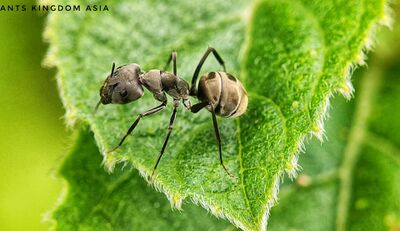
At first glance, they look like ordinary ants hurrying across a leaf, a tree trunk, or the forest floor. They have slender bodies, narrow “waists,” quick movements, and even what seem to be waving antennae.
But look closer.
Some of those “ants” are not ants at all. They are spiders.
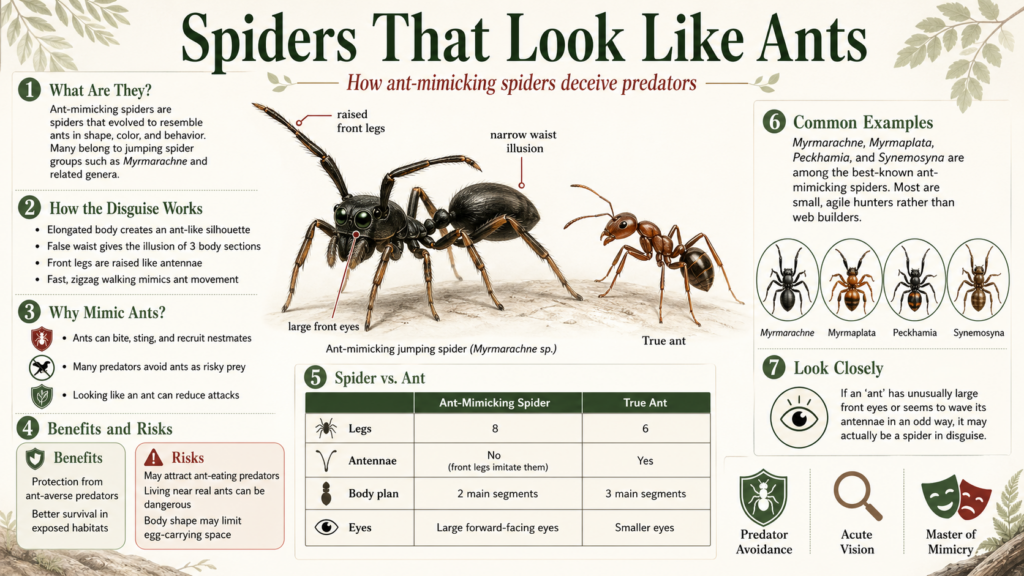
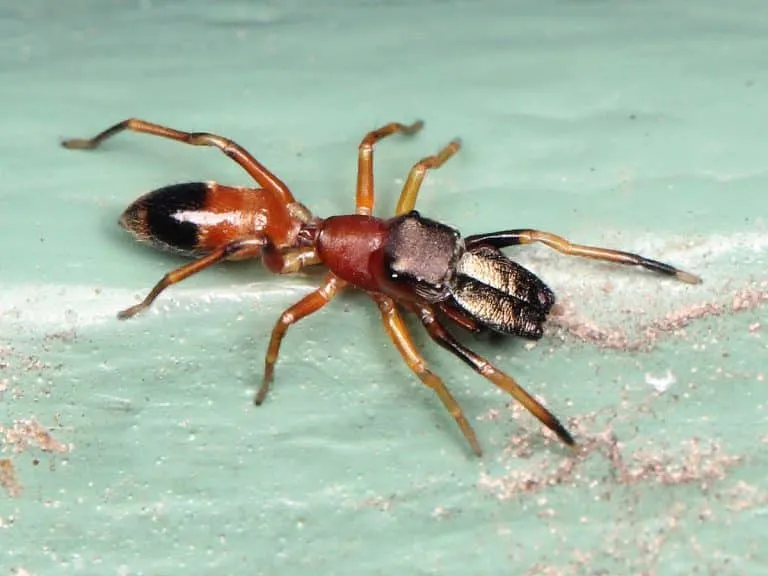
Among the strangest and most fascinating creatures in the arthropod world are spiders that look like ants. These tiny imposters have evolved to copy ants so convincingly that even experienced observers can be fooled for a moment. Many of them belong to the jumping spider family, especially genera such as Myrmarachne, Myrmaplata, Peckhamia, and Synemosyna.
Their disguise is not just about appearance. These spiders also walk like ants, wave their front legs like antennae, and live close to the ants they imitate. It is a remarkable act of natural deception — and it comes with both benefits and serious risks.
What Are Spiders That Look Like Ants?
Spiders that look like ants are often called ant-mimicking spiders or myrmecomorphs. The word “myrmecomorphy” simply means ant mimicry — when another animal evolves to resemble an ant.
This type of mimicry is especially common among spiders, particularly jumping spiders in the family Salticidae. Unlike many typical jumping spiders, which have compact, furry, rounded bodies, ant-mimicking species often have:
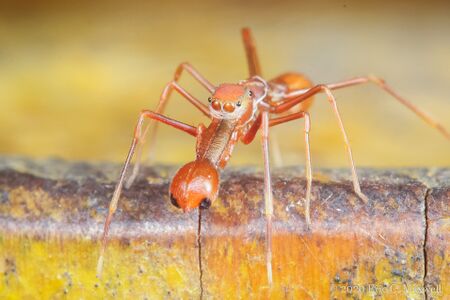
- Long, narrow bodies
- A thin waist-like shape
- Ant-like coloration
- Fast, erratic walking patterns
- Front legs raised and waved like antennae
A real ant has three main body sections: head, thorax, and abdomen. A spider technically has only two main body sections. To solve this problem, ant-mimicking spiders often use body shape, color patterns, and false constrictions to create the illusion of a third section.
The result can be surprisingly convincing.
Why Would a Spider Want to Look Like an Ant?
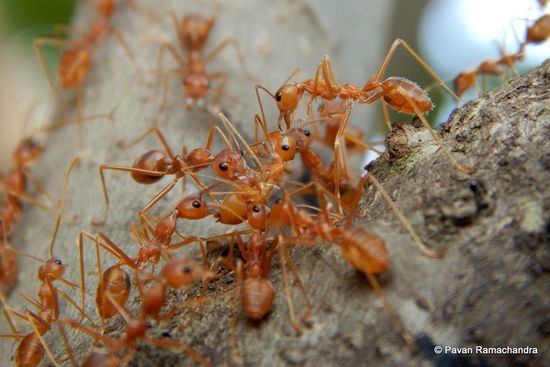
To us, ants may seem like small, ordinary insects. But in the world of predators, ants are often bad news.
Many ants can bite, sting, spray chemicals, or call in nestmates for backup. A single ant may not seem dangerous, but an ant colony can quickly become a serious threat. Because of this, many predators — including birds, lizards, wasps, mantises, and other spiders — often avoid eating ants.
For a spider, this creates an opportunity.
If a harmless or vulnerable spider can look enough like an ant, predators may decide it is not worth attacking. This is a classic example of Batesian mimicry, where a relatively defenseless animal gains protection by resembling a more dangerous or unpleasant one.
In simple terms:
the spider pretends to be something predators would rather leave alone.
How Do Ant-Mimicking Spiders Fool Predators?
The disguise works on several levels. A good ant mimic cannot simply have the right body shape. It also needs the right behavior.
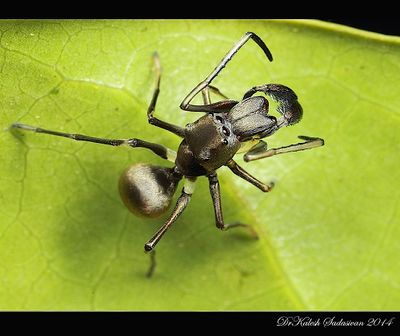
1. They Change Their Body Shape
Many ant-mimicking spiders have long, smooth, narrow bodies. Some have markings that create the illusion of separate ant-like body segments. Others have a constricted abdomen that makes them look as if they have a tiny ant waist.
In some species, even the legs are colored in a way that makes them appear thinner and more ant-like.
2. They Pretend Their Legs Are Antennae
Spiders have eight legs. Ants have six legs and two antennae.
That creates an obvious problem.
Many ant-mimicking spiders solve it by walking on their back three pairs of legs and lifting the front pair into the air. They wave those raised legs around like antennae, completing the illusion.
From a distance, a predator may see “six legs plus antennae,” not “eight-legged spider.”
3. They Move Like Ants
Typical jumping spiders often move in a stop-and-go pattern. They pause, look around, stalk prey, and then jump.
Ants move differently. They tend to walk quickly, turn often, and follow winding paths as they respond to chemical trails.
Some ant-mimicking jumping spiders copy this behavior. They move in fast, restless, zigzagging patterns, making them look less like spiders and much more like ants searching for food.
Meet Myrmarachne: The Famous Ant-Mimicking Jumping Spiders
One of the best-known groups of spiders that look like ants is the genus Myrmarachne. These jumping spiders are famous for their ant-like shape and behavior.
Myrmarachne species are found in many warm regions, including parts of Africa, Asia, Australia, and the Americas. More than 200 species have been described, making them one of the most successful examples of spider mimicry.
Their bodies are usually smooth and elongated. Their movements are nervous and ant-like. Many species live near the ants they resemble, which helps strengthen the illusion for predators.
But that also creates danger.
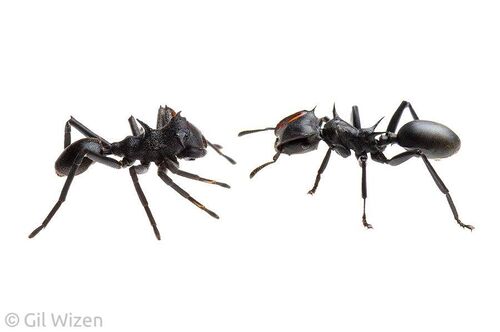
To look convincing, the spider often has to live close to real ants. If the ants discover the spider, the disguise does not always help. Ants may attack, bite, sting, or even kill the spider.
So the mimic is always walking a fine line: close enough to ants to look believable, but not so close that it becomes prey.
The Hidden Cost of Looking Like an Ant
Ant mimicry sounds like a perfect survival trick, but it is not free. These spiders pay a price for their disguise.
They May Attract Ant-Eating Predators
Some predators specialize in eating ants. To those predators, looking like an ant is not protective at all — it is an invitation.
This means ant-mimicking spiders may avoid one group of enemies while becoming more vulnerable to another.
Their Body Shape May Limit Reproduction
A long, narrow ant-like body can make the spider a better mimic, but it may also reduce the space available for eggs. In some ant-mimicking spiders, the body modifications that improve disguise may come with reproductive trade-offs.
Males Can Become Less Safe
In some species, males have enlarged mouthparts or long chelicerae. These features may help them compete for mates or attract females, but they can also make them look like ants carrying something in their jaws.
That matters because some ant-eating predators prefer to attack ants carrying objects, since those ants may be less able to bite back.
So, for male ant-mimicking spiders, looking attractive to females may also mean looking attractive to predators.
Do Ant-Mimicking Spiders Smell Like Ants?
This is where the story becomes even more interesting.
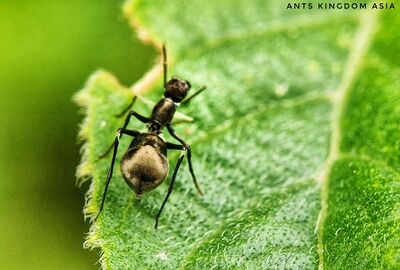
Many predators do not rely only on sight. Wasps and ants, for example, use chemical cues to identify prey. A spider might look like an ant, but if it still smells like a spider, some predators may not be fooled.
Some ant-mimicking spiders appear to reduce their own chemical signature. They may not fully smell like ants, but they also do not smell strongly like typical spiders. This kind of “chemical invisibility” can make the disguise more effective against predators that use scent.
In other words, the best ant mimics are not just visual actors. Their disguise may involve body shape, movement, behavior, and even reduced scent signals.
Are Spiders That Look Like Ants Dangerous to Humans?
Most ant-mimicking spiders are not dangerous to humans.
They are usually small, shy, and more interested in avoiding predators than bothering people. Many are jumping spiders, which are generally known for their excellent vision, active hunting style, and curious behavior.
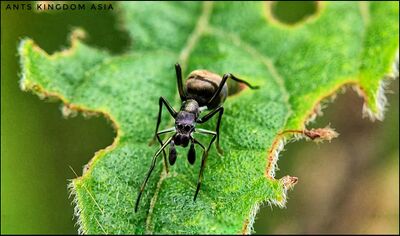
Like most spiders, they may bite if handled roughly, but they are not considered medically significant for humans.
The real danger in their lives is not from people. It is from ants, wasps, birds, lizards, frogs, mantises, and other spiders.
Where Can You Find Spiders That Look Like Ants?
Ant-mimicking spiders can be found in many parts of the world, especially in warm and tropical regions. Some species also live in North America and other temperate areas.
You may find them:
- On leaves and stems
- Around tree bark
- In gardens
- Near ant trails
- In leaf litter
- Around shrubs and low vegetation
Because they are small and fast, they are easy to miss. The best way to spot one is to watch ants carefully. If one “ant” seems to move a little differently, pauses to look around, or has unusually large forward-facing eyes, it may actually be a spider.
A magnifying glass or macro lens can reveal the truth quickly. Ants do not have the large, headlight-like front eyes that jumping spiders do.
Do These Spiders Eat Ants?
Some ant-mimicking spiders may prey on ants, but many use mimicry mainly for protection. The relationship varies by species.
Some mimics live near ants but avoid direct contact. Others may use their disguise to approach prey or even raid nests. One particularly fascinating species, Myrmarachne melanotarsa, has been observed using its ant-like appearance to frighten other jumping spiders away from their nests, then feeding on eggs or spiderlings.
This shows that mimicry is not always simple defense. Sometimes it can also become a tool for hunting.
How to Tell an Ant-Mimicking Spider from a Real Ant
If you see a tiny creature that looks like an ant, here are a few clues that it might be a spider:
Look at the Eyes
Jumping spiders often have large, forward-facing eyes. Ants do not have that same “big-eyed” look.
Count the Legs Carefully
Spiders have eight legs, but ant mimics often raise the front pair like antennae. If you watch closely, you may notice the “antennae” are actually legs.
Watch the Movement
Ants often follow trails and interact with other ants. A spider may move like an ant but still pause, turn, or stalk in a more spider-like way.
Notice the Body Shape
Some ant mimics are extremely convincing, but many still look slightly too smooth, too shiny, or too oddly segmented when viewed up close.
Why Ant-Mimicking Spiders Matter
These spiders are more than just strange curiosities. They are a beautiful example of how evolution works through pressure, trade-offs, and opportunity.
Their disguise protects them from some predators but exposes them to others. Their body shape improves mimicry but may limit reproduction. Their behavior helps them blend in but forces them to live close to dangerous ants.
That is what makes them so fascinating. They are not simply “pretending to be ants.” They are living inside a complicated evolutionary compromise.
For anyone who enjoys nature, spiders, insects, or backyard wildlife, ant-mimicking spiders are a reminder that even the smallest creatures can have astonishing survival stories.
The next time you see a line of ants moving across a leaf or wall, take a second look. One of them may not be an ant at all.
It may be a spider wearing one of nature’s best disguises.
FAQ
What are spiders that look like ants called?
Spiders that look like ants are commonly called ant-mimicking spiders or myrmecomorphs. Many of the best-known examples are jumping spiders, including species in the genus Myrmarachne.
Why do some spiders look like ants?
Many spiders mimic ants to avoid being eaten. Since ants can bite, sting, spray chemicals, or call nestmates for help, many predators avoid them. By looking like ants, spiders may gain protection from predators that would normally eat spiders.
Are ant-mimicking spiders real spiders?
Yes. They are true spiders, even though they may look and move like ants. They still have eight legs, silk-producing abilities, and typical spider anatomy, but their shape and behavior help them resemble ants.
Are spiders that look like ants dangerous?
Most ant-mimicking spiders are not dangerous to humans. They are usually small and shy. Like many spiders, they may bite if mishandled, but they are not generally considered harmful.
How can I tell an ant-mimicking spider from an ant?
Look for large forward-facing eyes, eight legs, and front legs raised like antennae. Ant-mimicking spiders may also pause and look around in a way that real ants usually do not.
Do ant-mimicking spiders eat ants?
Some may eat ants, but many use ant mimicry mainly for protection. Different species have different habits. Some avoid ants, while others may use their ant-like appearance to approach prey or raid nests.
Where do ant-mimicking spiders live?
They can be found in many regions, especially tropical and warm habitats. Some also live in North America. They are often seen near ants, on leaves, tree bark, shrubs, or in leaf litter.