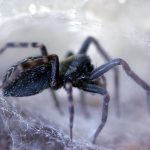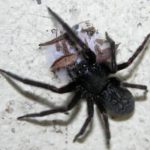
No. The black house spider (Badumna insignis) is venomous, not poisonous: it can inject venom through a bite, but it is not toxic to touch, and it is not considered medically significant. In the largest prospective study of confirmed Badumna bites, every patient felt pain, but the pain lasted a median of five minutes, nobody developed an ulcer, and no patient needed specific treatment.
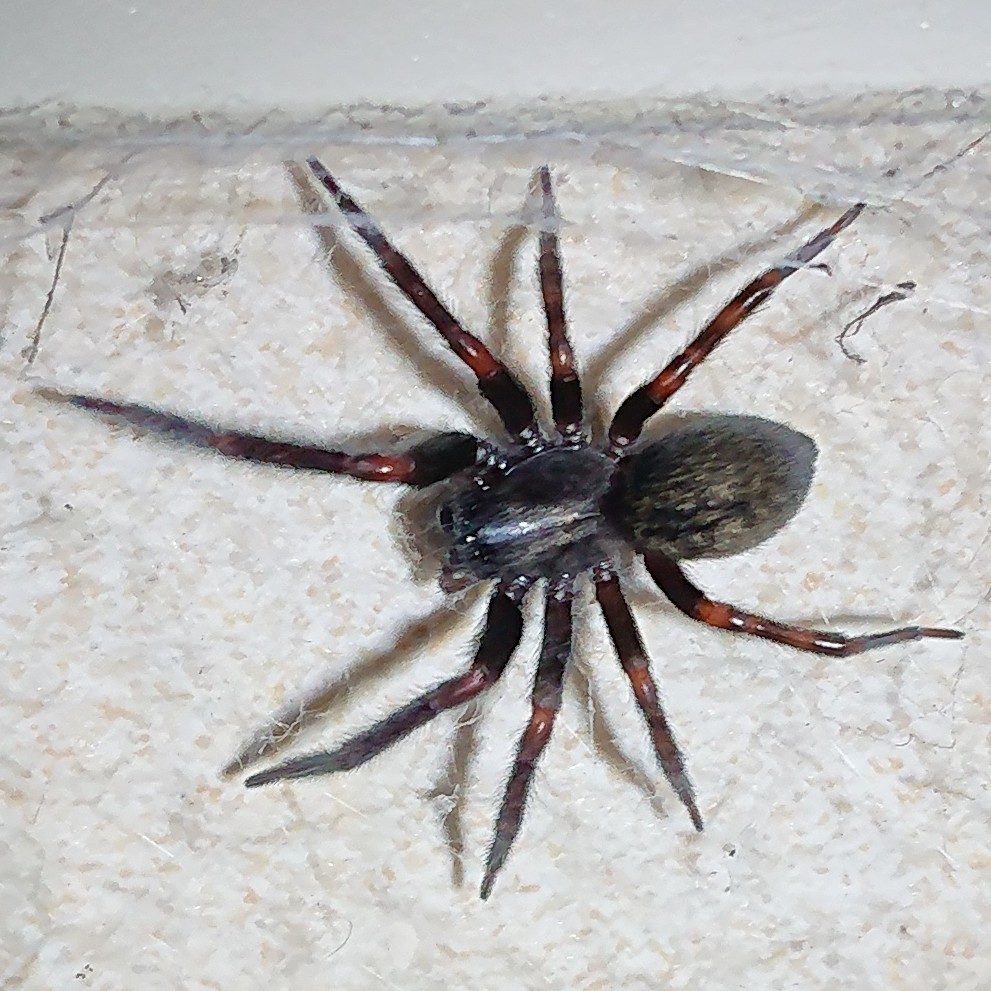
Venomous, not poisonous — and why the difference matters here
A poisonous animal harms you when you touch, lick or eat it. A venomous animal has to inject something. Black house spiders fall in the second group: their venom only reaches you through the fangs, and there is no evidence that handling one, brushing against its web, or having one in the house exposes you to any toxin.
That distinction is not just wordplay. It rules out most of the things people actually worry about — a spider walking across a kitchen bench, a web near a child’s bedroom window, a dead spider found in a shoe. None of those involve venom delivery. The only realistic exposure route is a bite, and bites are infrequent because the spider almost never leaves its retreat voluntarily.
Are black house spiders dangerous to humans?
They are not classed as dangerous. The best available evidence comes from a prospective Australian study that recruited 25 patients with definite bites by Badumna spiders — cases where the spider was caught and identified by an arachnologist, rather than guessed at afterwards. Pain occurred in every case and was severe in seven, but the median duration of pain was about five minutes, and no patient developed a necrotic ulcer.
| Recorded effect | Result in 25 confirmed Badumna bites |
|---|---|
| Pain | All 25 cases; severe in 7 |
| Median duration of pain | About 5 minutes |
| Redness at the bite site | 68% |
| Visible puncture marks | 24% |
| Swelling | 12% |
| Minor whole-body (systemic) effects | 4 of 25 bites |
| Necrotic ulcer | 0% (97.5% confidence interval 0–14%) |
Source: Isbister & Gray, Internal Medicine Journal, 2004. Note the boundary of this evidence: spiders were identified to the genus Badumna, which includes both B. insignis and the closely related Badumna longinqua. There is limited clinical data specific to B. insignis alone, and no published pharmacological characterisation of its venom that would let anyone describe a species-specific toxin profile.
Museum accounts add that nausea, vomiting, sweating and giddiness have occasionally been recorded after bites, and that skin lesions have followed multiple bites in a small number of reports. Those are anecdotal case descriptions rather than prospective data, which is why the two sources appear to disagree — the study measured what happened in confirmed bites, while the older reports collected unusual outcomes. Treat the study figures as the realistic expectation and the anecdotal reports as rare exceptions.
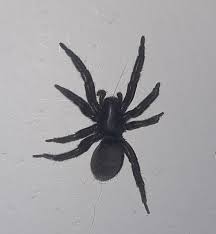
What does a black house spider bite feel like?
Expect sharp local pain that fades quickly, usually within minutes, often with redness around the site and sometimes mild swelling. Fewer than a quarter of confirmed bites left visible puncture marks, so the absence of two neat dots does not mean you were not bitten — and their presence does not confirm which animal did it.
Bites happen when the spider is pressed against skin: reaching into a window corner, moving stored timber, pulling on a glove or shoe left in a shed. Females stay in the web permanently unless forced out; wandering males looking for mates are the ones most often found loose indoors during summer. If you want the wider picture on how ordinary indoor spiders compare, see our guide to how risky common house spiders really are.
Do black house spider bites cause flesh-eating ulcers?
There is no evidence that they do. This myth exists because black house spiders were once grouped with the white-tailed spider in Australian reports of “necrotic arachnidism” — skin ulcers blamed on spider bites. The 2004 prospective study was designed specifically to test that claim, and none of the 25 confirmed Badumna bites produced an ulcer. The authors concluded that patients with these bites can be reassured and do not need further investigation or treatment.
Laboratory work has separately found enzymes in Badumna extracts that could in principle damage tissue, but enzyme activity in a test tube is not the same thing as an ulcer in a patient. When the two lines of evidence are compared, the clinical outcomes are what matter: a slow-healing or spreading wound after a suspected spider bite is far more likely to be a skin infection or another condition, and deserves a proper medical assessment rather than a spider diagnosis.
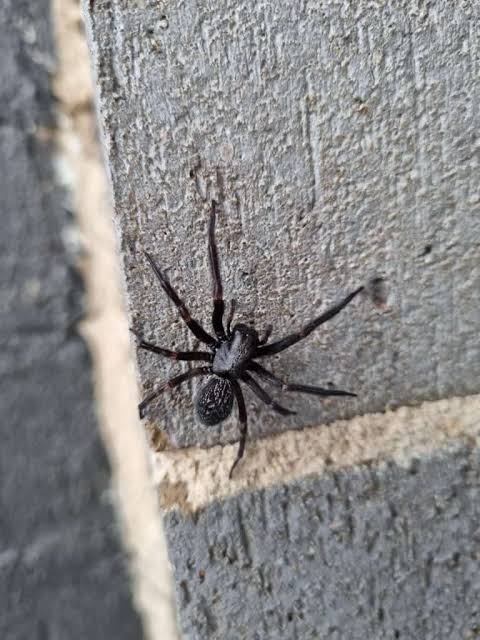
What should you do if a black house spider bites you?
Australian and New Zealand resuscitation guidance treats spider bites in two categories. Pressure immobilisation bandaging is reserved for the funnel-web spider group; for all other spider bites, the advice is a cold pack for pain and medical care if the person becomes unwell.
- Wash the area with soap and water.
- Apply a wrapped cold pack for around 15 minutes to ease the pain.
- Rest the limb and watch the site over the next day or two.
- Seek medical advice if pain keeps worsening, swelling spreads, the site looks infected, or systemic symptoms are strong or persistent.
General bite aftercare is covered in more detail in our guide to treating a spider bite at home.
If you are not certain what bit you: Australian health guidance is to treat a bite from a funnel-web spider, a mouse spider, or any large black spider you cannot identify as an emergency — call 000 and apply pressure immobilisation. The safe rule is that identification confidence, not the spider’s likely identity, decides the response. In Australia you can also call the Poisons Information Centre on 13 11 26 for advice.
How to tell a black house spider from a funnel-web
The confusion is almost entirely about the web. Black house spiders build a lacy sheet of cribellate silk — combed dry strands that snag insect legs rather than sticking to them — with one or more funnel-shaped entrances leading back to a retreat. Australian funnel-webs (family Atracidae) are not related to them and differ in appearance, size and life history.
| Black house spider | Australian funnel-web group | |
|---|---|---|
| Family | Desidae | Atracidae |
| Typical location | Window frames, brickwork, eaves, rough tree bark | Ground burrows, or crevices in tree trunks |
| Web | Lacy silk sheet with exposed silk and funnel-like entrances | Less funnel-like retreat; tree-dwelling species disguise the entrance with bark and debris |
| Medical significance | Not medically significant | Medically significant; bites are treated as emergencies |
Colour and size are poor identifiers on their own — plenty of unrelated dark spiders reach similar dimensions. If you want to work through physical features rather than webs, browse the spider identification guides by type or the fuller black house spider species profile.
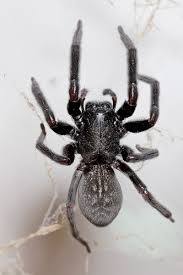
Should you worry about one living on your window frame?
Practically, no. The Australian Museum records female black house spiders at roughly 12–18 mm in body length and males at 9–15 mm, though adult size varies considerably and some popular sources quote males at closer to 9–10 mm. Adults live for about two years, and females essentially never leave the web, adding layers of silk until the sheet looks grey and matted.
They earn their keep. Around buildings they take moths, beetles and termites drawn to lights; on rough-barked trees they intercept flies, beetles, butterflies and bees attracted to sap flows. They are also prey themselves — white-tailed spiders, parasitic wasps and flies all hunt them. If you want the webs gone, remove them with a broom or vacuum and seal the crevices behind them rather than reaching into corners with bare hands.
Is the “black house spider” outside Australia the same species?
Often not, and this matters if you are searching from outside Australasia. The World Spider Catalog records Badumna insignis as native to Australia and introduced to Japan and New Zealand only. Its close relative, Badumna longinqua, has spread much further — including to the Americas, South Africa and parts of Europe — and is the species usually meant by “grey house spider” overseas, though Australian usage favours “brown house spider” for it.
So a dark spider in a window frame in California, Britain or Brazil is unlikely to be B. insignis. It may be B. longinqua, or an unrelated local species entirely. Since the clinical evidence above was collected at genus level, it covers both Badumna species; it says nothing about whatever unrelated spider might be occupying your window in another region.
Frequently asked questions
Is a black house spider poisonous or venomous?
Venomous. It delivers venom only by biting. There is no evidence of any toxic effect from touching a black house spider, its web, or a dead specimen.
Can a black house spider bite kill you?
No deaths have been attributed to this species. In confirmed bites the effects were local pain and redness that settled quickly, and the researchers concluded that patients could be reassured without further treatment.
How long does a black house spider bite hurt?
In the confirmed-bite study the median duration of pain was about five minutes, although pain was described as severe in about a quarter of cases. Local redness can persist longer than the pain itself.
Do I need a pressure bandage after a black house spider bite?
No — pressure immobilisation is reserved for the funnel-web spider group. Use a cold pack instead. The exception is uncertainty: if you cannot rule out a funnel-web or another large black spider, apply pressure immobilisation and call emergency services.
Why is my spider bite turning into an ulcer if this species doesn’t cause ulcers?
A wound that worsens or fails to heal is unlikely to be explained by a Badumna bite, since none of the confirmed bites produced necrosis. Skin infections and other conditions are far more common causes, and any spreading or non-healing wound should be assessed by a doctor.
Scientific Sources
- World Spider Catalog — Badumna insignis (L. Koch, 1872): accepted name, family placement in Desidae, synonymy, and distribution (Australia; introduced to Japan and New Zealand).
- Isbister GK, Gray MR. Black house spiders are unlikely culprits in necrotic arachnidism: a prospective study. Internal Medicine Journal, 2004: prospective series of 25 definite Badumna bites and their clinical outcomes.
- Isbister GK, Gray MR. A prospective study of 750 definite spider bites, with expert spider identification. QJM, 2002: the larger Australian cohort from which the Badumna cases were drawn, and the methodology for confirming bites.
- Australian Museum — Black House Spider, Badumna insignis: size range, web structure, habitat, diet, breeding, predators, and recorded bite effects.
- ANZCOR Guideline 9.4.2 — First Aid Management of Spider Bite: when pressure immobilisation applies and how other spider bites should be managed.
- healthdirect Australia — Spider bites: treatment, symptoms and first aid: government health service guidance on first aid steps and when to call emergency services.