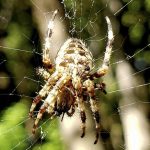
Acacesia hamata is a small orb weaver (family Araneidae) found from the eastern and central United States south to northern Argentina. Adult females are only about 5–9 mm long. The species is easy to overlook because it builds its web at dusk, takes it down before dawn, and spends the day pressed against a leaf with its front legs stretched forward. The best field clues are that daytime posture, a brownish abdomen with paired wavy lines, and a small orb web that only appears at night in low vegetation.

Quick identification profile
| Group | True spider (order Araneae), orb-weaver family Araneidae |
|---|---|
| Body length | Females about 5–9 mm; males about 3.5–5 mm (body only, not including legs) |
| Abdomen | Oval to slightly pointed at the rear, without obvious shoulder humps; usually brown, sometimes greenish gray, orange or pinkish |
| Pattern | Two sets of thin, often wavy lines forming a double leaf-shaped mark, darker in the center |
| Legs and carapace | Brownish tan; legs spiny, more noticeably so in males |
| Web | Small vertical orb, roughly 20–30 cm (8–12 in) across, built at dusk and removed before dawn |
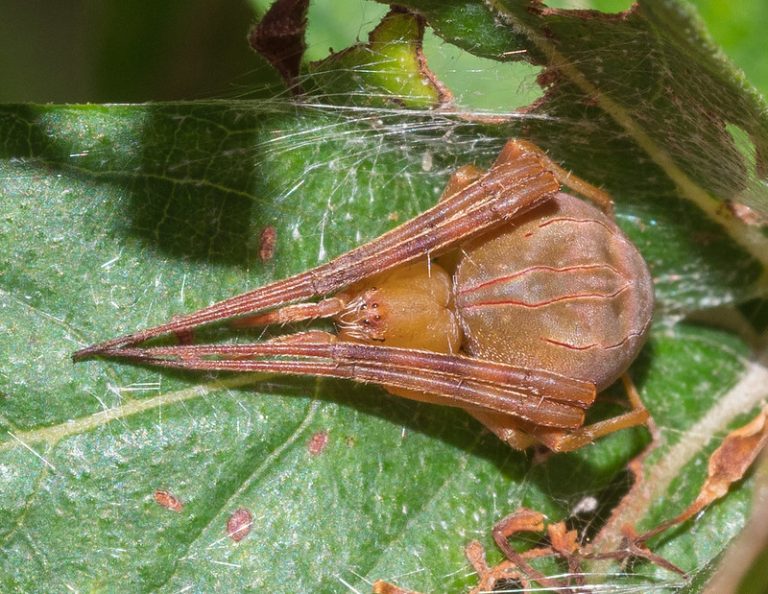
| Daytime behavior | Rests on a leaf or stem with the legs folded forward |
| Habitat | Old fields, meadows, forest edges, shrubby vegetation and bogs |
| Season (eastern US) | Mostly seen from about July to September |
Size, shape, and color
This is a small spider. In the 1994 revision of the genus, measured females ranged from about 5.3 to 8.6 mm in body length and males from 3.6 to 4.4 mm. North Carolina State Parks’ species account gives a slightly wider range, about 4.7–9.1 mm for females and 3.6–4.8 mm for males. Those numbers describe the body only; with legs extended, the spider looks larger.
The abdomen is the most useful feature to look at. It is broadest toward the front and narrows toward the rear, and it lacks the paired “shoulder” bumps seen on many other orb weavers. Most individuals are some shade of brown or tan, but greenish gray, orange and pinkish individuals also occur. Across the top runs a double, leaf-shaped pattern made of thin lines, with the central area usually darker than the sides.
Males carry similar markings on a noticeably smaller, narrower abdomen. Their legs can look banded and more spiny than a female’s.


A web that appears only at night
The most distinctive thing about Acacesia hamata is its schedule. According to North Carolina State Parks’ spider survey, it starts a new orb at dusk, sits at the hub through the night, and removes the web at dawn. The web is small, about 20–30 cm (8–12 in) across, and is usually placed within about a meter (3 ft) of the ground in grasses and shrubs.
The capture spiral is closely spaced, and the web has been described as effective at catching moths. Detailed studies of this species’ diet are lacking, so it is safest to say that it takes small night-flying insects that hit the web.
Females can also take the web down quickly. When startled by a bright light, a female may cut the support lines and roll up the silk in under a minute, eating it as she goes.
Where it hides during the day
Because the web is gone by morning, daytime sightings are usually of the spider alone. It rests on a leaf or stem with its front legs held forward in a tight bundle, sometimes fully in the open. In this position the brown or orange body can pass for a dry plant fragment.
Females lay their egg sacs on an open leaf and may stay nearby to guard them.


Range and when to look
The World Spider Catalog lists the range as the United States to Argentina. The genus revision describes it in more detail: from eastern Pennsylvania west to Arkansas, south to Florida and the Bahamas, and on through Mexico, Central America and parts of the Caribbean and South America to northern Argentina. BugGuide’s US records extend west to Texas and Nebraska and north to New Jersey, and Maryland has many community records.
It is the only Acacesia species known from the United States. The genus is small, with six accepted species in the World Spider Catalog; the others live in Mexico, Central America and South America.
In the eastern US, adults are mostly reported in mid to late summer. BugGuide lists July and August as the main months, and Maryland records run from early July to late September. Because the web is only up at night, North Carolina’s survey notes that the species is usually found by searching vegetation after dark.
How sure can a photo identification be?
A good photo from the eastern or central United States that shows the folded-leg daytime posture, a small lined abdomen without shoulder humps, and a body under about 1 cm is consistent with Acacesia hamata. Adding the location, the date, and whether there was a small web at night makes the identification stronger.
Keep a few limits in mind:
- Color is weak evidence. This species ranges from greenish gray to orange and pink, so color alone cannot confirm it.
- Several small orb weavers rest with their legs pulled in. Check abdomen shape and pattern together, not posture alone.
- Location matters. South of the US, other Acacesia species occur, and the revision separates them mainly by abdominal pattern details and by the structure of the male palp and female epigynum. Outside the US, a photo may only support a genus-level answer.
For a general method, see our spider identification guide, which explains how to combine location, body shape, eyes and webs.
Is Acacesia hamata dangerous?
No. Like nearly all spiders, it has venom for subduing insect prey, but it is not considered medically significant. Texas A&M AgriLife Extension describes orb weavers as harmless to people.
If one is on a plant you need to move, let it walk onto a twig or a card rather than picking it up. For spiders that do carry real medical risk in North America, see our spider bite and danger section.
Names and classification
| Accepted name | Acacesia hamata (Hentz, 1847) |
|---|---|
| Family | Araneidae (orb weavers) |
| Genus | Acacesia Simon, 1895 |
| Informal common name | Difoliate orbweaver (used by some regional surveys; not widely standardized) |
| Older names | Originally described as Epeira hamata. Names now treated as synonyms include Epeira foliata Hentz, 1847 and Araneus hallucinor Petrunkevitch, 1911 (full list in the World Spider Catalog). |
Nicholas Hentz described the species in 1847 under the genus Epeira, an old catch-all genus for orb weavers. Several later names turned out to refer to the same spider and are now treated as synonyms. You may still see Epeira hamata in older books. For more on the family as a whole, see our page on orb-weaving spiders, or browse other species in Spider Types.
Frequently asked questions
Why can’t I find its web during the day?
Because it isn’t there. Acacesia hamata builds its web at dusk and takes it down before dawn, so daytime searches usually turn up only the resting spider on a leaf.
Does it come indoors?
It lives in outdoor vegetation such as meadows, field edges and shrubs, and is not an indoor species. One found inside was most likely carried in on plants or clothing.
Why are some individuals pink or orange?
Color naturally varies within this species. The reason for the variation has not been well studied, which is another reason not to identify it by color alone.
References
- World Spider Catalog (2026). Acacesia hamata (Hentz, 1847). Natural History Museum Bern. wsc.nmbe.ch/species/2377 (accessed November 3, 2026).
- World Spider Catalog (2026). Genus Acacesia Simon, 1895. Natural History Museum Bern. wsc.nmbe.ch/genus-detail/437 (accessed November 3, 2026).
- Glueck, S. (1994). A taxonomic revision of the orb weaver genus Acacesia (Araneae: Araneidae). Psyche 101: 59–84. Online text
- North Carolina State Parks. Spiders of North Carolina: Acacesia hamata, difoliate orbweaver. Species page
- BugGuide. Species Acacesia hamata. Iowa State University. bugguide.net/node/view/2021
- Maryland Biodiversity Project. Acacesia hamata. marylandbiodiversity.com/species/6507
- Brown, W. & Merchant, M. Spiders (E-408). Texas A&M AgriLife Extension. Online fact sheet