
Australian mygalomorph identification
Wishbone Spider: Facts, Identification, Burrows and Bite Risk
“Wishbone spider” is a common name used for several Australian burrowing mygalomorph spiders rather than one species. It is most consistently associated with spiders in the genus Aname and related members of the family Anamidae. They are named for branching, silk-lined burrows that may resemble a Y or wishbone below the soil.
Direct answer: Wishbone spiders are venomous predators, but they are not generally recognized as a medically significant group for humans. Bite information is limited, and an unidentified dark mygalomorph should never be handled with bare hands. Because wishbone spiders can resemble Australian funnel-web and mouse spiders, a suspected bite should be treated cautiously whenever a dangerous group cannot be confidently excluded.
Wishbone Spider Quick Facts
| Common name | Wishbone spider; the name may be applied to several related Australian mygalomorph spiders and is not one species. |
|---|---|
| Main taxonomic focus | Family Anamidae, especially the Australian genus Aname. [1] |
| Current Aname diversity | The World Spider Catalog currently recognizes 138 accepted species of Aname, with many added or revised during 2025. [2] |
| Spider group | Mygalomorphae, the lineage that also includes Australian funnel-web spiders, mouse spiders, trapdoor spiders and tarantulas. |
| Burrow | Usually a silk-lined, open burrow. In many Aname species it includes a concealed secondary branch, producing a Y-shaped profile below ground. |
| Activity | Females and immature spiders are generally burrow-based. Sexually mature males may leave their burrows and wander in search of females. |
| Human danger | Not generally recognized as medically significant, but bite data are limited and visual confusion with dangerous mygalomorphs requires caution. |
| Identification reliability | Species-level identification usually cannot be made reliably from color, size or one blurred photograph. |
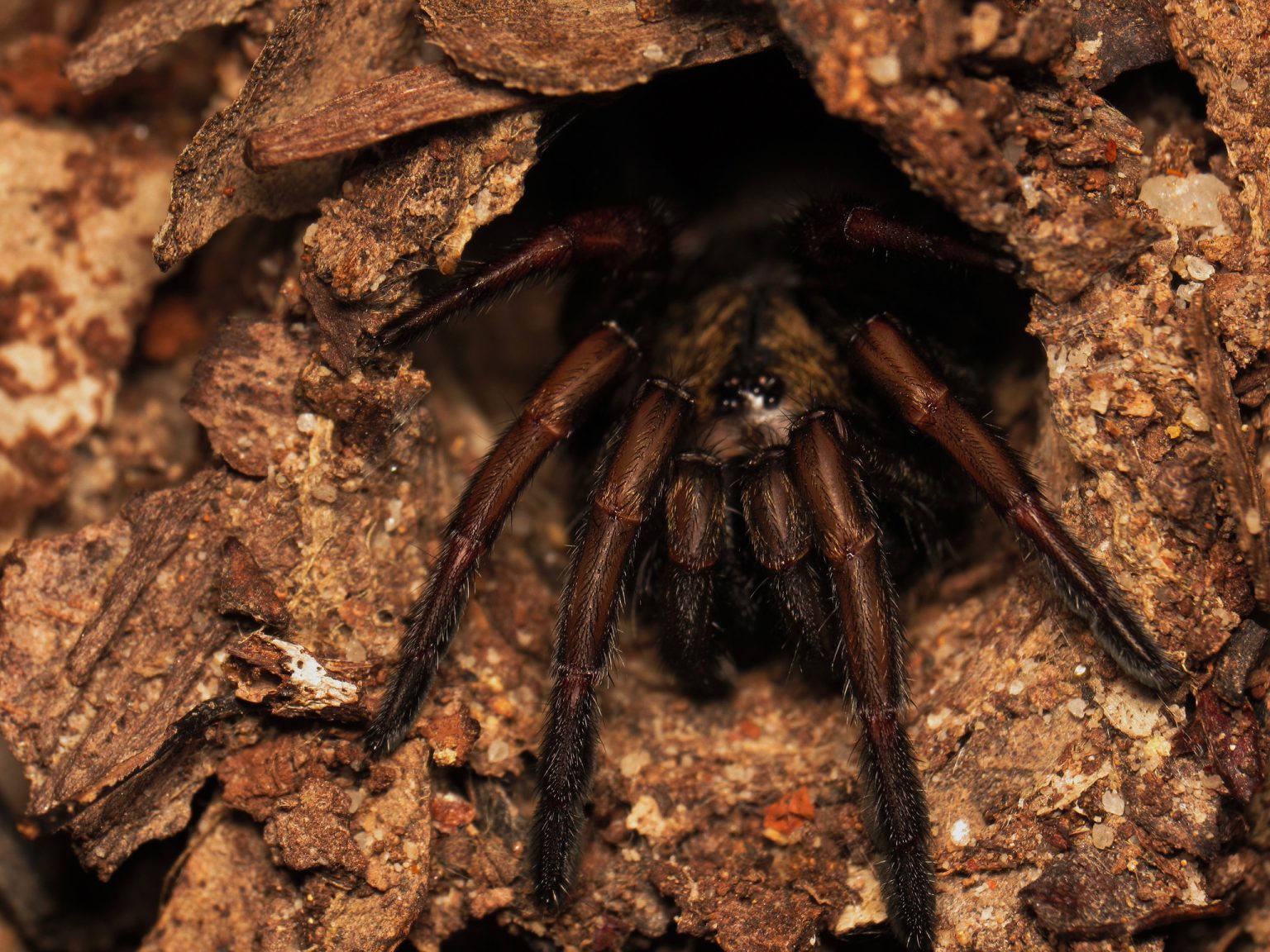
What Is a Wishbone Spider?
A wishbone spider is not a single species. The name refers primarily to Australian burrowing mygalomorphs whose silk-lined burrows may divide underground into a main shaft and a shorter concealed branch.
The genus most strongly associated with the name is Aname, a highly diverse Australian genus in the family Anamidae. The same or similar common name has sometimes been used more broadly for related open-holed trapdoor spiders. Common names therefore cannot replace a scientific identification.
These spiders belong to Mygalomorphae. Instead of using the unexplained and misleading expression “primitive spider,” it is more accurate to describe them as mygalomorph spiders and explain their anatomy. Their large chelicerae and fangs move in a more nearly parallel, downward-striking direction, rather than opposing each other in the pincer-like action seen in many araneomorph spiders.
Learn more about this major spider lineage in the Spiderpedia guide to mygalomorph spiders .
Terminology warning: “Wishbone spider,” “open-holed trapdoor spider” and “trapdoor spider” overlap in everyday usage. They do not always identify the same family, genus or burrow type.
Current Classification: Anamidae, Not Nemesiidae
Current World Spider Catalog classification recognizes Anamidae Simon, 1889 as an accepted spider family. It currently includes ten accepted genera, including Aname, Chenistonia, Namea, Hesperonatalius, Kwonkan, Proshermacha, Swolnpes, Teyl, Teyloides and Troglodiplura. [1]
Current placement:
Order Araneae → Mygalomorphae → Family Anamidae →
Genus Aname
Historical placement:
Older publications placed Aname in Dipluridae and later in
Nemesiidae. Anaminae was elevated to family level as Anamidae in 2020.
The older Nemesiidae label remains important when reading historical
literature, but it is not the current family placement.
[3]
The genera Aname, Namea and Chenistonia are separate accepted genera. Features, habitats or distributions documented for one should not automatically be assigned to the others.
Aname
The principal genus discussed in this article. It is widespread and extremely diverse in Australia, with 138 currently accepted species and many more believed to remain undescribed.
Namea and Chenistonia
These are distinct anamid genera with their own diagnostic characters and species distributions. They should not be treated as alternate names for Aname.
The 2025 Revision That Added 55 Aname Species
A major 2025 monograph in the European Journal of Taxonomy revised the Aname fauna of subtropical and tropical eastern Australia, covering the region from northern New South Wales to Cape York Peninsula. [4]
The researchers combined traditional morphology, photographs of living spiders, burrow biology, extensive fieldwork and molecular phylogenetics. The study treated 68 eastern Australian species and formally described 55 species new to science. It also redescribed valid species, restored several previously synonymized names and placed one older name into synonymy. [4]
Queensland Museum estimates that the genus may contain approximately 300 species in total and reported that roughly 60 percent remain undescribed. Many of these spiders occur in remote, dry or poorly surveyed environments. [5]
Why this matters for identification: A spider may belong to an undescribed species, or to a recently revised species whose previous name is no longer correct. A photograph-matching website cannot resolve those taxonomic problems reliably.
Wishbone Spider Identification
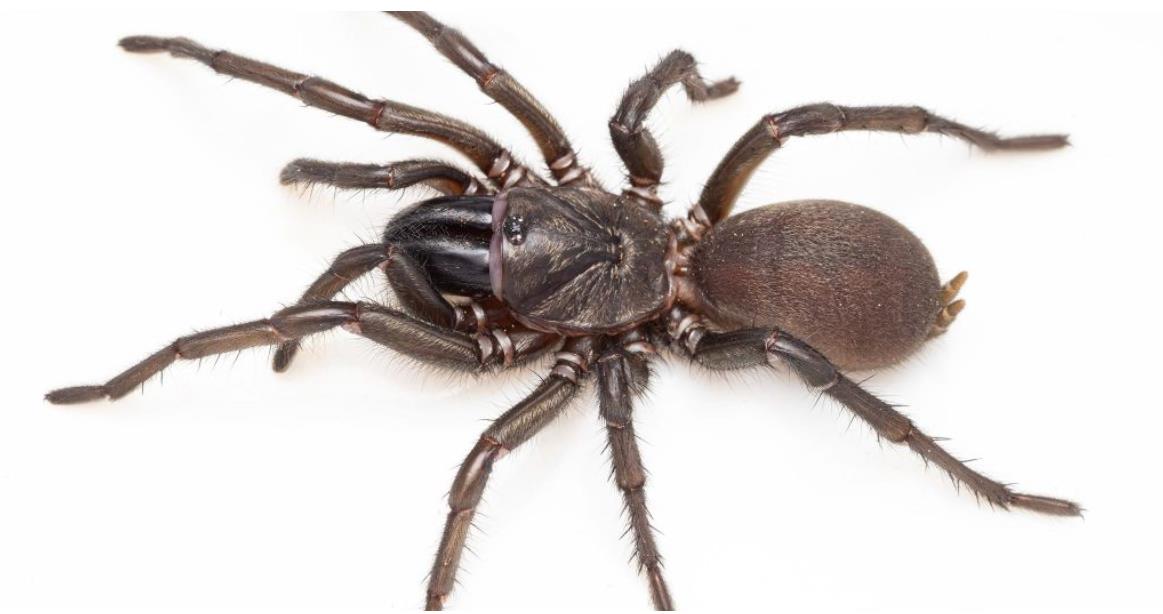
Wishbone spiders usually have the robust body, strong legs and large downward-moving fangs typical of mygalomorph spiders. Depending on the species, they may appear black, deep brown, reddish brown, bronze, grey-brown or covered in fine golden or silvery hairs.
Color is not a reliable species character by itself. Lighting, soil, moisture, age, sex, recent moulting and camera exposure can all alter the apparent color. Several unrelated mygalomorph groups can also look uniformly black or dark brown.
- A sturdy mygalomorph body with large chelicerae.
- An open, silk-lined soil burrow, sometimes with a subtle silk collar.
- Two rear spinnerets that may be visible but are generally less elongated than the prominent spinnerets of many funnel-web spiders.
- Fine bronze, golden or silver hairs in some species, but not all.
- Mature males that may have longer, more slender legs than females.
Why females are especially difficult to identify
Formal Aname diagnoses frequently rely heavily on mature male characters, including structures on the pedipalps and first legs. Western Australian Museum collection information notes that females of different Aname species can be difficult to distinguish and that reliable genus-level characters for females have historically been limited. [6]
For this reason, an isolated female, juvenile or blurred nighttime photo should usually be identified only as an unknown mygalomorph, Anamidae-like spider or possible Aname, rather than being given a confident species name.
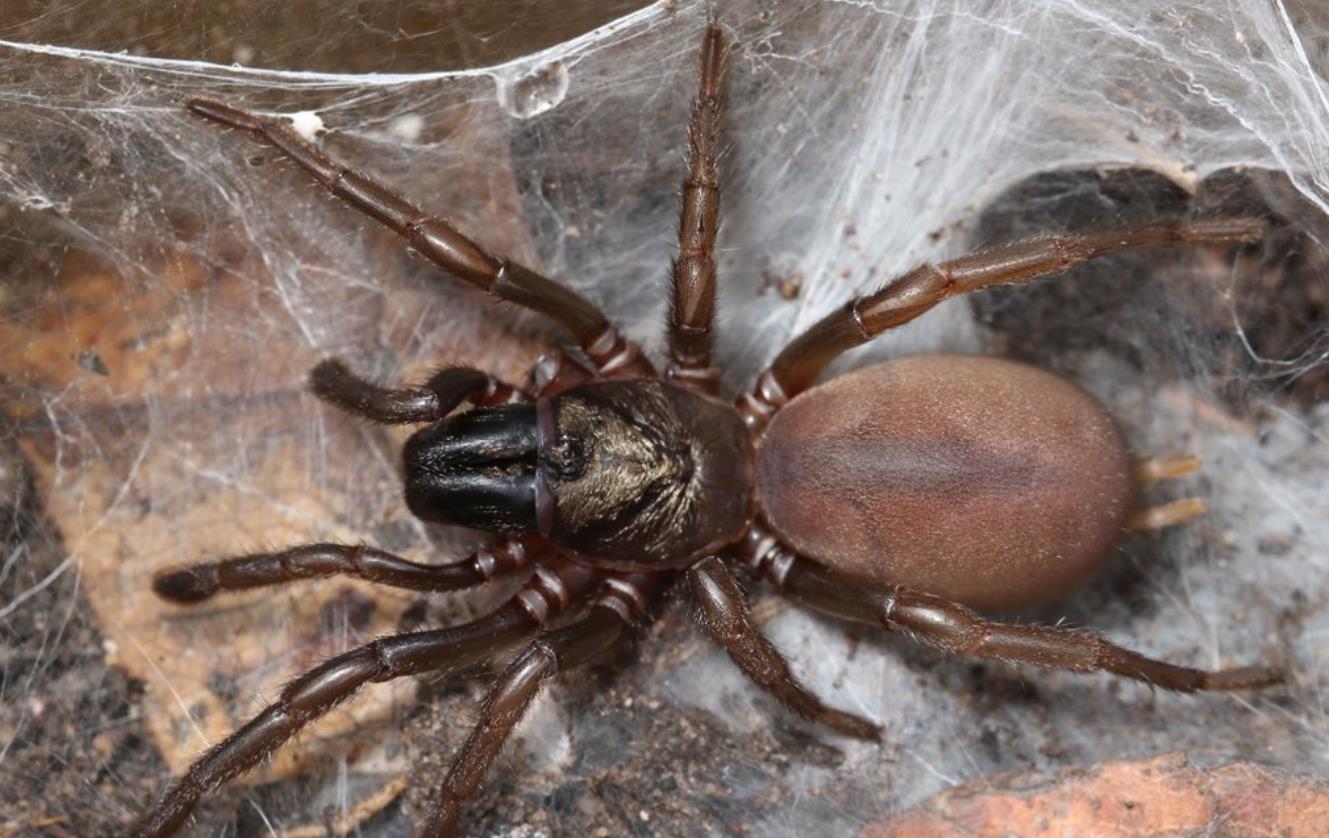
For a structured approach to photographs, habitat, body proportions and web or burrow evidence, see the Spiderpedia spider identification guide .
What Does a Wishbone Spider Burrow Look Like?
The common name comes from the underground architecture, not necessarily from a clearly visible Y-shaped pattern on the soil surface.
Many Aname species build an open, silk-lined main shaft with a shorter secondary tunnel. The second branch may remain concealed below the surface and may function as a refuge or escape route. Queensland Museum describes this hidden branch as a probable “escape chute.” [5]
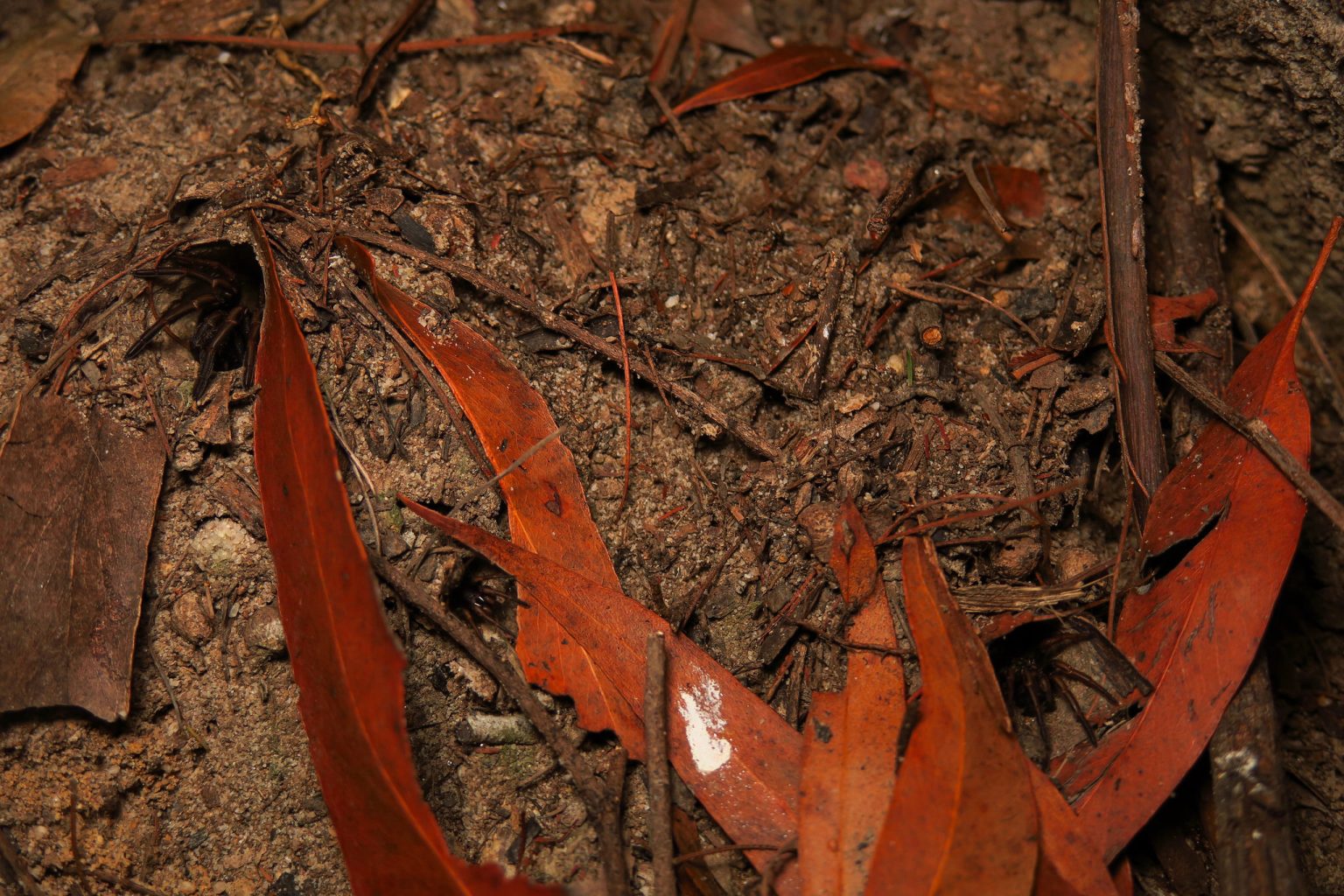
Not every burrow has the same depth, angle, entrance diameter or silk structure. These features can vary among species, life stages, soil types and local conditions. It is therefore inaccurate to give one universal wishbone spider burrow depth.
It is also unsafe to assume that every uncovered burrow belongs to Aname. Some trapdoor spiders do not build a true door, and funnel-web or mouse spider burrows can vary considerably.
Where Do Wishbone Spiders Live?
Aname is an Australian genus distributed across most of the continent, with particularly high diversity in mainland drylands, woodlands, open forests and other ground environments. Individual species, however, may occupy much smaller regions or specialized habitats. [4]
The 2025 eastern revision alone documented species from subtropical and tropical areas extending from northern New South Wales through Queensland to Cape York. Other revisions have focused on arid Western Australia and southern Australia.
A spider found in Queensland should not automatically be assigned the same name as a similar-looking spider from Western Australia. Geographic isolation is important in mygalomorph evolution, and many species have restricted distributions.
No universal range: Statements such as “wishbone spiders live throughout all of Australia” are too broad at species level. The common-name group is widespread, but each species has its own distribution.
Behavior, Hunting and Diet
Wishbone spiders are primarily burrow-based ambush predators. The spider waits inside its silk-lined retreat and responds to vibrations produced by suitable prey near the entrance.
Likely prey includes ground-active insects and other small arthropods, but the documented diet is not identical for every species. A spider may rush from the burrow, seize the prey with its legs and chelicerae, and use venom to immobilize it.
Their venom is an adaptation for feeding and defense. The fact that a spider is venomous does not by itself establish that its bite is medically dangerous to humans.
Wishbone spiders should not be credited with a specific, quantified ecological service such as “controlling pest populations” unless that effect has been studied. It is sufficient to describe them accurately as predators within their local invertebrate communities.
Females, Wandering Males and Reproduction
Female and immature Aname spiders generally live within a burrow. Western Australian Museum records describe individuals remaining in a burrow during development, while sexually mature males leave and search for adult females. [6]
Wandering males are therefore more likely than females to be found on paths, patios, roads, swimming pools or inside buildings. Their presence indoors does not mean that they normally live in houses; they may have entered accidentally while searching for a mate or shelter. [7]
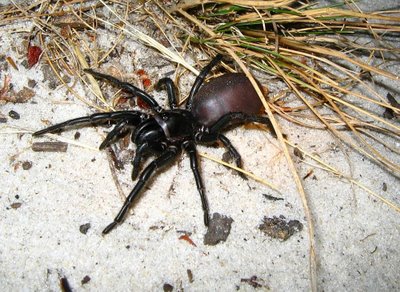
There is no single breeding or wandering season that applies to every wishbone spider across Australia. Timing varies with species, region, rainfall, temperature and local climate. Statements that all males appear in one particular month or season should be avoided.
Similarly, one lifespan, clutch size or age at maturity should not be assigned to the entire common-name group. Detailed life-history information is unavailable for many species.
What Is a Black Wishbone Spider?
“Black wishbone spider” is an informal common name, not a reliable identification based solely on color. It has a historical association with Aname diversicolor, which was originally described under the genus Dekana. Dekana is now treated as a synonym of Aname. [1] [8]
Other dark Aname species may also be casually labeled “black wishbone spiders” in photographs and field discussions. That usage should not be treated as proof that every black specimen is A. diversicolor.
A glossy black spider could instead be an Australian funnel-web, mouse spider, trapdoor spider or another mygalomorph. Color is therefore one of the least reliable ways to exclude a medically important species.
Wishbone Spider vs Funnel-Web, Mouse Spider and Trapdoor Spider
These groups can overlap in size, color and general body shape. The table provides useful context, but it is not a substitute for expert identification.
| Group | Current classification | Typical burrow or silk | Potential field clues | Human-safety context |
|---|---|---|---|---|
|
Wishbone spider Aname focus | Mainly discussed here as Anamidae, especially Aname. The common name may be used more broadly. | Open silk-lined burrow, often with a hidden secondary branch that creates a Y-shaped underground profile. | Variable black, brown, bronze or hairy appearance. Species identification is difficult, particularly for females and juveniles. | Not generally recognized as medically significant, but specific bite data are limited. Do not identify safety from color alone. |
|
Australian funnel-web spider Atrax Hadronyche Illawarra | Family Atracidae. | Silk-lined retreat or burrow, frequently with radiating trip lines. Architecture varies among species. | Often dark with a glossy, sparsely haired carapace and relatively prominent rear spinnerets. These clues are not reliable enough to rule a funnel-web out from a blurred image. | Medically significant. A suspected funnel-web bite is an emergency requiring pressure immobilization and urgent local medical assistance. [9] |
|
Mouse spider Missulena | Family Actinopodidae. | Burrow structure varies and may include a door, paired doors or a side chamber, depending on the species. | Often has a broad, bulbous head and powerful jaws. Some males have contrasting colors, while other species may be entirely black. | Potentially medically significant. Australian Museum recommends funnel-web first aid for a suspected mouse spider bite. [10] |
| Trapdoor spider | A broad common name used across several mygalomorph families. Australian examples include Idiopidae. | Some species build a hinged lid; others have an open burrow or only a silk collar. A missing door does not exclude a trapdoor spider. | Brown or dark, robust and frequently confused with funnel-web spiders. Identification depends on anatomy, burrow and locality. | Many familiar Australian trapdoor spiders are not regarded as dangerous, although bites may cause local pain and swelling. Identification uncertainty still requires caution. [11] |
Do not use this table to clear an unknown spider as safe. A dark mygalomorph photographed from above may not show the spinnerets, eye group, chelicerae, tibial spurs or other characters needed to separate these groups.
Additional Spiderpedia comparisons: how to identify a funnel-web spider , mouse spider danger and identification , and Australian trapdoor spider facts .
Are Wishbone Spiders Dangerous?
Wishbone spiders possess venom for subduing prey, but Aname and Anamidae are not generally listed among Australia’s medically significant spider groups. Published clinical information specifically identifying wishbone spider bites is limited.
Limited data do not justify saying that a wishbone spider cannot bite or that every bite is harmless. A large mygalomorph has strong fangs, and a defensive bite could cause puncture pain and local effects even when the venom is not medically important.
The main risk is mistaken identity
A person may identify an unknown dark spider as a wishbone spider when it is actually a funnel-web or mouse spider. This is why safety advice should be based on the uncertainty of the identification, not on a confident common name applied from one photograph.
Suspected funnel-web or unidentified large black spider bite: Follow current local emergency and public-health guidance. In Australia, Healthdirect advises keeping the person still, applying a pressure immobilization bandage and splint for a suspected funnel-web bite, and calling emergency services. [12]
Do not write “no treatment is required.” Medical decisions depend on the spider, symptoms, location and the advice of local health professionals. Severe pain, sweating, vomiting, breathing difficulty, muscle twitching, weakness, collapse or rapidly worsening symptoms require urgent medical care.
General information is available in the Spiderpedia spider-bite danger guide , but an online article cannot diagnose a bite.
How to Handle an Unknown Wishbone-Like Spider Safely
- Do not pick up an unknown mygalomorph with bare hands.
- Keep children and pets away from the spider and its burrow.
- Do not place fingers into a burrow or attempt to excavate it.
- Photograph the spider from a safe distance and include the burrow, location and scale when possible.
- Contact a museum, arachnologist, wildlife handler or qualified pest professional when identification or relocation is necessary.
- Do not deliberately provoke the spider to expose its fangs or defensive posture.
A wandering spider indoors can often be isolated by closing the room and keeping people away while professional advice is obtained. Advice that recommends casual container capture is inappropriate when a funnel-web cannot be excluded.
Frequently Asked Questions
Is a wishbone spider one species?
No. “Wishbone spider” is a common name used for several Australian burrowing mygalomorph spiders. It is most strongly associated with the genus Aname in Anamidae.
What family does the Aname spider belong to?
Current classification places Aname in the family Anamidae. Older publications may list it under Dipluridae or Nemesiidae because the classification changed over time.
How many Aname species are known?
World Spider Catalog Version 27 currently lists 138 accepted species. The real diversity is believed to be much greater, with many Australian species still undescribed.
What happened in the 2025 Aname revision?
The revision examined subtropical and tropical eastern Australian Aname, treated 68 species and formally described 55 species new to science using morphology, DNA, field observations and burrow biology.
Why is it called a wishbone spider?
Many species build a silk-lined burrow with a main shaft and a concealed side branch. In profile, the two tunnels resemble a Y or wishbone.
Can the Y-shaped burrow always be seen?
No. The secondary branch is often hidden underground, while only one entrance reaches the surface. Leaf litter and soil may also conceal the visible opening.
Are wishbone spiders dangerous to humans?
They are not generally recognized as a medically significant group, but species-specific bite information is limited. An unknown mygalomorph should be treated cautiously because funnel-web and mouse spiders can look similar.
What happens after a wishbone spider bite?
There is not enough verified clinical information to give one standard symptom list for all wishbone spiders. Seek medical or poison-information advice, especially when the spider was not professionally identified.
Is a black wishbone spider a funnel-web spider?
No, but the groups can look similar. “Black wishbone spider” is an informal name associated historically with Aname diversicolor. A black spider should not be identified by color alone.
How can I identify a wishbone spider?
Use locality, burrow structure, clear views of the spinnerets, chelicerae and legs, and mature reproductive anatomy. Even with good photographs, many specimens cannot be reliably identified to species.
Do female wishbone spiders leave their burrows?
Females are generally burrow-based. Mature males are more likely to wander while searching for females, although behavior and timing vary among species.
Related Spiderpedia Guides
Authoritative Sources
Classification was checked against World Spider Catalog Version 27 in July 2026. The 2025 eastern Australian revision is the primary source for current Aname diversity, taxonomy and identification limitations.
- World Spider Catalog — Anamidae Simon, 1889: current accepted genera and synonyms .
- World Spider Catalog — Current accepted species list for Aname L. Koch, 1873 .
- World Spider Catalog — Anamidae and Aname taxonomic history, including former Dipluridae and Nemesiidae placement .
- Wilson, J. D., Harvey, M. S., Simmons, L. W. & Rix, M. G. (2025). An integrative systematic revision of the wishbone spiders of subtropical and tropical eastern Australia, with the description of 55 new species. European Journal of Taxonomy 985: 1–298 .
- Queensland Museum — 55 new-to-science species of wishbone spiders, burrow biology and estimated undescribed diversity .
- Western Australian Museum Collections — Aname identification, female limitations and male dispersal .
- Western Australian Museum — Wandering male Aname and historical black wishbone spider context .
- World Spider Catalog — Aname diversicolor and the historical “black wishbone spider” taxonomic literature .
- Australian Museum — Australian funnel-web spiders, identification limits and danger to humans .
- Australian Museum — Mouse spiders, Actinopodidae, identification and funnel-web first-aid recommendation .
- Australian Museum — Australian trapdoor spiders, burrow variation, lookalikes and bite context .
- Healthdirect Australia — Current spider-bite symptoms, emergency advice and funnel-web pressure-immobilization first aid .
- NSW Agency for Clinical Innovation — Clinical management of suspected funnel-web spider bites .
Editorial identification note: The retained photographs are described conservatively at the mygalomorph or possible wishbone-spider level. They should not be assigned to an Aname species unless the original specimen, locality and diagnostic anatomical evidence are available.