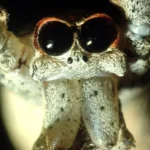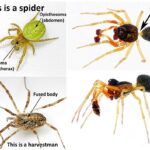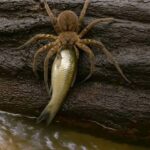
A spider with big eyes is often a jumping spider, but wolf spiders and some net-casting spiders can also appear conspicuously large-eyed. Compact spiders with two dominant forward-facing eyes usually belong to the jumping spider family. Robust ground hunters may be wolf spiders, while extremely slender spiders with two enormous eyes may be net-casting spiders. Eye size alone, however, cannot confirm an identification.
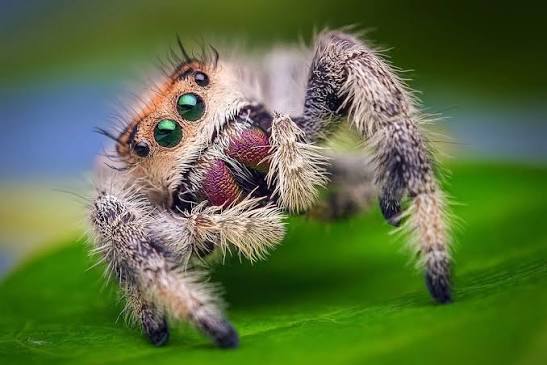
The most useful clues are the arrangement of all the eyes, overall body proportions, leg shape, movement, time of activity, web structure, habitat, and geographic location. A sharp frontal photograph can suggest a family, but confirming an exact species may require additional views or examination by an experienced arachnologist.
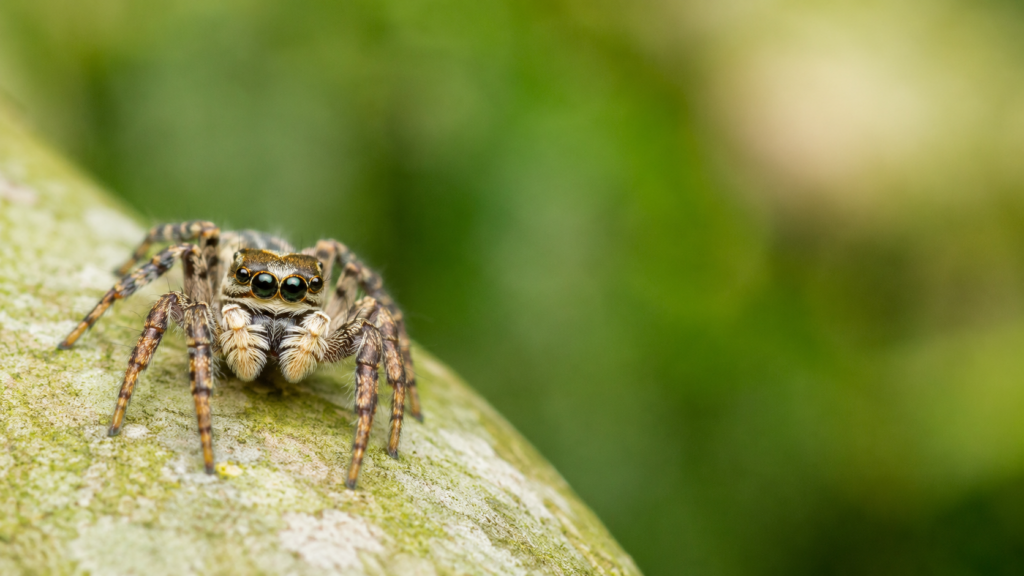
The Three Main Possibilities
| Likely group | Most useful eye clue | Body and behavior | Web clue |
|---|---|---|---|
| Jumping spiders | Two very large forward-facing central eyes | Compact body; visually tracks movement; often makes short jumps | Usually no prey-catching web |
| Wolf spiders | Two large eyes above a row of four smaller eyes | Robust ground-running hunter | Usually hunts without a capture web |
| Net-casting spiders | Two exceptionally enlarged eyes in some genera | Slender body and very long legs; mainly active at night | Holds a small capture net between the front legs |
This comparison can narrow the possibilities, but it should not be used as a species-level identification key.
Jumping Spiders: Two Large Forward-Facing Eyes
Jumping spiders belong to the family Salticidae. Their most recognizable feature is a pair of large anterior median eyes positioned at the front of the carapace. Smaller eyes surround them along the front, sides, and upper surface of the head region.
The two principal eyes provide detailed forward vision, while the secondary eyes help detect movement across a wider field. This visual system supports the precise stalking, orientation, and jumping behavior for which the family is known. Salticidae remains an accepted family in the current World Spider Catalog.
A likely jumping spider usually has several of these characteristics:
- A compact or relatively short body
- A high, broad front body region
- Two visibly dominant central eyes
- Short, controlled jumps
- A tendency to turn and face movement
- Activity in daylight or well-lit places
- No permanent prey-catching web
Jumping spiders still produce silk. They commonly use it for safety lines, resting retreats, egg sacs, and protection while molting, rather than constructing a large capture web and waiting for prey.
Color is highly variable. A jumping spider may be black, brown, gray, green, orange, patterned, iridescent, or densely covered in hairs and scales. Color alone cannot separate Salticidae from every other family.
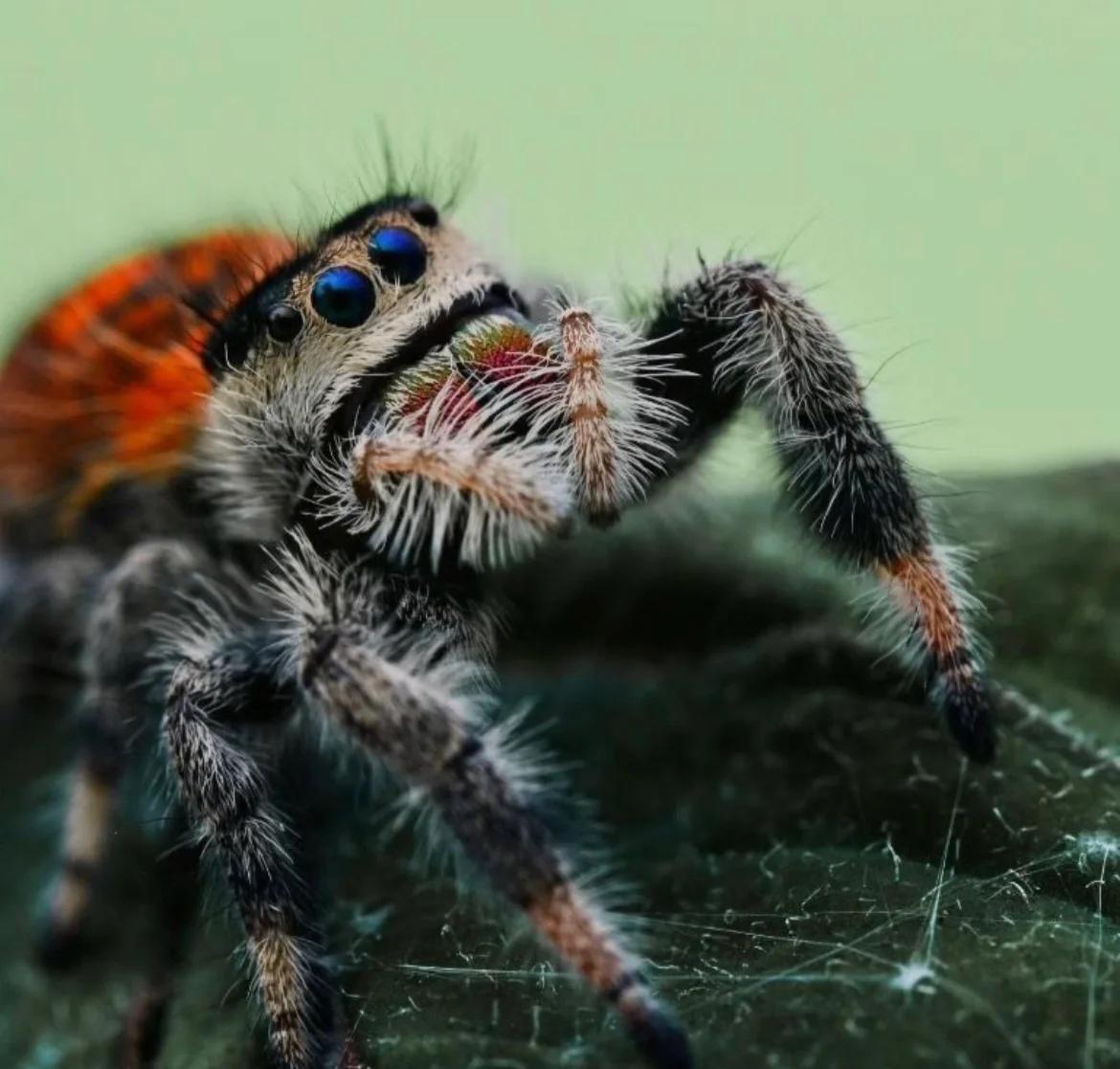
A photograph that shows only two dark circles may give the impression that the spider has two eyes. In reality, most jumping spiders have eight, although several of the smaller eyes may be hidden by the camera angle, shadows, hairs, or limited image resolution. The guide to how many eyes spiders have explains these variations in greater detail.
Wolf Spiders: Two Large Eyes Above Four Smaller Eyes
Wolf spiders belong to the family Lycosidae. Their eye arrangement is different from that of jumping spiders. A typical wolf spider has four small eyes in a lower row, two much larger eyes above them, and another pair positioned farther back on the carapace.
From a frontal angle, the two middle eyes may dominate the photograph. From above, however, the rear pair and the row of four smaller eyes may become visible. The characteristic arrangement is often more informative than body color or hairiness. Lycosidae is currently treated as an accepted family, although scientific research continues to examine relationships within the group.
Wolf spiders are generally more elongated and robust than jumping spiders. Many run across soil, leaf litter, lawns, paths, rocks, or indoor floors. Their movement is usually rapid running rather than the deliberate visual stalking and controlled leaps associated with jumping spiders.
Useful supporting clues include:
- A sturdy, ground-running body
- Brown, gray, tan, or mottled camouflage
- Four small front eyes visible under magnification
- Two large eyes in the middle row
- Two additional eyes farther back
- Strong eyeshine when illuminated at night
- No large orb or tangled capture web nearby
Some wolf spiders use burrows or silk-lined retreats, and behavior varies across the family. The absence of a visible web therefore supports an identification but does not prove it.
A female carrying a round egg sac attached behind her abdomen is strong evidence for Lycosidae. After hatching, wolf spider young may ride on the female’s abdomen for a period. These behaviors are much more informative than a general description such as “large brown spider.”
Net-Casting Spiders: Two Exceptionally Large Eyes
Net-casting spiders belong to the family Deinopidae. Some members of this family have the most visually exaggerated pair of eyes among the spiders likely to appear in identification photographs.
Species in the genera Deinopis and Asianopis may have two enormous posterior median eyes accompanied by six much smaller eyes. The current World Spider Catalog recognizes Asianopis, Deinopis, and Menneus within Deinopidae. Members of Menneus do not necessarily show the same extremely enlarged-eye appearance, so “ogre-faced spider” should not be treated as a visual description of every species in the family.
Net-casting spiders differ sharply from compact jumping spiders. Typical clues include:
- A narrow, elongated body
- Very long, slender legs
- Twig-like camouflage
- Two extremely prominent eyes in certain genera
- Nocturnal activity
- A resting posture among stems, branches, or foliage
- A small rectangular or net-like web held between the front legs
Instead of waiting in a conventional stationary capture web, a net-casting spider holds a small expandable silk net and places it over passing prey. This distinctive hunting method is one of the strongest identification clues.
Readers comparing a long-bodied nocturnal spider can consult the standardized guide to ogre-faced and net-casting spiders. The older duplicate Deinopidae page should not be used.
Why Large Eyes Alone Cannot Identify a Spider
“Big eyes” is a relative description. A macro lens may make small eyes look enormous, while flash can create bright reflections that merge several eyes into one apparent spot. Hairs, markings, motion blur, and an oblique camera angle may also hide part of the eye pattern.
Eye arrangement is usually more useful at the family level than at the species level. Two spiders in the same family may share a recognizable pattern while differing in markings, proportions, mature reproductive structures, and geographic distribution.
For a reliable identification, combine the eyes with the following evidence:
Geographic location
Record the country and the state, province, territory, or general region. A visually similar spider from another continent is not automatically a plausible match.
Overall body shape
Decide whether the spider is compact and high-bodied, robust and ground-running, or extremely slender and long-legged.
Activity period
A visually alert spider moving on a wall in daylight is more consistent with many jumping spiders. A long-legged spider preparing a silk net at night suggests Deinopidae. A fast runner crossing soil or flooring may suggest Lycosidae, but other hunting families can behave similarly.
Web structure
Jumping spiders normally use silk for retreats and safety lines. Many wolf spiders hunt without a prey-catching web. Net-casting spiders construct and actively manipulate a small capture net.
Habitat
Record whether the spider was found on a wall, tree trunk, leaf, flower, lawn, forest floor, wetland margin, branch, or inside a building. The immediate microhabitat is often more useful than a broad label such as “outdoors.”
The broader spider identification guide explains how to combine location, body shape, legs, markings, eyes, web type, habitat, and behavior without forcing an unsupported species name.
How to Photograph a Big-Eyed Spider for Identification
Take photographs without touching, cornering, or provoking the spider. Optical zoom or a macro lens is safer than placing your face close to an unknown animal.
Try to record:
- A clear view from above
- A frontal view taken from a safe distance
- A side view showing body height and leg proportions
- The complete web or silk structure
- The surface or plant on which the spider was found
- A wider habitat photograph
- The date and general geographic location
- An estimate of body length excluding the legs
Do not place a hand, coin, ruler, or other object beside a live unknown spider. A ruler can be photographed against the same surface after the spider has moved.
Even a good photograph may support only a family or genus identification. Closely related species can require microscopic examination of mature anatomical structures. A cautious family-level answer is more accurate than a confident species name based only on facial appearance.
Are Spiders With Big Eyes Dangerous?
Large eyes do not indicate medically significant venom. Eye size reflects sensory biology and hunting behavior, not the severity of a possible bite.
Most true spiders are venomous in the biological sense that they use venom delivered through their fangs to subdue prey. “Venomous” is not the same as “poisonous”: venom is injected, whereas poison causes harm through ingestion, contact, or absorption.
A venomous animal is not automatically dangerous to people. “Dangerous” is a practical description of risk, while “medically significant” refers to species whose bites can produce clinically important effects under relevant conditions.
Jumping spiders, wolf spiders, and net-casting spiders are not generally grouped with the spiders most widely recognized for medically significant bites. This does not mean that every possible bite is incapable of causing pain, local irritation, or an individual reaction. Unknown spiders should not be handled.
Spider bites also cannot be diagnosed reliably from the appearance of a skin lesion. Many wounds, infections, and other conditions are incorrectly attributed to spiders when no spider was observed. Official poison guidance notes that some spider bites can cause harm and recommends contacting an appropriate poison center or medical professional when a bite is suspected or symptoms are concerning.
Seek urgent medical assistance for breathing difficulty, collapse, severe or spreading pain, substantial muscle cramping, repeated vomiting, rapidly worsening symptoms, or another serious systemic reaction. Follow the guidance of local emergency services, healthcare professionals, or the poison information service for your country.
This information is educational and does not replace advice from a doctor, emergency responder, or local poison center.
What to Do When You Find an Unknown Spider
Leave an outdoor spider undisturbed when it is not creating an immediate problem. Spiders are predators of insects and other small arthropods and usually attempt to escape or remain concealed rather than interact with people.
For a low-risk indoor relocation:
- Keep children and pets away.
- Place a clear container over the spider without touching it.
- Slide a stiff piece of card beneath the container.
- Carry the closed container outside and release the spider away from frequently used entrances.
Do not attempt this when local medically significant species are possible, when the spider is inside a difficult crevice, or when safe containment is uncertain. Close off the area and contact a qualified local professional instead.
The most defensible identification of a spider with big eyes may be “jumping spider,” “wolf spider,” or “net-casting spider” rather than an exact species. Confirm the answer by checking the complete eye pattern, body structure, behavior, web, habitat, and geographic range together.