Spider Webs in House Corners: Why They Appear
Spider webs appear in house corners because these spaces offer shelter, places to attach silk, and opportunities to catch insects. The junction between a wall and ceiling can support a web while keeping it away from everyday activity. Corners near windows, doors, and quiet storage areas can be especially suitable.
Finding a few webs does not necessarily mean your home has a spider infestation or that it is dirty. Some webs belong to spiders still living nearby. Others are old silk structures left behind after the spider has moved or died.
Understanding the difference can help you decide whether simple cleaning is enough or whether something is encouraging spiders to return.
Why Do Spiders Build Webs in House Corners?
A corner might seem like an unremarkable part of a room, but for a web-building spider, it can offer several advantages.
1. Corners Provide Reliable Attachment Points
Spiders attach silk to surrounding surfaces to support their webs. Where two walls meet, or where a wall joins the ceiling, several attachment surfaces are close together.
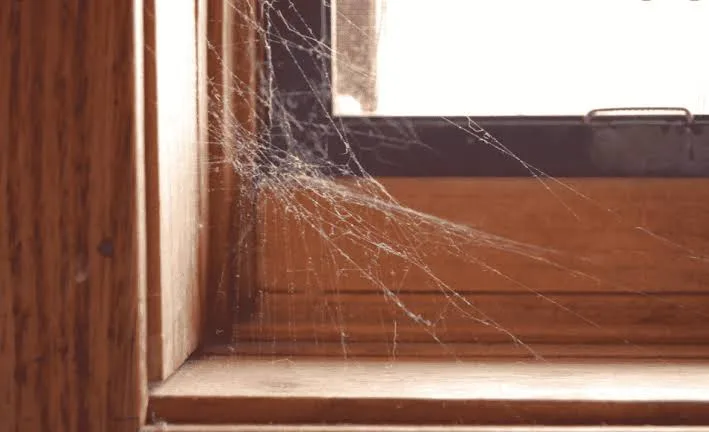
This makes corners useful for building irregular three-dimensional webs.
The common house spider, Parasteatoda tepidariorum, is a familiar example in North America and many other regions. It belongs to the cobweb spider family, Theridiidae, and frequently builds tangled webs around windows, wall junctions, and other sheltered structures.
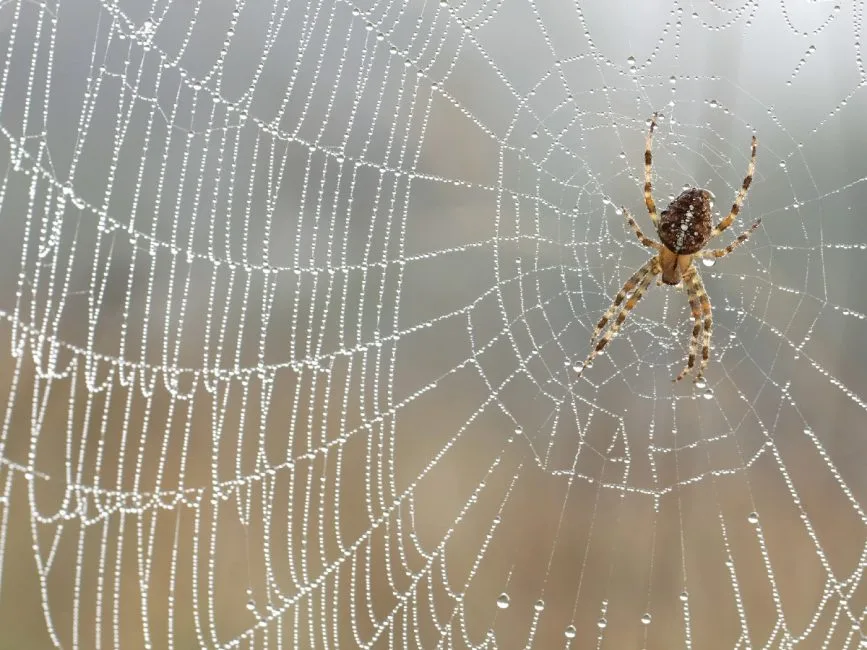
Unlike an orb-weaver’s familiar circular web, its silk network often looks disorganized.
That irregular appearance is normal.
2. Corners Are Often Undisturbed
Spiders benefit from locations where their webs are unlikely to be damaged repeatedly.
The upper corner of a bedroom may remain untouched for weeks. Spaces behind furniture, beneath shelves, and around basement joists can be even less disturbed.
A spider occupying one of these positions can wait for prey without frequently rebuilding after accidental damage.
This explains why webs sometimes appear in places that are difficult to reach with a normal duster.
3. Insects Provide a Food Source
Many web-building spiders capture small insects and other arthropods.
If flies, moths, gnats, or other tiny insects regularly move through a particular area, a spider may benefit from building a web nearby.
Window corners can be useful because insects enter through gaps, gather near light, or move along window frames.
A spider does not need a large number of insects every day. Even occasional successful captures can make a sheltered location worth occupying.
For more information, see what house spiders eat.
4. Some Indoor Areas Offer Favorable Conditions
Basements, crawl spaces, garages, and storage rooms often contain protected spaces suitable for spiders.
Some also provide humidity, insect prey, or numerous hiding places.
However, not every web-building spider prefers damp conditions. Different species occupy different indoor microhabitats, including relatively dry locations.
The presence of a web alone cannot tell you whether a room has a moisture problem.
Why Are Spider Webs So Common in Ceiling Corners?
Ceiling corners combine several features that can make them suitable for spiders.
They are above most household activity, offer nearby attachment surfaces, and may be close to window frames, vents, or light fixtures where insects occasionally pass.
Many people also clean ceiling corners less frequently than floors, countertops, or furniture.
That matters because an abandoned spider web can remain in place long after the original spider disappears.
Eventually, airborne dust and other particles collect on the silk, making it more visible.
A ceiling corner that suddenly looks full of cobwebs may therefore contain webs that have been present for some time.
The webs have not necessarily appeared overnight.
Cobwebs vs. Active Spider Webs: How to Tell the Difference
People often use the word cobweb for a tangled, dusty spider web.
In everyday speech, it frequently refers to old spider silk, although the term can also describe the irregular webs made by cobweb spiders.
The distinction is useful when deciding whether a spider is still occupying a particular corner.
| Feature | Active web | Old or abandoned web |
|---|---|---|
| Appearance | Often relatively clean, with visible silk structure | May look gray, dusty, or collapsed |
| Spider present | May be visible or hidden nearby | Usually no resident spider |
| Captured insects | May contain fresh prey | May contain old debris |
| Silk condition | Often maintained or repaired | May be broken or sagging |
| What it suggests | Possible ongoing spider activity | Evidence of earlier activity |
These are clues rather than absolute rules. A spider can hide out of sight, and an old web may not immediately become dusty.
Oregon State University Extension explains that apparently mysterious strands of indoor cobwebbing often originate from spider silk that later collects airborne dust.
Dust does not normally arrange itself into long, suspended spider-web strands.
What Spiders Make Webs in House Corners?
Several spider groups can produce webs in indoor corners. Web shape can help narrow down the possibilities, but it rarely identifies an exact species by itself.
Common House Spiders
The common house spider, Parasteatoda tepidariorum, is a widespread cobweb-building species.
It often constructs irregular networks of silk in sheltered areas of buildings.
In North American homes, it is one possible explanation for tangled webs around windows, ceilings, and furniture.
Cellar Spiders
Cellar spiders belong to the family Pholcidae.
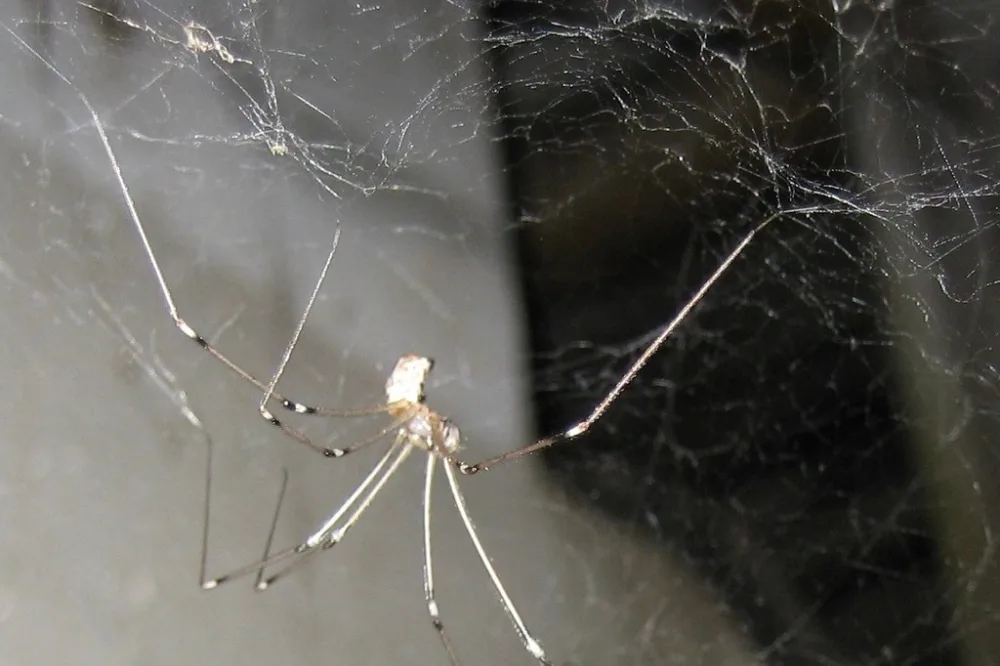
Many have relatively small bodies and unusually long, thin legs. They commonly occupy ceilings, basements, garages, and other protected areas.
Their webs are loose, irregular structures. Some cellar spiders vibrate rapidly when disturbed, which can make their bodies appear blurred.
A long-legged spider hanging upside down in a delicate corner web may be a cellar spider, although identification requires more than leg length alone.
Other Cobweb-Building Spiders
Other members of Theridiidae can also build tangled webs in buildings.
These include some Steatoda species and, in regions where they occur, widow spiders.
Because several groups construct similar webs, an irregular corner web should not automatically be attributed to the common house spider.
Spider identity depends on location, body shape, markings, and other visible features.
For help comparing these clues, consult the Spider Identification Guide.
Why Do Spider Webs Keep Coming Back After Cleaning?
Removing a web does not necessarily change the conditions that made its location useful.
If a corner remains sheltered and small insects continue passing through it, the original spider may rebuild nearby. Another spider may eventually occupy the same general area.
Common house spiders sometimes abandon unsuccessful webs and construct new ones elsewhere, leaving multiple webs behind.
This can create the impression that spiders are multiplying rapidly, even when some of the visible webs are empty.
Recurring webs can have several explanations:
- A resident spider is rebuilding after its web was removed.
- Another spider has settled in the same suitable location.
- Insects continue entering through nearby gaps.
- Old webs remain in neighboring corners.
- Storage clutter provides additional sheltered locations.
The most useful response is to look at the surrounding conditions rather than simply removing the same strands repeatedly.
A sudden increase in webs also does not prove an infestation. It is a reason to inspect the area more carefully.
Spider Webs in the House but No Spiders: What Does It Mean?
Finding webs without seeing a spider is common.
The most straightforward explanation is that the original spider has left, died, or relocated.
Some webs remain suspended long enough to collect dust even after they are no longer being used.
Another possibility is that the spider is still nearby but concealed in a crack, behind furniture, or in a retreat connected to the silk.
Certain spiders are less conspicuous during daylight, so an empty-looking web is not conclusive evidence that its occupant has disappeared.
Look for recently added strands, fresh prey, or activity around the web before making assumptions.
There is no need to handle an unidentified spider to investigate.
How to Prevent Spider Webs in House Corners
Completely eliminating indoor spider webs may be unrealistic, especially in buildings with open windows, garages, or easy access from outdoors.
However, several practical steps can reduce recurring webs.
Remove Old Webs Regularly
Use a vacuum cleaner with an extension attachment or a long-handled duster to reach ceiling corners.
Pay attention to window frames, shelving, spaces behind furniture, and other areas where webs accumulate.
Removing abandoned silk prevents old cobwebs from becoming increasingly noticeable.
Seal Common Entry Points
Inspect gaps around windows, doors, foundations, and other openings.
Repair damaged screens and use suitable weatherstripping or sealants where needed.
This helps limit entry by both spiders and the insects they feed on.
Reduce Indoor Insect Activity
If you regularly see small flies, moths, or gnats, investigate where they are coming from.
Proper food storage, routine cleaning, intact window screens, and addressing specific moisture-related insect problems may help reduce prey availability.
Outdoor lights near doors and windows can also attract flying insects, creating opportunities for spiders nearby.
Reduce Clutter in Storage Areas
Stacks of cardboard boxes, unused household items, and crowded shelves create protected spaces that are difficult to inspect or clean.
Keeping storage areas organized and leaving some access around walls makes maintenance easier.
Relocate Spiders When Appropriate
If an ordinary, safely identifiable house spider is somewhere inconvenient, it may be possible to guide it into a container without direct handling.
Avoid touching an unknown spider, particularly in a region where medically significant species occur.
For ordinary household spider activity, chemical insecticides are often unnecessary. Cleaning, exclusion, and reducing insect access are sensible first steps.
Are Spider Webs in House Corners Dangerous?
The web itself is generally a household nuisance rather than a direct danger.
Many common indoor spiders help capture small insects and pose little risk when left undisturbed.
However, a web’s location or irregular shape cannot establish that its maker is harmless.
Some medically significant spiders also build irregular webs. Their occurrence varies considerably by geographic region.
If you see an unfamiliar spider in a garage, storage area, or other sheltered location, avoid placing bare hands into the web or surrounding clutter.
Look at the spider’s physical characteristics and regional distribution before attempting identification.
A single corner web is not evidence that dangerous spiders have established themselves in your home.
Frequently Asked Questions
Why do spider webs appear in the same corner every week?
The corner may continue offering shelter, good attachment surfaces, and opportunities to capture insects. A spider may rebuild its web, or another spider may use a similar location.
Do spider webs mean my house is dirty?
No. Spiders can build webs in clean homes. However, neglected corners allow old silk to accumulate dust, making the webs more noticeable.
Can spider webs appear without spiders?
A spider must have produced the original silk, but it does not need to remain there. An abandoned web can persist after its maker has moved or died.
Why are there so many spider webs in my basement?
Basements often contain quiet corners, exposed structural supports, stored objects, and protected spaces. Some also support insects that serve as spider prey.
Should I remove spider webs from ceiling corners?
You can remove them as part of routine cleaning. If webs repeatedly return, inspect the area for spiders, entry gaps, and insect activity rather than relying on dusting alone.
Do spiders always build webs to catch insects?
No. Many spiders use silk for shelters, egg sacs, safety lines, and other purposes. Some, including jumping spiders and wolf spiders, hunt without constructing permanent prey-catching webs.
The Bottom Line
Spider webs appear in house corners because these spaces often provide suitable support, shelter, and opportunities to catch prey.
A dusty web may simply be evidence of a spider that has already moved on. A repeatedly rebuilt web suggests the location still offers favorable conditions.
Regular cleaning, sealing entry points, and reducing indoor insect activity can help limit recurring webs without treating every spider sighting as a serious problem.
For more about the different ways spiders use silk, explore Spider Behavior.