Quick answer: A brown spider with long legs in your house is not a single species. In North America, common possibilities include cellar spiders, funnel weavers such as house spiders, and wandering male southern house spiders. A brown recluse is only one regional possibility and should not be identified from color or a violin-like mark alone. Start with your location, the web, body shape, spinnerets, leg proportions and eyes.

A spider cannot usually be identified reliably from color alone or from one blurry photograph. “Brown” and “long-legged” describe many unrelated spiders, and the same individual can look lighter, darker or less patterned under different lighting.
If you are trying to identify an unknown spider, combine several characters rather than searching for a single mark. Geographic location, body shape, actual body size, leg proportions, markings, eye arrangement, spinnerets, web architecture, habitat and behavior all matter. Spiderpedia’s spider identification guide explains this process in more detail.
Which Brown Long-Legged Spider Is in Your House?
For a North American household sighting, the following groups are useful starting points. This is a narrowing tool, not a substitute for examination of a specimen or detailed photographs.
| Possible spider | Useful clues | Web or behavior | Where it is especially relevant |
|---|---|---|---|
| Cellar spider Pholcidae | Very small body with extremely long, fine legs | Hangs in a loose three-dimensional web; may vibrate rapidly when disturbed | Basements, garages, ceilings, crawl spaces and quiet corners |
| Funnel weaver Agelenidae | Brown patterned body, long legs and often conspicuous spinnerets at the rear | Sheet of silk leading to a funnel-shaped retreat; may run rapidly | Basements, garages, foundations, sheds and ground-level rooms |
| Southern house spider Kukulcania hibernalis | Adult male is tan-brown, slender and long-legged, with conspicuously elongated pedipalps | Females and juveniles occupy woolly-looking silk around a crevice; adult males wander | Especially the southern United States and warmer regions of the Americas |
| Huntsman spider Sparassidae | Flattened body with legs extending noticeably sideways | Active hunter rather than a prey-catching web builder | Especially tropical and subtropical regions |
| Brown recluse Loxosceles reclusa | Plain tan-to-brown body, six eyes in three pairs, relatively uniform legs without obvious bands | Does not sit in a conventional prey-catching web; hides in secluded sites | Established mainly in the south-central and parts of the Midwestern United States |
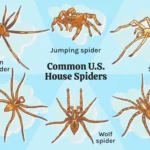
For a broader comparison of spiders that live in or wander into buildings, see Spiderpedia’s guide to common house spiders in North America.
1. Cellar Spiders: Extremely Long, Threadlike Legs
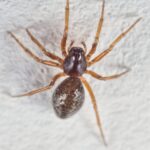
If the legs look disproportionately long compared with a tiny central body, a cellar spider is one of the strongest possibilities. Cellar spiders belong to the family Pholcidae. One familiar building-associated species is the long-bodied cellar spider, Pholcus phalangioides, an accepted species in the family Pholcidae that has been introduced widely outside its original western Asian range.
Behavior is often more useful than color. Cellar spiders commonly hang beneath loose, irregular webs in ceiling corners, basements, garages, cellars and other sheltered parts of buildings. When disturbed, some rapidly shake or vibrate in their webs until their outline becomes difficult to see.
Their color can range from pale tan or grayish to brownish, so a homeowner may describe them simply as a “brown spider with really long legs.” The combination of a tiny body, exceptionally thin legs and hanging posture is much more informative than the brown coloration.
Safety: Cellar spiders possess venom used on prey, but they are not considered medically significant spiders. The old claim that they have exceptionally dangerous venom but cannot bite humans is not a reliable description of their biology. See cellar spider bite and safety facts.
2. Funnel Weavers and House Spiders
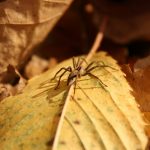
A brown spider with long legs running across a basement or garage floor may instead be a funnel weaver in the family Agelenidae. This is a large family containing many similar-looking species, and photographs do not always allow identification to species level.
A particularly useful clue is the web. Many funnel weavers build a horizontal or slightly curved sheet of silk that narrows into a protected funnel retreat. The spider waits near the entrance and can move very quickly across the web when prey lands on it.

The domestic house spider, Tegenaria domestica, is one building-associated funnel weaver with a very broad introduced distribution. Other house-associated agelenids include species of Eratigena, including giant house spiders in regions where they occur.
Look especially for:
- a patterned rather than uniformly plain abdomen;
- long but sturdier legs than those of a typical cellar spider;
- paired spinnerets visibly projecting from the rear of the abdomen in some species;
- a sheet-and-funnel web;
- rapid running when disturbed.
Funnel weavers are commonly confused with wolf spiders and brown recluses. The combination of abdominal patterning, web architecture and prominent spinnerets can quickly move an identification away from a recluse.
3. Male Southern House Spiders Can Look Recluse-Like
In warmer parts of the Americas, especially the southern United States, a long-legged tan spider may be a male southern house spider, Kukulcania hibernalis, family Filistatidae.
This species shows strong differences between the sexes. Females are comparatively robust and dark, while adult males are lighter, narrower and much leggier. University of Florida entomologists specifically note that males are often mistaken for brown recluses because of their general shape and coloration.
Useful clues include the male’s unusually long pedipalps—the paired appendages beside the mouth—and an eye arrangement that does not match a recluse. Southern house spiders have eight eyes, whereas recluse spiders have six.
The web can also help. Females and juveniles build distinctive woolly-looking cribellate silk around cracks, holes, window frames, masonry and other sheltered crevices. Adult males leave these sites and wander while looking for females, which is why a homeowner may suddenly see a lanky brown male crossing a wall or floor.
4. Huntsman Spiders: Long Legs That Extend Sideways
Readers outside the cooler parts of North America should not assume the same candidate list applies. In tropical and subtropical areas, huntsman spiders in the family Sparassidae are another important possibility.
Huntsman spiders usually have a distinctly flattened body and laterigrade legs—legs rotated so that they extend more sideways than the legs of a typical funnel weaver or recluse. This gives some species a broad, crab-like stance.
They are active hunters rather than builders of prey-catching webs and may turn up on walls, ceilings, behind furniture or around buildings. Exact identification depends strongly on geographic region because Sparassidae contains many species worldwide.
Is a Long-Legged Brown Spider a Brown Recluse?
Not necessarily. In fact, brown recluse is one of the most frequently over-applied spider identifications in North America. Many unrelated spider species can appear small and brown. Long legs, indoor habitat or a dark mark on the front of the body do not establish a recluse identification.
The accepted scientific name of the brown recluse is Loxosceles reclusa, family Sicariidae. Its established range is concentrated in the south-central United States and portions of the Midwest. Individual spiders can occasionally be transported elsewhere, but a mystery brown spider far outside the established range should not automatically be labeled a brown recluse.

Brown recluse identification requires multiple traits
A possible brown recluse should be evaluated using a combination of features:
- Geographic range: Is the spider actually in a region where Loxosceles reclusa is established?
- Eyes: Brown recluses have six eyes arranged in three pairs rather than the eight eyes typical of many common house-spider groups.
- Legs: The legs are comparatively uniform in color and lack the conspicuous banding and strong projecting spines found on many lookalikes.
- Abdomen: The abdomen is usually relatively plain rather than strongly striped, chevroned or mottled.
- Web: A brown recluse does not occupy the conspicuous sheet-and-funnel capture web characteristic of an agelenid funnel weaver.
- Overall anatomy: All traits must agree; one dark mark is not sufficient.
Do not try to confirm the eye arrangement by handling an unknown live spider or moving your face close to it. Use a clear photograph with optical or macro magnification, or obtain professional identification if the distinction matters for safety.
Why the “violin mark” is not enough
The dark violin- or fiddle-like mark associated with brown recluses can be useful as part of a complete identification, but many unrelated spiders have dark lines, shadows or markings on the cephalothorax.
Some cellar spiders, crevice weavers, funnel weavers and other brown spiders are repeatedly submitted to experts as suspected recluses. Geography, eye arrangement, leg structure and overall body pattern should all be checked before the name “brown recluse” is used.
A Five-Step Identification Checklist
- Record the location. Country, state or province can eliminate many impossible species immediately.
- Look at the web before disturbing it. A loose ceiling web, funnel retreat, woolly crevice web or absence of a capture web can be highly informative.
- Compare body-to-leg proportions. A cellar spider has a very different silhouette from a funnel weaver, southern house spider or huntsman.
- Photograph the spider from above and, if safely possible, from the side. Do not handle it for a photograph.
- Check diagnostic structures. Spinnerets, leg banding, pedipalps and eyes are often more useful than overall color.
What Do the Web and Location Tell You?
| What you observe | Possibility to investigate |
|---|---|
| Tiny body hanging in a loose web with extremely long threadlike legs | Cellar spider, family Pholcidae |
| Brown spider beside a horizontal sheet leading into a funnel | Funnel weaver, family Agelenidae |
| Tan long-legged male near a window frame or masonry crevice in the southern U.S. | Southern house spider, Kukulcania hibernalis |
| Large flattened spider with legs splayed sideways in a warm climate | Huntsman spider, family Sparassidae |
| Plain tan spider in an undisturbed storage area within established recluse range | Possible Loxosceles; anatomy still needs confirmation |
| Patterned, hairy spider running on the floor with no capture web | Wolf spider or another wandering ground hunter |
Can a Photo Identify the Exact Species?
Sometimes, but not always. A good photograph can often support identification to a family, genus or distinctive species. Exact species identification becomes more difficult when several close relatives share the same general appearance.
In some spider groups, reliable species-level identification requires an adult specimen and examination of structures such as the mature male pedipalps or female reproductive anatomy under magnification. Juveniles may not yet possess the characters needed for a formal species-level identification.
That is why “funnel weaver,” “cellar spider” or “southern house spider” can be a scientifically better answer than forcing an uncertain species name from an unclear photograph.
Are Brown Long-Legged House Spiders Dangerous?
Risk depends on the species. It is useful to separate several terms that are often treated as synonyms:
- Venomous means an animal delivers venom, usually through a bite or sting.
- Poisonous usually describes an organism or substance that causes harm when eaten, absorbed or touched. It is generally not the appropriate term for spider venom.
- Dangerous refers to the practical likelihood of causing significant harm to people.
- Medically significant refers to spiders whose bites can produce clinically important effects.
Cellar spiders, common funnel weavers and southern house spiders are not regarded as medically significant in ordinary household encounters. Brown recluse spiders are medically significant, but that does not mean every brown indoor spider should be treated as a recluse.
Avoid handling an unknown spider with bare hands. If removal is necessary, use a method that keeps your hands away from the animal, or seek assistance if you believe a medically significant species may be present.
Do Not Diagnose a Spider Bite From a Skin Lesion
Skin lesions have many possible causes, and spider bites are often difficult to confirm without seeing or identifying the spider involved. Redness, swelling, itching, blistering, pain, ulceration or tissue damage does not by itself prove that a spider—much less a particular spider species—was responsible.
Brown recluse bites can cause medically important local injury and, less commonly, systemic illness. If a suspected bite is becoming rapidly worse, produces severe pain or substantial tissue changes, or is accompanied by systemic symptoms such as fever, weakness, vomiting, breathing difficulty or other concerning symptoms, seek appropriate local medical care. A poison center can also provide region-specific advice.
Frequently Asked Questions
What is the most likely brown spider with long legs in a house?
There is no single answer. A spider with extremely long, delicate legs hanging in a loose indoor web strongly suggests a cellar spider. A patterned spider associated with a sheet-and-funnel web suggests a funnel weaver. In the southern United States, a wandering male southern house spider is another important possibility.
Does a brown spider with long legs mean brown recluse?
No. Long legs and brown coloration occur in many unrelated spider families. A credible brown recluse identification requires the correct geographic range plus a matching combination of eye arrangement, body pattern, leg characteristics and other anatomical features.
What spider looks like a brown recluse but has very long legs?
Adult male southern house spiders are well-known recluse lookalikes in warmer parts of the Americas. Cellar spiders and several funnel weavers can also be misidentified as recluses, although their web, proportions and other anatomical details are different.
What if the spider has long spinnerets on the back?
Two conspicuous projections extending beyond the rear of the abdomen are a useful clue for several funnel-weaving spiders, particularly grass spiders and related agelenids. That feature does not fit a brown recluse.
Why did a long-legged spider suddenly appear on my floor?
Some adult male spiders leave established webs or retreats to search for females. Outdoor hunting spiders may also enter through gaps around doors, foundations or windows. A single wandering spider therefore does not necessarily mean there is an indoor infestation.
References and Further Reading
- Natural History Museum Bern, World Spider Catalog. Loxosceles reclusa Gertsch & Mulaik, 1940 .
- Natural History Museum Bern, World Spider Catalog. Pholcus phalangioides (Fuesslin, 1775) .
- University of Florida IFAS Extension. Southern House Spider, Kukulcania hibernalis (Hentz) .
- Colorado State University Extension. Spiders in the Home .
- University of Kentucky Department of Entomology. Brown Recluse Spiders .
- Poison Control. Brown Recluse Spider Bites: Know the Signs, Reduce the Risks .