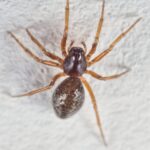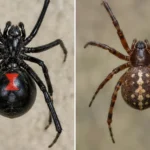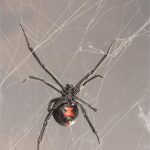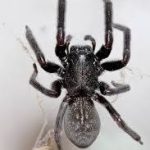

A black spider with white spots is most often a jumping spider, a ground spider, a spiny orb-weaver or a cobweb spider — and in several regions it can also be a young or male widow spider. The useful clue is not that the markings are white, but where they sit on the body, combined with size, body shape, web and location.

What Spider Is Black With White Spots?
Several unrelated groups fit that description, so the first step is to place the marking rather than name a species. Pale spots on the middle of a hairy abdomen, a single pale stripe running lengthwise, a crescent across the front of a glossy abdomen and white points on a hard spiny shell all belong to different families with different behaviour and different medical relevance.
The table below works from the marking outward. Use it to reach a likely group, then confirm with body shape, web and region.
| Where the pale marking sits | Body form and behaviour | Likely group | What to check next |
|---|---|---|---|
| One larger spot in the middle of the abdomen with two smaller spots behind it | Compact, hairy, short-legged; large forward-facing eyes; moves in bursts and jumps | Phidippus jumping spiders (Salticidae), including the bold jumper | Spot colour (orange or yellow in some individuals), leg banding, whether it turns to face you |
| Pale bands and streaks along the sides of a small, striped abdomen and head region | Very small; jerky start-and-stop movement on sunlit walls, fences and window frames | Zebra jumping spider and relatives (Salticidae) | Whether the front body region is banded too, and whether the jaws look enlarged |
| One elongated pale mark down the centre of the abdomen, plus a small white spot just above the spinnerets | Flattened, fast, ground-running; no capture web; usually active at night | Parson spiders, Herpyllus (Gnaphosidae) | Zigzag running, chestnut-brown leg segments, indoor sightings in autumn |
| Pale crescent or band across the front edge of a rounded abdomen, sometimes faint or absent | Glossy, bulbous abdomen; hangs in an irregular tangled cobweb in a sheltered recess | False widows, Steatoda (Theridiidae) | Region, web position, and a careful photograph rather than handling |
| White or cream curved stripes on a grey-to-black abdomen, often on a slimmer or smaller spider | Rounded abdomen; strong low tangle web in sheltered outdoor or garage sites | Immature or male widow spiders, Latrodectus (Theridiidae) | Treat as a possible widow until region and anatomy are checked; do not handle |
| White points or spots on a hard shell that is wider than it is long, ringed with spines | Sits in a circular orb web, often at head height between plants | Spiny orb-weavers, Gasteracantha and Austracantha (Araneidae) | Number and shape of the abdominal spines, and the country |
| Fine pale flecks scattered evenly over a dark body, with no defined shape | Varies widely | Many unrelated spiders; may also be reflective hairs or camera flash | Re-photograph without flash before treating it as a marking at all |
Marking position is a starting point, not a determination. Several rows can apply to the same photograph.
Can You Identify a Black Spider With White Spots From One Photo?
Usually you can reach a family or a recognisable group, and sometimes a genus, but not a confirmed species. A spider cannot usually be identified reliably from color alone or from one blurry photograph. Flash bleaches dark bodies, warm indoor light shifts grey towards brown, and motion blur merges separate spots into one patch.
Life stage matters as much as lighting. In several species the abdominal spots start orange or yellow in young spiders and become white as the spider matures, so the same species can produce very different search descriptions at different ages. Adult males and adult females of one species can also differ in size, proportion and pattern.
A dependable species name often requires an adult specimen, magnification and examination of mature reproductive structures — the male pedipalps or the female epigyne — by someone with a regional key. Immature spiders may not yet have those structures at all, which means a careful answer for a juvenile can legitimately stop at “jumping spider, family Salticidae”. Combine location, body shape, size, leg proportions, markings, eyes, spinnerets, web, habitat and behaviour instead of matching a single image; the full method is set out in our step-by-step spider identification process.
What Is the Black Spider With a White Dot on Its Back?
In North America this description most often leads to the bold jumping spider, Phidippus audax, a common day-active hunter around gardens, fences and building walls. Washington State University’s extension entomology outreach describes it as black with a distinctive irregular orange-to-white spot on the back of the abdomen, found in gardens and around homes.
University of Michigan’s BioKIDS species account gives more detail: the cephalothorax and abdomen are black with fine white hairs, and in the middle of the abdomen there is a large triangular white spot with two smaller spots set behind and to the sides. That large spot may be orange in juveniles, and the spots may be white, yellow or orange depending on the individual. Some individuals also show two oblique pale stripes towards the sides. The chelicerae — the jaw bases in front of the face — are iridescent green, which is a useful confirmation when a photograph is sharp enough. Females measure roughly 8 to 15 mm in body length and males roughly 6 to 13 mm, and the species occurs from southeastern Canada west to British Columbia and south to Florida, the Gulf Coast and northern Mexico.
Behaviour is often the fastest confirmation. Jumping spiders turn to face movement, stalk in short bursts and leap rather than run continuously, and they do not sit waiting in a capture web. Phidippus is a large genus, so a bold jumper lookalike from the same genus is entirely possible, and “a Phidippus jumping spider” is frequently the most defensible answer from a photograph.

What Is the Tiny Black-and-White Spider on My Windowsill?
A very small black-and-white spider that moves in short jerks on a sunlit wall or window frame is frequently a zebra jumping spider, Salticus scenicus. The Natural History Museum in London describes it as a small spider with white and black markings and a characteristic jerky start-and-stop movement, usually hunting on external walls and surfaces but frequently coming indoors through open doors and windows, with an overall size of about 8 millimetres and a season running from spring through autumn.
Reported body lengths differ between sources. Several accounts give adult females as roughly 5 to 9 mm and adult males as roughly 5 to 6 mm, while the Natural History Museum’s public guide quotes a single overall figure of about 8 mm. The difference largely reflects whether a source is quoting body length only or a general impression of size, so treat any single number as approximate. Adult males have noticeably enlarged chelicerae, which is one of the few features separating the sexes in a photograph.
The species occurs widely across the Northern Hemisphere, including North America and Europe, which is why the same description turns up in searches from both continents. Other small salticids carry pale bands, so a banded miniature jumper is not automatically Salticus scenicus outside its documented range.
What Is the Black Spider With a White Stripe That Runs Very Fast?
A fast, flat, dark spider with a single pale lengthwise mark and no web is likely a parson spider. Penn State Extension describes the eastern parson spider, Herpyllus ecclesiasticus, as a rather hairy spider with flat-lying black hairs on the cephalothorax and grey hairs on the abdomen, with a chestnut-brown exoskeleton that is easiest to see on the legs. The common name comes from the distinctive white dorsal marking on the abdomen, which resembles the clerical cravat worn in the seventeenth and eighteenth centuries, and there is a small white spot located just above the spinnerets.
Females are 8 to 13 mm long and males average about 6 mm. These are ground spiders in the family Gnaphosidae, which hunt actively without a capture web, spin silken daytime retreats under bark, boards and stones, and enter buildings in autumn seeking a place to overwinter. When disturbed they run in a zigzag pattern, which makes them awkward to catch and easy to overestimate in size.
A near-identical species, Herpyllus propinquus, replaces it west of the Continental Divide, so a western record is better recorded as Herpyllus at genus level unless a specialist has examined it. Other dark ground spiders and some ant-mimicking spiders also carry pale bands, which is why the phrase “black spider with a white stripe” on its own resolves to a group rather than a species. If the spider was found indoors, comparing it against the other spiders commonly found inside North American homes will usually settle whether it is a resident or a wanderer.

Do Widow Spiders Ever Have White Markings?
Yes, and this is the single most important reason not to treat white markings as reassurance. The LSU AgCenter notes that in the southern and northern black widows, Latrodectus mactans and Latrodectus variolus, the upper surface of the abdomen is variable: individuals may be solid black from above, but many carry bold red or orange markings, sometimes with white or yellow highlights. Immature females are typically more boldly marked with red and white or yellow markings, and those markings partially disappear as the spider matures.
A small dark cobweb spider with pale curved stripes can therefore be a juvenile widow rather than a harmless lookalike. Adult female L. mactans and L. variolus are medium-to-large spiders around 10 to 12 mm in body length with glossy, globular abdomens, and the red or orange hourglass marking sits underneath, not on top. The same source notes that males and small immatures are not a threat to people because of their much smaller size — but establishing that a spider is a small immature of a low-risk species, rather than something else, is exactly the judgement a photograph struggles to support.
False widows in the genus Steatoda add a further layer. They share the rounded abdomen and tangled cobweb but are a separate genus, and their pale markings often take the form of a crescent or band across the front of the abdomen that fades with age and can be lost entirely in older females. They are not widow spiders, and the risk framing is different; we cover it separately in how dangerous false widow spiders really are.
| Feature | Widow spiders (Latrodectus) | False widows (Steatoda) | Bold jumper (Phidippus audax) | Parson spiders (Herpyllus) |
|---|---|---|---|---|
| Body surface | Smooth and glossy | Smooth, often glossy or plum-toned | Densely hairy | Covered in fine flat-lying hairs |
| Abdomen shape | Rounded and globular in adult females | Rounded, sometimes more oval | Oval, carried on a compact high front body | Elongated and low |
| Typical pale markings | White or yellow highlights and stripes, strongest in immatures | Pale crescent or band at the front of the abdomen, often fading | Central spot with two smaller spots behind it | Single lengthwise cravat-shaped mark plus a spot above the spinnerets |
| Web | Strong irregular tangle web, usually low and sheltered | Irregular tangle web in a recess | None for prey; small silk retreat only | None for prey; silk retreat only |
| Movement | Stays in the web, hangs inverted | Stays in the web | Stalks, turns to face movement, jumps | Runs fast, often in a zigzag, mainly at night |
| How to treat it | Regional medical concern; do not handle or turn over | Avoid handling; seek advice if symptoms worsen | Avoid unnecessary handling | Avoid unnecessary handling |

Which Black-and-White Spiders Sit in a Round Web?
If the spider is in a wheel-shaped orb web and the abdomen looks like a hard, spiny shell wider than it is long, the answer is a spiny orb-weaver rather than any of the groups above. University of Florida’s Featured Creatures account for Gasteracantha cancriformis, the spinybacked orbweaver, records females at 5 to nearly 9 mm in length but 10 to 13 mm in width, with six pointed abdominal projections. The carapace, legs and underside are black, with some white spots on the underside of the abdomen, and colour forms vary considerably across the range. Adult males are much smaller, with a grey abdomen bearing white spots and only four or five small posterior humps in place of the large spines. The species occurs from the southern United States to northern Argentina.
That account also illustrates why naming is not always stable: the name Gasteracantha ellipsoides was used for this spider by some twentieth-century authors before Levi’s 1978 revision found it to be a synonym of Gasteracantha cancriformis. Older field guides may still carry the earlier name.
In Australia, the equivalent search usually leads to the jewel spider or Christmas spider, Austracantha minax. Queensland Museum describes a black carapace and a star-shaped abdomen with six prominent conical spurs, usually marked with white, yellow, orange and black, with males much smaller, darker and with less pronounced abdominal spurs. Reported female body lengths differ between sources — roughly 8 mm in some Australian identification resources and up to about 12 mm in others — so a single figure should not be quoted as definitive. These spiders often occur in loose aggregations of overlapping orb webs rather than singly.
How Big Are Black Spiders With White Spots?
Body length excludes the legs, and leg span routinely makes a spider look two or three times larger than it is. Where sources disagree, both figures are shown below rather than the largest.
| Spider | Family | Adult female body length | Adult male body length | Basis |
|---|---|---|---|---|
| Bold jumping spider, Phidippus audax | Salticidae | 8–15 mm | 6–13 mm | University of Michigan BioKIDS species account |
| Zebra jumping spider, Salticus scenicus | Salticidae | Reported about 5–9 mm | Reported about 5–6 mm | Natural History Museum gives an overall size of about 8 mm; other sources give the narrower ranges shown |
| Eastern parson spider, Herpyllus ecclesiasticus | Gnaphosidae | 8–13 mm | About 6 mm on average | Penn State Extension |
| Spinybacked orbweaver, Gasteracantha cancriformis | Araneidae | 5–9 mm long, 10–13 mm wide | Much smaller; large spines replaced by small humps | UF/IFAS Featured Creatures |
| Jewel spider, Austracantha minax | Araneidae | Reported about 8–12 mm, depending on source | Much smaller and darker | Queensland Museum, with size figures varying between Australian sources |
| Southern and northern black widows, Latrodectus mactans and L. variolus | Theridiidae | About 10–12 mm | Much smaller than the female | LSU AgCenter |
Are Black Spiders With White Spots Poisonous or Dangerous?
The words are not interchangeable. Venomous means a spider injects venom through a bite, which is true of almost all spiders. Poisonous would mean it causes harm when eaten, which does not describe these spiders. Dangerous implies a likelihood of serious harm. Medically significant means a bite can sometimes produce symptoms that warrant medical assessment. Most of the spiders in this article fall into the first category and not the last.
The BioKIDS account for the bold jumping spider describes the species as venomous but states that the bite is not dangerous to humans. Penn State Extension notes that the bite of a parson spider is painful and that some individuals may experience an allergic reaction with varying symptoms, but that parson spiders are generally not considered medically important; most bites occur when the spiders are trapped against the skin in clothing or bedding. Widow spiders are the group in this article with genuine regional medical significance, and the LSU AgCenter’s guidance is explicit that active widow webs should not be probed by hand, gloved or otherwise, or with a stick.
Skin lesions have many possible causes, and spider bites are often difficult to confirm without seeing or identifying the spider involved. Redness, swelling, pain, blistering, itching or an ulcer does not by itself establish that a spider was responsible.
If symptoms are severe, spreading rapidly, or affecting the whole body — intense muscle pain or cramping, difficulty breathing, vomiting, fever or significant swelling away from the site — seek prompt medical care locally rather than attempting an online diagnosis. Local guidance and available treatment vary by country and region.
What to Record Before You Ask for an Identification
The most common reason an identification request stalls is missing context rather than a poor photograph. Record these before you post or email:
- Country, state or province, and the nearest general locality
- Date, approximate time, and whether it was indoors or outdoors
- Estimated body length excluding the legs, and how you estimated it
- Whether it was sitting in a web, and if so, the web’s shape and position
- What it did — jumped, ran in a zigzag, hung inverted, stayed still
- A sharp view of the upper surface, plus a wider shot showing the surroundings
- The original unedited file, since compression removes the detail an expert needs
Do not turn an unknown spider over, restrain it, or move your face close to inspect the eyes. A missing photograph is a better outcome than a bite. If the answer turns out to be a small, plainly coloured spider without clear white markings after all, our comparison of small brown spiders found indoors covers that description separately.

More Questions About Black Spiders With White Spots
What is the black spider with three white dots on its back?
In North America this pattern points strongly towards the bold jumping spider, Phidippus audax, which typically shows a larger spot in the middle of the abdomen with two smaller spots behind it. The spots may appear orange or yellow rather than white in some individuals, particularly younger ones. Other Phidippus species can show comparable patterns, so genus level is often the safest answer from a photograph.
Is a black spider with white spots a baby black widow?
It can be. Immature widow spiders are described as more boldly marked than adults, with red and white or yellow markings that partially fade as they mature. A small dark cobweb spider with pale curved stripes, sitting in an irregular tangle web low down in a garage, shed or woodpile, deserves a cautious regional check rather than an assumption that white markings mean a harmless species.
Does a white spot mean the spider is harmless?
No. White markings occur in low-risk jumping spiders and ground spiders, in false widows, and in immature and male widow spiders. The marking colour carries no information about venom. Risk is assessed from the group, the region and the life stage, not from the palette.
Why do the spots look orange in my photo but white in guides?
Two reasons. In several species the abdominal spots genuinely start orange or yellow in juveniles and turn white with maturity. Separately, camera flash, warm indoor lighting and automatic white balance can all shift apparent colour. Re-photograph in daylight without flash before treating the colour as diagnostic.
Can an identification app confirm the species?
Apps and image searches can suggest candidates, but they often ignore geography and life stage and cannot see the reproductive structures that regional keys depend on. Treat a suggestion as a hypothesis to test against range and anatomy, and route any medically relevant identification to a museum, university extension office or qualified arachnologist.
References and Further Reading
- Penn State Extension. Parson Spider — description, size, life history and medical importance of Herpyllus ecclesiasticus.
- Natural History Museum, London. Zebra jumping spider — size, season, markings and behaviour of Salticus scenicus in and around UK homes.
- BioKIDS, University of Michigan. Phidippus audax — abdominal spot pattern, eye arrangement, measurements and North American distribution.
- UF/IFAS Featured Creatures. Spiny Orb Weaver Spider, Gasteracantha cancriformis — identification, sexual dimorphism, distribution and synonymy.
- LSU AgCenter. Southern and Northern Black Widow Spiders — adult and immature markings, size, and safety guidance.
- Queensland Museum. Jewel Spider — carapace, abdominal spurs and colour pattern of Austracantha minax.