A small spider that stops, turns to look at you, and suddenly jumps across a windowsill may be a jumping spider. These active hunters belong to the family Salticidae, a diverse group best recognized by their unusually large front eyes and sharp, deliberate movements.
To identify a small jumping spider, look for a compact body, two prominent forward-facing eyes, short bursts of movement, and the ability to jump between surfaces. Many common jumping spiders measure approximately 3–12 mm in body length, although some species fall outside that range.
No single feature confirms an identification. Size, eye arrangement, body proportions, behavior, and geographic location provide a much more reliable answer when considered together.
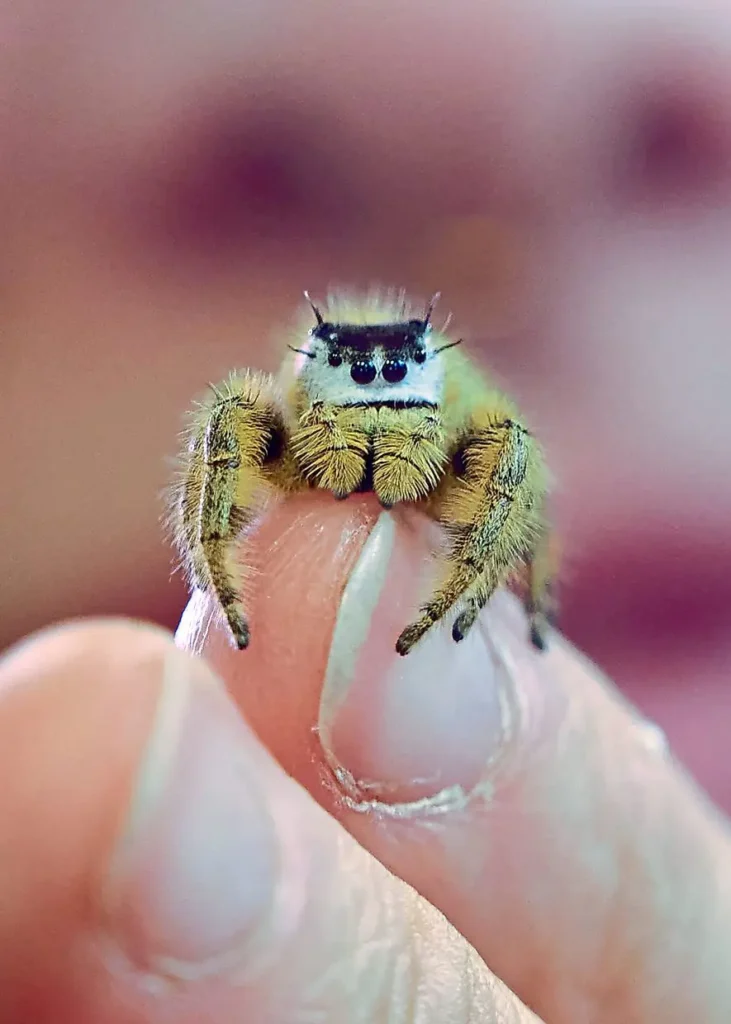
Quick Identification: Five Signs of a Small Jumping Spider
| Feature | What to Look For |
|---|---|
| Size | Often 3–12 mm in body length, excluding legs |
| Eyes | Eight eyes, with two exceptionally large eyes facing forward |
| Body shape | Often compact, with a relatively broad, high front body |
| Movement | Short, quick movements, frequent pauses, and controlled jumps |
| Hunting behavior | Actively stalks prey rather than relying on a typical capture web |
A spider that matches several of these characteristics is consistent with a jumping spider. Identifying its exact species usually requires a closer examination of its markings, anatomy, and location.
How Small Are Jumping Spiders?
Most jumping spiders are small enough to fit comfortably on a fingertip, but their size varies considerably across species.
The Australian Museum gives a typical size range of 3–12 mm for jumping spiders. This refers to body length, not the distance between the tips of their extended legs.
Some species are much smaller, while others can exceed this typical range.
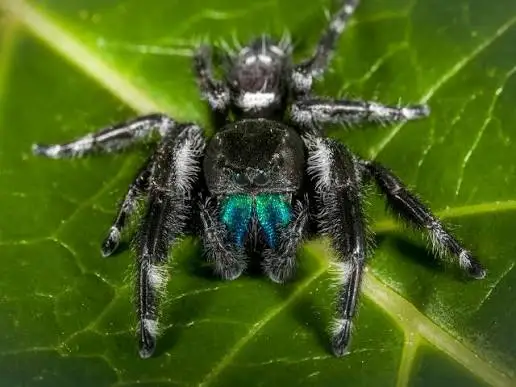
What Does a 3–5 mm Jumping Spider Look Like?
At approximately 3–5 mm long, a jumping spider may look like a tiny moving speck until viewed closely.
Its most useful characteristics are often:
- A broad-looking front body relative to its small abdomen.
- Large dark eyes visible from the front.
- Brief pauses between movements.
- A tendency to turn toward nearby activity.
- Short jumps between leaves, walls, or other surfaces.
Even at this size, jumping spiders are capable of actively tracking and capturing small insects.
Does a Tiny Jumping Spider Mean It Is a Baby?
Not necessarily.
An exceptionally small jumping spider might be a juvenile, but it could also belong to a naturally small species.
Young jumping spiders, commonly called spiderlings, resemble miniature versions of adults in many respects. However, their coloration, body proportions, and markings can change as they mature.
Adults and juveniles of different species can therefore overlap in size.
Size alone cannot establish a jumping spider’s age or species.
Jumping Spider Eyes: The Most Useful Identification Feature
The eyes are usually the strongest visual clue when identifying a jumping spider.
Most jumping spiders have eight eyes arranged across the front and sides of the cephalothorax, the front body region where the eyes, mouthparts, and legs are attached.
Their arrangement is distinctive.
The Two Large Front Eyes
The most noticeable feature is a pair of exceptionally large, forward-facing eyes called the anterior median eyes.
These eyes give many jumping spiders an almost expressive appearance.
More importantly, they provide detailed vision that helps the spider inspect objects, recognize potential prey, and guide its movements.
When a jumping spider appears to be looking directly at you, it may actually be orienting its main eyes toward your movement.
Where Are the Other Six Eyes?
Although the two main eyes receive the most attention, the remaining six eyes are important too.
The typical jumping spider eye arrangement includes:
- Four eyes across the front: two large central eyes and two smaller eyes toward the sides.
- Two small eyes farther back: usually less obvious without magnification.
- Two additional eyes near the back sides of the cephalothorax: contributing to awareness of the surrounding environment.
This arrangement is often described as three rows of 4–2–2 eyes, although the exact appearance differs among jumping spider groups.
A clear frontal photograph can reveal the four front eyes. A view from slightly above may help reveal the others.
Why Do Jumping Spiders Have Such Good Vision?
Unlike many web-building spiders that depend heavily on vibrations, jumping spiders rely extensively on visual information.
Their smaller eyes help detect movement across a broad field of view. Their large principal eyes provide more detailed information about whatever has attracted their attention.
A spider may notice movement, turn its body, pause, and then approach or retreat.
This coordinated visual behavior is one reason jumping spiders can be recognized by observation even when their body markings are difficult to see.
For a broader comparison of eye arrangements across spider groups, see Spiderpedia’s guide to spiders with big eyes.
Body Shape, Legs, and Color
A small jumping spider often has a sturdy, compact appearance.
Many have a relatively high, broad cephalothorax, a rounded or oval abdomen, and legs that look strong rather than exceptionally long and slender.
Fine hairs or scales can cover the body, producing patterns that appear fuzzy, velvety, or even iridescent under close observation.
However, these characteristics are not universal.
Some jumping spiders have slender bodies, elongated legs, or shapes that mimic ants. A compact appearance is helpful, but it is not an absolute requirement.
Can Small Jumping Spiders Be Black, Brown, or Gray?
Yes. Small jumping spiders can be black, brown, gray, tan, or combinations of several colors.
Some have pale abdominal spots, contrasting leg bands, or stripes. Others blend almost perfectly into tree bark or dry vegetation.
Color can change with age, sex, species, and lighting conditions.
A black jumping spider is not automatically one particular species. Likewise, a brown jumping spider cannot be identified from its color alone.
If the specimen has few visible markings, Spiderpedia’s small brown spider identification guide explains how to combine appearance with other clues.
How Small Jumping Spiders Move and Behave
Behavior is especially valuable when the spider is too small for its eyes or markings to be seen clearly.
Jumping spiders typically move differently from many spiders that wander continuously across surfaces.
1. They Move in Short Bursts
A jumping spider may run a short distance, stop, turn, and move again.
This start-and-stop behavior is particularly noticeable while hunting or investigating an unfamiliar object.
The spider may remain motionless for several seconds before suddenly changing direction.
A jerky gait is a useful clue, although other spider groups can also make abrupt movements.
2. They Turn Toward Movement
Jumping spiders frequently orient toward objects that move nearby.
A spider on a wall may turn to face a passing hand, follow the movement of an insect, or reposition itself to inspect something outside its immediate path.
This behavior reflects its visually guided approach to the environment.
It does not necessarily mean that the spider is approaching a person aggressively.
3. They Jump Between Surfaces
Jumping is one of their characteristic ways of moving.
A small jumper may leap from a leaf to a stem, across a narrow gap, or toward an insect it has been stalking.
Before jumping, jumping spiders commonly attach a silk dragline to the surface.
That thread can help prevent an uncontrolled fall and may allow the spider to climb back after an unsuccessful jump.
Jumping ability is a strong clue, but it is not unique to this family. Other spiders can also jump or make short leaps.
4. They Hunt Without Typical Capture Webs
Most jumping spiders are active hunters.
Rather than waiting for insects to become trapped in a sticky web, they locate prey visually and approach it until they can make a controlled attack.
Their prey may include flies, mosquitoes, small moths, and other arthropods.
However, jumping spiders still produce silk.
They commonly use it to create draglines, resting shelters, molting retreats, and structures associated with egg laying.
Finding a small silk shelter does not rule out a jumping spider.
5. Some Perform Courtship Displays
Males of certain jumping spider species use elaborate movements when approaching females.
These displays can include leg waving, body postures, and conspicuous movements of the abdomen.
Peacock spiders are especially well-known examples, but elaborate courtship varies considerably across Salticidae.
A small spider waving its front legs is not automatically courting. Similar movements can occur during other interactions.
Small Jumping Spider vs. Other Small Spiders
A tiny jumping spider can be confused with several other spider groups, especially when viewed from above or photographed from a distance.
| Spider group | Useful differences |
|---|---|
| Jumping spider (Salticidae) | Two very large forward-facing eyes; often compact; active visual hunting and deliberate jumps |
| Wolf spider (Lycosidae) | Different eye arrangement, with two prominent eyes above a lower row of smaller eyes; often hunts on the ground |
| Crab spider (Thomisidae) | Often holds its front legs out to the sides and may adopt a sideways, crab-like posture |
| Small cobweb spider (Theridiidae) | Often has a more rounded abdomen and relies on an irregular silk capture web |
These are typical differences, not definitive species-level tests.
For example, some jumping spiders mimic ants and do not have the familiar rounded body. Some wolf spiders also move quickly and can make short leaps.
If the eyes are not visible, compare the spider’s overall posture, preferred habitat, and behavior rather than relying on one feature.
For uncertain specimens, follow a broader spider identification method before selecting a species name.
A Familiar Example: The Zebra Jumping Spider
The zebra jumping spider, Salticus scenicus, is a useful example of a small jumping spider with recognizable markings.
It has a compact body with contrasting dark and pale bands that create a striped appearance.
The Natural History Museum in London describes it as a small spider, approximately 8 mm in overall size, with characteristic start-and-stop movements.
Zebra jumping spiders are known from Europe and have established populations in parts of North America.
They are frequently observed on sunlit walls, fences, windows, and other exposed surfaces where they hunt small insects.
Their large front eyes, compact posture, and sudden movements are typical jumping spider characteristics.
However, not every striped jumping spider is Salticus scenicus. Other species can share similar patterns, and juvenile markings may be misleading.
Geographic location and detailed anatomy remain important for identification.
Where Are Small Jumping Spiders Usually Found?
Jumping spiders occupy a wide variety of habitats.
They can be encountered on vegetation, tree trunks, rocks, walls, garden furniture, and the exterior surfaces of buildings.
Many species are particularly active during daylight.
On Walls and Windows
Small jumping spiders are often noticed on windowsills, window frames, fences, and sunlit exterior walls.
These exposed surfaces may offer opportunities to detect and capture small insects.
A spider repeatedly turning toward movement while patrolling a window frame is consistent with the behavior of many jumping spiders.
On Leaves and Garden Plants
Leaves and stems provide both hunting surfaces and shelter.
A jumping spider may wait on a leaf, approach an insect, or move around a stem to change its viewing angle.
Coloration and body shape often help it blend with the surrounding vegetation.
Inside the House
Finding a jumping spider indoors does not necessarily indicate that a population is established in the house.
An individual may have entered through an open window or door, or moved indoors while following prey.
Some species regularly use buildings as part of their habitat, while others are occasional visitors.
The spider’s location can help narrow the possibilities, but it should be considered alongside its eyes, body shape, and behavior.
How to Identify a Small Jumping Spider From a Photo
Small spiders can be difficult to identify because the most informative features may be barely visible.
For a useful photograph, try to capture:
- A front view: shows the principal eyes and their relationship to the smaller front eyes.
- A top view: records the abdomen, overall proportions, and dorsal markings.
- A side view: helps reveal the height and shape of the cephalothorax.
- A size reference: such as a ruler placed nearby without touching the spider.
- The location: including the country or region and the surface where the spider was found.
Use a macro setting or close-focus lens if available, but avoid getting so close that the spider becomes disturbed.
A short video may be helpful because movement can provide identification clues that a still photograph cannot capture.
Even a sharp photograph may only support identification to the family or genus level. Some species require examination of adult reproductive structures or other diagnostic features.
Are Small Jumping Spiders Dangerous to Humans?
Jumping spiders are not generally considered medically significant to humans.
Like most spiders, they possess venom used to subdue prey, but that does not mean they are dangerous to people.
They generally avoid contact and are unlikely to bite unless trapped, squeezed, or handled.
When bites occur, effects are usually limited, although individual reactions can vary.
It is best to avoid handling an unknown spider. If a suspected bite causes severe, spreading, or worsening symptoms, seek appropriate medical advice.
A skin mark alone cannot confirm a spider bite or identify the species responsible.
Frequently Asked Questions
What is a tiny spider with two big eyes?
A tiny spider with two conspicuously large forward-facing eyes may belong to the jumping spider family, Salticidae. Confirm the identification by checking its body shape, additional eyes, movements, and location.
How small can a jumping spider be?
Some jumping spider species have adults measuring only a few millimeters, while others are considerably larger. Many familiar species fall within a body-length range of about 3–12 mm. Young spiders may be much smaller than mature individuals.
Why does a jumping spider stop and look at me?
Jumping spiders rely heavily on vision. When they detect movement, they often turn to inspect it with their principal eyes. Pausing and facing a moving object is normal exploratory behavior and does not necessarily indicate aggression.
Do small jumping spiders build webs?
Most do not construct the typical prey-catching webs associated with orb-weavers or cobweb spiders. However, they produce silk for safety lines, resting retreats, molting shelters, and egg protection.
How can I tell whether a jumping spider is male or female?
In many adult jumping spiders, males have enlarged pedipalps, the small appendages near the mouth, which may resemble tiny boxing gloves. Color and body size can also differ between sexes, depending on the species. Juveniles may be difficult to sex reliably.
Can a jumping spider be identified by its color?
Color can help narrow the possibilities, but it rarely provides enough information on its own. Similar colors occur in unrelated species, and appearance may differ by sex and age. Eye arrangement, anatomy, geographic location, and behavior are more reliable when combined.
Final Identification Checklist
A small spider is likely to be a jumping spider when several clues appear together: two oversized front eyes, a relatively compact body, deliberate stop-and-go movements, visually guided hunting, and controlled jumps.
If its eyes are not visible, observe its movements and take photographs from more than one angle.
Remember that identifying a spider as a member of Salticidae is not the same as identifying its species. Sometimes the most accurate conclusion is simply that the animal is a jumping spider.
References
- Australian Museum. Jumping Spiders.
- Australian Museum. How Spiders See the World.
- University of Florida IFAS Extension. Regal Jumping Spider: Identification and Biology.
- Natural History Museum, London. Zebra Jumping Spider.
- Washington State University. Jumping Spider.
- World Spider Catalog. Natural History Museum Bern. Taxonomic reference for Salticidae.