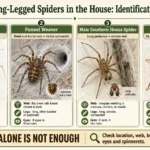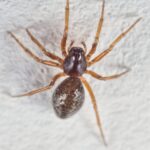
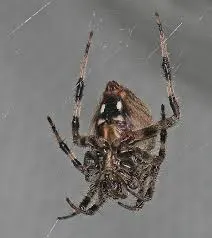
A brown spider with striped legs is most often a wolf spider, a fishing spider, a barn funnel weaver, an orb-weaver, or, in the southern United States and southern California, a brown widow. Leg stripes narrow the list, but they don’t settle it on their own. Where you found the spider, whether it had a web, its body shape, and its size do most of the work.
This guide covers North America. One useful fact up front: banded legs are a strong sign that the spider is not a brown recluse, because recluse legs are a single, even color.
Quick answer
- Running on the ground, no web: likely a wolf spider.
- Large, legs spread flat, near water or woods: likely a fishing spider.
- In a basement or shed, with a flat sheet web and a funnel: possibly a barn funnel weaver.
- In a round wheel-shaped web near a porch light: likely an orb-weaver.
- Round abdomen, tangled web under outdoor furniture, southern U.S.: possibly a brown widow.
What Counts as “Striped Legs”?
When people describe a spider’s legs as striped, they usually mean bands: light and dark rings around each leg, a bit like a candy cane. Arachnologists call these rings annulations.
Banding can be bold or very faint. It can also be easy to miss in a dim basement and obvious in a flash photo. If the stripes run lengthwise along the body rather than around the legs, that is a different clue, and it points strongly toward wolf spiders and their relatives.
5 Brown Spiders With Striped or Banded Legs
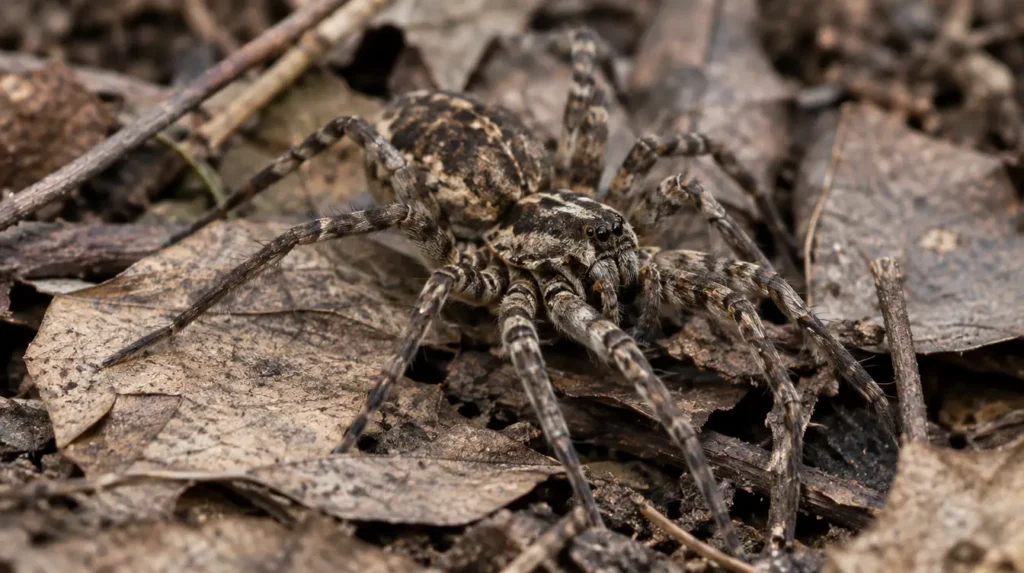
1. Wolf Spiders (Family Lycosidae)
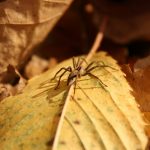
Wolf spiders are the most common answer to this question in North America. They are usually gray, brown, black, or tan, with darker markings that often form stripes on the body. Some species, such as the tiger wolf spider, have clearly banded legs. Others have plain legs.
- Size: about ¼ to 1 inch in body length, depending on the species.
- Behavior: they don’t build capture webs. They run down prey or wait for it, often at night.
- Eyes: a row of four small eyes sits below four larger ones, and two of the upper eyes are enlarged. See our guide to spiders with big eyes for how this compares with jumping spiders.
- Telltale sign: a female dragging a round egg sac attached to her spinnerets, or carrying spiderlings on her back.
Wolf spiders sometimes wander indoors, especially at ground level. They can bite if handled, but North American wolf spider bites are not considered medically serious.
2. Fishing Spiders (Genus Dolomedes)
Fishing spiders are big, flattened, and often mottled brown, with legs that are frequently banded. The dark fishing spider (Dolomedes tenebrosus) is the one most likely to surprise people, because it doesn’t stay near water. It also turns up in wooded areas, around logs and stumps in yards, and occasionally inside homes.
- Size: large. Adult females are roughly ½ to over 1 inch in body length, and the leg span can reach about 3½ inches.
- Posture: legs are often held almost straight out to the sides. They commonly rest head-down or upright on tree trunks, wooden walls, and stone.
- Markings: the abdomen usually shows dark W-shaped or chevron marks.
- Web: none. Fishing spiders hunt by pouncing.
Size is what usually separates a fishing spider from a wolf spider. A dark fishing spider is noticeably larger and flatter, and its legs look longer for its body.
3. Barn Funnel Weaver (Tegenaria domestica)
If you found a banded-leg brown spider in a basement, shed, or garage, the barn funnel weaver (also called the domestic house spider) is a good candidate. It came to North America from Europe and is now well established across the continent.
- Size: females are about 7.5 to 11.5 mm (roughly ⅓ to ½ inch) in body length. Males are smaller.
- Markings: a reddish-brown or light brown front body with two darker or paler lengthwise lines, a mottled abdomen, and legs with banding that can be quite faint.
- Web: a flat sheet of silk with a funnel retreat, often in corners, door crevices, and other dark spots.
- Clue from behind: fairly long spinnerets at the tip of the abdomen.
The leg banding helps separate this species from two lookalikes in the same family, the hobo spider and the giant house spider. No documented bites from barn funnel weavers have been recorded.
Not every brown funnel weaver indoors has banded legs. If your spider had long legs and plain coloring, our guide to the brown spider with long legs in the house covers cellar spiders, house spiders, and other indoor candidates.
4. Orb-Weavers (Family Araneidae)
Several orb-weavers have ringed legs. A common example is the spotted orbweaver (Neoscona crucifera), whose legs are usually gray with brown rings. Its abdomen is plump and slightly triangular, often with a dark pattern shaped like an upside-down spruce tree.
- Size: about ½ inch in body length. Males are smaller.
- Web: a large, round, wheel-shaped web strung between trees, shrubs, or buildings. Many build near outdoor lights that attract insects.
- Timing: active at night. By day they hide in corners and crevices, often under eaves.
- Season: adults are most noticeable in late summer and early fall.
If you see a banded-leg spider sitting in a round web outdoors, an orb-weaver is the obvious first guess. Orb-weavers rarely bite unless handled.
5. Brown Widow (Latrodectus geometricus)
The brown widow is a non-native spider in the United States. For decades it was known mainly from Florida. It has since spread along the Gulf Coast and Southeast, from Texas to South Carolina, and is established in urban Southern California. Outside those areas, it is a much less likely answer.
- Legs: tan to light brown with dark brown bands.
- Body: a round abdomen, mottled tan to dark brown, sometimes with white, black, or orange markings.
- Underside: an orange to yellow-orange hourglass. It is often fainter and less sharp-edged than a black widow’s.
- Egg sacs: round and covered with small spiky points. This is one of the easiest clues to spot.
- Where: tangled, irregular webs under eaves and window ledges, inside outdoor furniture, under decks, around potted plants, and in the recessed handles of plastic trash bins.
Brown widows are venomous. Their bites are reported less often than black widow bites, and they rarely cause severe symptoms in people, but any suspected widow bite is worth a call for medical advice (see below).
Comparison Table
| Spider | Typical body length | Web? | Where you’d see it | Best extra clue |
|---|---|---|---|---|
| Wolf spider | ¼–1 in | No | Ground, leaf litter, floors | Two large forward eyes; egg sac on spinnerets |
| Dark fishing spider | About ½ to over 1 in (females) | No | Tree trunks, wooden walls, near water or woods | Large and flat; legs spread wide |
| Barn funnel weaver | About ⅓–½ in (females) | Sheet web with funnel | Basements, sheds, garages | Long spinnerets; faint leg bands |
| Spotted orbweaver | About ½ in | Round wheel web | Eaves, porches, outdoor lights | Plump abdomen; active at night |
| Brown widow | Small; round abdomen | Tangled, irregular web | Outdoor furniture, eaves, bin handles (southern U.S.) | Orange hourglass; spiky egg sacs |
Could a Spider With Striped Legs Be a Brown Recluse?
Very unlikely. Brown recluse legs are evenly light-colored, with no stripes or bands, and they carry fine hairs rather than obvious spines. Recluses also have six eyes arranged in three pairs, while most spiders have eight. If the legs are clearly banded or spiny, you can usually rule out a recluse.
The violin-shaped mark on a recluse’s back is less helpful than people expect, because many harmless spiders have dark markings in the same spot. Leg color and eye arrangement are better checks.
How to Narrow It Down
Work through these clues in order. Each one removes several candidates.
- Location. Note your state or province first. A brown widow is a real possibility in Florida, the Gulf states, or Southern California, and an unlikely one in Minnesota.
- Web or no web. No web points to a wolf spider or fishing spider. A sheet web with a funnel suggests a funnel weaver. A round orb points to an orb-weaver. A messy tangle points to a cobweb spider such as a widow.
- Body shape. A round, glossy abdomen looks very different from the longer, hairy body of a wolf spider or the flat body of a fishing spider.
- Body length, not leg span. Measure or estimate from the front of the head to the tip of the abdomen. Leg span can make a spider look two or three times bigger than it is.
- Eyes and rear end. If you can safely get a clear photo, the eye pattern and the spinnerets help a great deal.
Even with all of this, many spiders can only be named to family or genus from a photo. That’s normal. Our spider identification guide explains the full method, and the common North American spider identification page covers other frequent visitors. For tiny brown spiders, see small brown spider identification.
Are Brown Spiders With Striped Legs Dangerous?
Most are not. Wolf spiders, fishing spiders, barn funnel weavers, and orb-weavers may bite if they are grabbed or pressed against skin, but their bites are not considered a serious medical concern in North America.
The brown widow is the one to treat with more care. It is venomous, although its bites rarely cause severe symptoms. Don’t handle any spider you can’t identify. Moving it outdoors with a jar and a piece of card is safer than picking it up.
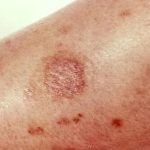
A red or sore spot on the skin is not proof of a spider bite, and the spider can’t be identified from symptoms alone. If you have severe pain, spreading symptoms, muscle cramps, or you feel unwell after a suspected bite, get medical advice. In the United States, Poison Help is available at 1-800-222-1222. In Canada, contact your provincial poison centre. For more background, see our spider bite and safety section.
Frequently Asked Questions
What is the most common brown spider with striped legs?
In much of North America, a wolf spider is the most likely answer for a banded-leg brown spider seen running across the ground or floor. Indoors in basements and sheds, a barn funnel weaver is also common.
Is a big brown spider with banded legs near a pond a wolf spider?
It might be, but a fishing spider is a strong possibility. Fishing spiders are larger and flatter, hold their legs spread wide, and often rest on rocks, wood, or vegetation near water.
Does a brown spider with striped legs mean a brown widow?
Not by itself. Brown widows do have banded legs, but so do many harmless spiders. Look for a round abdomen, an orange hourglass on the underside, spiky round egg sacs, and a tangled web, and consider whether you live within the brown widow’s range.
Do spiders with striped legs live inside houses?
The barn funnel weaver can live in buildings year-round, usually in basements, sheds, and dark corners. Wolf spiders and dark fishing spiders are more often accidental visitors that wander in from outside. One spider indoors doesn’t mean an infestation.
Can I identify the species from leg stripes alone?
No. Leg banding is shared by spiders in several unrelated families. Combine it with your location, the web, body shape, size, and eye pattern. Often the most reliable answer you can reach is the family or genus.
References and Further Reading
- Missouri Department of Conservation. Wolf Spiders – Field Guide.
- Missouri Department of Conservation. Dark Fishing Spider – Field Guide.
- University of Minnesota Extension. Dark Fishing Spider.
- Penn State Extension. Barn Funnel Weaver Spider.
- BugGuide (Iowa State University). Tegenaria domestica.
- Missouri Department of Conservation. Arboreal Orbweaver (Spotted Orbweaver) – Field Guide.
- UC Riverside Center for Invasive Species Research. Identifying Brown Widow Spiders.
- UC Riverside Spider Research. Brown Widows Get a Foothold in Southern California.
- Los Angeles County Agricultural Commissioner/Weights & Measures. Brown Widow Spider (PDF).
- UC Riverside Spider Research. How to Identify (and Misidentify) a Brown Recluse Spider.
- Health Resources and Services Administration. Poison Help Line.
- Natural History Museum Bern. World Spider Catalog (for current scientific names).