Most spiders that people describe as “white” turn out to be one of a few things: a crab spider waiting on a flower, a pale sac spider or ghost spider that hunts at night, a spider that has only just molted, or a darker spider with bold white markings. Sometimes the “white spider” is not a spider at all. Color is a starting point, but location, body shape, size, and behavior narrow the list much faster.
Quick answer
- White or pale yellow spider sitting still on a flower: most likely a crab spider (family Thomisidae).
- Pale, unpatterned spider wandering indoors at night or resting in a small silk sac: a sac spider (Cheiracanthium) is a common possibility; ghost spiders are another.
- Normally colored spider that suddenly looks washed out: it may have just molted.
- Dark spider with white spots or a white tip: treat it as a marked spider, not a white one.
- Tiny moving dots with fine webbing on leaves: probably spider mites, which are mites, not spiders.
Common White Spiders at a Glance
Start with where you found the spider and what it was doing. The table below is a sorting tool, not a final identification.
| Where and how you saw it | Likely group | Clues to check |
|---|---|---|
| Sitting motionless on a white or yellow flower, no web | Crab spiders (Thomisidae) | Front two pairs of legs longer and heavier than the back pairs; legs curve forward like a crab’s |
| Walking on a wall or ceiling at night, or tucked in a small silk sac in a corner | Sac spiders (Cheiracanthium) | Pale yellowish to grayish-tan body with no clear pattern; fast, active hunter |
| Pale spider on foliage, active at night | Ghost spiders (Anyphaenidae) | Very fast runner; telling it from a sac spider usually needs a close look at the underside |
| Familiar spider that looks unusually pale, often near an empty shed skin | Any spider after a molt | Same shape as the usual species; color returns over time |
| Hard, wide spider with spines in a round web | Spinybacked orbweaver (Gasteracantha cancriformis) | White or yellow back with black spots and short spines (Americas) |
| Tiny specks on the underside of leaves with fine webbing | Spider mites (not spiders) | Under 1/20 inch long; need a hand lens to see clearly |
Why Color Alone Is Not Enough
White is one of the least reliable colors for identification. Some crab spiders switch between white and yellow. Many pale spiders look cream, beige, or light gray depending on the light, and camera flash can wash out colors further. A spider that has just molted can also look much paler than it will a few days later.
Because of this, a good identification combines several clues: where you live, the habitat, the spider’s body length (not counting legs), the shape of the body and legs, whether there was a web, and what the spider was doing. Our spider identification guide explains how to use these clues together. In many cases, a family-level answer such as “a crab spider” is the honest stopping point.
White Crab Spiders on Flowers (Thomisidae)
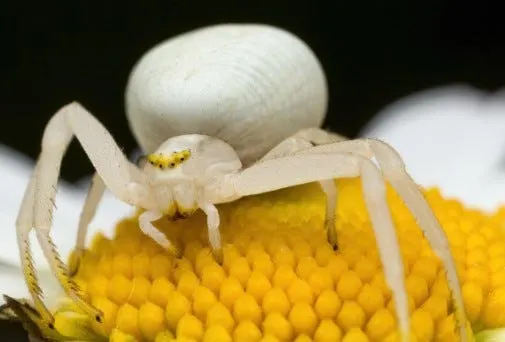
If you found a white spider sitting perfectly still on a flower, a crab spider is the first group to consider. Crab spiders do not build webs to catch prey. They wait on flowers or leaves and ambush visiting insects. In Australian flower spiders, the two front pairs of legs are much heavier, longer, and more strongly spined than the back pairs, and all the legs curve forward in a crab-like way. That leg shape is a better clue than the color.
Goldenrod crab spider (Misumena vatia)
This is one of the best-known white crab spiders. The World Spider Catalog lists it from North America, Europe, and a wide band of Asia, along with Morocco. Females are pale, with a white or yellow carapace, and some have reddish markings on the abdomen. They measure about 6 to 9 mm in body length. Males are much smaller, about 3 to 4 mm, and darker, with reddish-brown front legs.
Adult females can change color from white to yellow and back. Laboratory work on this species describes the change as taking a few days, not minutes, so a spider will not change color while you watch it. A white female on a white daisy and a yellow female on goldenrod may be the same species.
Whitebanded crab spider (Misumenoides formosipes)
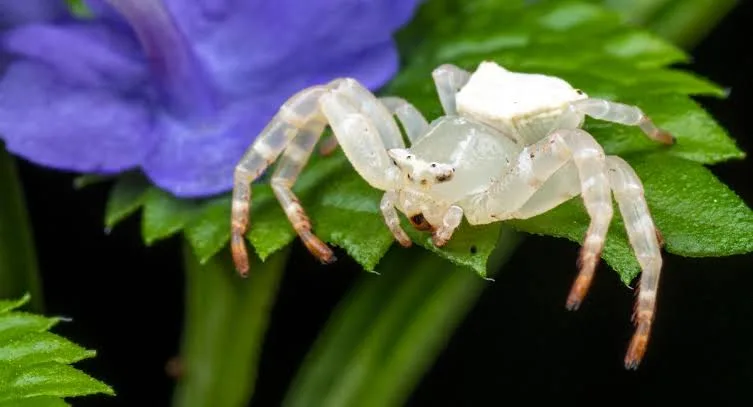
This North American crab spider ranges through the United States and Canada. Its color runs from whitish-yellow to yellowish-brown, and it can also shift color to blend with its surroundings. The best clue is a small white or yellowish ridge on the face below the eyes, which gives the species its name. Females are about 1/4 to nearly 1/2 inch in body length; males are under 1/8 inch. Adults are most noticeable in early autumn on flowers such as fleabanes, asters, thistles, milkweeds, and goldenrods.
Flower spiders in Australia and Asia
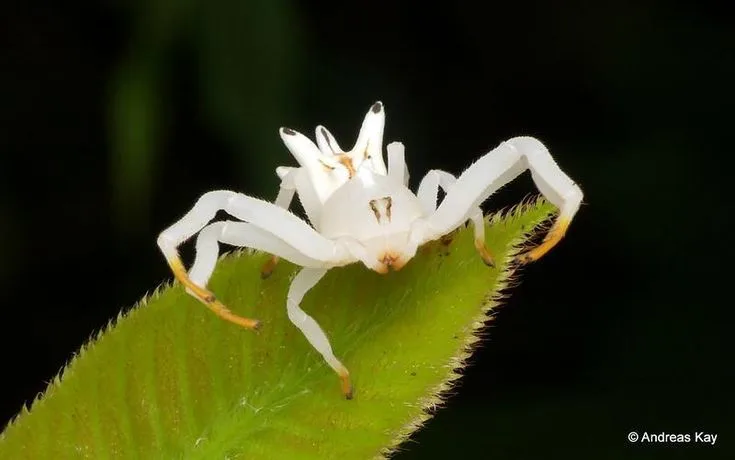
In Australia, flower spiders (also crab spiders) are common through much of the south and east, especially on native plants like grevilleas and wattles. Some are mostly white or yellow and match the petals they sit on. One species often called the white crab spider, Thomisus spectabilis, is listed by the World Spider Catalog from India to Australia. Australian flower spiders range from about 3 mm to 1.2 cm in body length, with males smaller than females.
The Australian Museum describes flower spiders as not dangerous to humans, and the University of Michigan’s Animal Diversity Web says the same of the goldenrod crab spider.
Pale Spiders Indoors: Yellow Sac Spiders
When people find a pale spider on a ceiling or wall at night, a sac spider in the genus Cheiracanthium is one common possibility, especially in North America. These “yellow sac spiders” are generally yellowish but can be pale grayish-tan, and they have no conspicuous markings.
- Size: about 3/8 inch (roughly 10 mm) body length when full grown, with a leg span of about 3/4 inch.
- Behavior: they do not catch prey in webs. They wander and hunt at night and rest by day in small silk retreats.
- Region: Cheiracanthium inclusum is native to the Americas. Cheiracanthium mildei is native to Europe and nearby regions and has been introduced to North America, where it often lives in buildings.
Sac spiders are often blamed for unexplained skin wounds, but the evidence does not support that reputation. A study of 20 verified sac spider bites in the United States and Australia found none that caused tissue death (necrosis), and the authors concluded that these spiders have been wrongly treated as a significant medical concern. A bite can still be painful, so it is best not to handle one.
Ghost Spiders (Anyphaenidae)
Ghost spiders are another group of pale, night-active hunters. In North America, the garden ghost spider (Hibana gracilis) is recorded from Canada and the United States. Ghost spiders spend the day in silk retreats under leaves or rocks and are very fast runners.
They look a lot like sac spiders. One difference is the position of a small breathing opening (the tracheal spiracle) on the underside of the abdomen: in ghost spiders it sits closer to the middle of the abdomen, while in similar-looking spiders it is near the spinnerets. That detail usually needs a sharp close-up photo, so for most people “a sac spider or ghost spider” is a reasonable answer.
A Spider That Has Just Molted
Spiders grow by shedding their exoskeleton. Right after a molt, the new exoskeleton is soft for a short time before it begins to harden, and the spider is vulnerable during this period. Many freshly molted spiders look paler than usual for a while, and their normal color returns as the new exoskeleton hardens.
If you see a pale spider that otherwise looks like a species you know, check nearby for an empty shed skin. A shed skin can itself look like a pale, dead spider, but it is hollow and does not move.
Spiders With White Markings, Not White Bodies
Many searches for “white spiders” are really about spiders with large white patches. The spinybacked orbweaver (Gasteracantha cancriformis) is a good example. In Florida it usually has a white back with black spots and red spines, though specimens from other areas can be yellow instead of white, or have black spines. Females are about 5 to 9 mm long and wider than they are long. They build round orb webs, often with small tufts of silk on the outer lines. Their bite is not known to cause serious effects in people.
If your spider is mostly dark with white spots, stripes, or a white tip, our guide to black spiders with white spots is the better place to start.
The “White-Tailed Spider” Is Not a White Spider
In Australia, the name white-tailed spider refers to Lampona cylindrata and Lampona murina. Despite the name, these are dark reddish to gray, cigar-shaped spiders with banded legs. Only the tip of the abdomen is white. Females are about 18 mm long and males about 12 mm. They often turn up in and around houses in summer and autumn, where they hunt other spiders such as black house spiders.
White-tailed spider bites have long been linked to skin ulcers, but the Australian Museum notes that the available evidence suggests ulceration is not a common outcome of a bite.
White “Spiders” That Are Not Spiders
A few things that look like small white spiders belong to other groups, or are not living animals at all.
- Spider mites. These are mites, not spiders. Mites are arachnids, like spiders and ticks, but they belong to a different group (Acari). Spider mites are less than 1/20 inch long, live on the undersides of leaves, and produce fine silk webbing, which is where their name comes from. To the naked eye they look like tiny moving dots. If you are dealing with them on garden or house plants, see our page on spider mites in the garden.
- Shed skins. As described above, a molted exoskeleton can look like a pale spider. It does not move and is hollow.
- Silk retreats and egg sacs. A small white silk pouch in a corner, under a leaf, or along a window frame may be a spider’s resting retreat or egg sac rather than a spider.
Are White Spiders Dangerous?
White color does not tell you anything about danger. Crab spiders and sac spiders, two of the pale groups covered here, are not considered a serious medical risk. As with any spider, the main precaution is not to pick it up with bare hands.
Risk depends on the species and the region, not on color. If you are worried about a specific spider, identify it first using several clues, and check the Spider Bite & Danger section for region-specific information. If someone develops severe or worsening symptoms after a suspected bite, contact a doctor or your local poison center. A skin wound cannot be identified as a spider bite from its appearance alone.
What to Note Before Asking for an Identification
If you want help identifying a white or pale spider, these details make the biggest difference:
- Your location, at least country and state or region.
- Where it was: on a flower, on a wall indoors, in a web, under bark, on a houseplant.
- Body length without the legs, compared with a coin or ruler if possible.
- Leg shape: are the front legs much longer and held forward like a crab’s?
- Any web: round orb web, messy tangle, small silk sac, or none.
- Behavior: sitting still, running fast, active at night.
- Photos from the top and, if possible, the side, in natural light rather than with flash.
Use your phone camera rather than your hands to get a closer look; there is no need to catch the spider. If you are in North America, our common spider identification page covers the spiders you are most likely to meet, and the Spider Types section has profiles of more groups.
More Questions About White Spiders
Are there albino spiders?
Before assuming a spider is albino, rule out the more ordinary explanations: a naturally pale species, a crab spider that has taken on a white color, or a spider that has recently molted. True albinism would be very hard to confirm from a photo.
Can a white crab spider turn yellow?
Yes. Female goldenrod crab spiders can change from white to yellow and back again. The change takes a few days, so you will not see it happen in real time.
What is the small white spider on my flowers?
A spider sitting still on a flower with no web is most likely a crab spider. Look at the legs: if the front two pairs are longer and held forward, that supports a crab spider. Which species it is depends on where you live.
What are the tiny white spiders on my houseplant?
If they are barely visible dots on the undersides of leaves with fine webbing, they are more likely spider mites than true spiders. A hand lens helps you tell the difference.
Is a pale spider on my ceiling at night a sac spider?
It may be. Sac spiders are pale, unpatterned, and hunt at night, and one species often lives in buildings. Ghost spiders look similar, and other pale spiders exist, so a clear photo and your location are needed for a more confident answer.
References and Further Reading
- World Spider Catalog. Natural History Museum Bern. Accessed October 2026. Species records for Misumena vatia, Misumenoides formosipes, Thomisus spectabilis, Cheiracanthium inclusum, Cheiracanthium mildei, and Hibana gracilis. wsc.nmbe.ch
- Insausti, T. C., & Casas, J. (2008). The functional morphology of color changing in a spider: development of ommochrome pigment granules. Journal of Experimental Biology, 211(5).
- Animal Diversity Web, University of Michigan Museum of Zoology. Misumena vatia. animaldiversity.org
- Missouri Department of Conservation. Field Guide: Goldenrod Crab Spider; Whitebanded Crab Spider. mdc.mo.gov
- Australian Museum. Flower spiders. australian.museum
- Colorado State University Extension, Department of Agricultural Biology. Yellow-legged sac spiders. colostate.edu
- Vetter, R. S., Isbister, G. K., Bush, S. P., & Boutin, L. J. (2006). Verified bites by yellow sac spiders (genus Cheiracanthium) in the United States and Australia: where is the necrosis? American Journal of Tropical Medicine and Hygiene, 74(6), 1043–1048.
- Spiderbytes. Ghost spiders (Anyphaenidae). spiderbytes.org
- University of Florida IFAS Extension. Spinybacked Orbweaver, Gasteracantha cancriformis (EDIS IN324). ufl.edu
- Australian Museum. White-tailed spider. australian.museum
- University of California IPM. Pest Notes: Spider Mites. ipm.ucanr.edu
- Cornell University Library. Arachnophilia: Growing spiders. library.cornell.edu