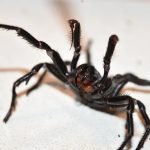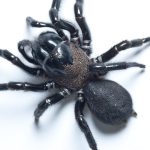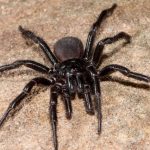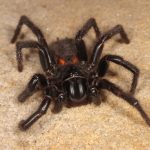
“Funnel-web spider” means two very different animals depending on where you live. In Australia, it refers to funnel-web spiders in the family Atracidae: heavy, glossy, black-to-brown spiders that live in burrows or tree crevices, and some of which have venom that can cause serious illness. In North America and Europe, the funnel-shaped webs people notice in lawns, hedges, and garage corners are made by funnel weavers (family Agelenidae), a separate group of fast, long-legged, usually striped spiders that are not considered medically significant.
The quickest way to tell them apart is to start with your location, then look at the web. Atracid funnel-web spiders are only known from Australia, and they do not build the flat sheet-and-funnel webs that cover grass and shrubs.
Short answer
- Outside Australia: a funnel web on a lawn, bush, or wall is almost certainly a funnel weaver (Agelenidae), not an Australian funnel-web spider.
- In Australia: look for a burrow or crevice with silk trip lines spreading from the entrance. A flat sheet web on a lawn does not fit a funnel-web spider.
- Safety: in Australia, treat any suspected funnel-web bite as a medical emergency. Funnel weaver bites are uncommon and usually cause only minor local symptoms.
Step 1: Start with where you are
Location narrows the answer more than any color or size clue. The World Spider Catalog currently lists 39 species of Atracidae in three genera (Atrax, Hadronyche, and Illawarra), and the Australian Museum describes their range as eastern and south-eastern Australia, from Tasmania to north Queensland, with some species in drier inland forests and South Australia’s Gulf region. The Sydney funnel-web spider (Atrax robustus) has a much smaller range around the Sydney region.
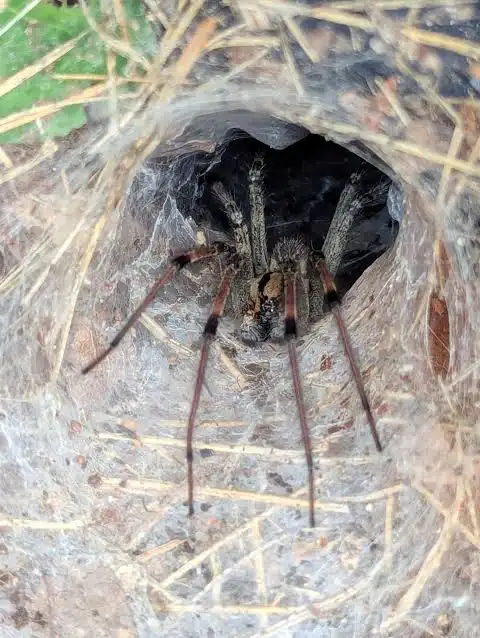
Funnel weavers are a large, widespread family with well over a thousand described species. In North America, the ones people meet most often are grass spiders (Agelenopsis) outdoors, and house-dwelling funnel weavers such as the barn funnel weaver (Tegenaria domestica) and the giant house spider (Eratigena atrica) indoors.
| Where you found it | What “funnel web” most likely means |
|---|---|
| United States, Canada, UK, Europe | A funnel weaver (Agelenidae), such as a grass spider or a house-dwelling funnel weaver |
| Eastern or south-eastern Australia, burrow or tree crevice | Possibly a funnel-web spider (Atracidae); check for trip lines and body clues below |
| Australia, lacy web around a window frame or wall crack | More consistent with a black house spider (Badumna insignis, family Desidae) |
Step 2: Read the web shape
Web architecture is the clue most people can check without getting close to the spider.
Funnel weaver webs: a flat sheet with a tube at one side
Funnel weavers build a broad, mostly horizontal sheet of dense silk, often slightly dipped in the middle, with a narrow funnel retreat at one edge where the spider waits. The silk is not sticky. Instead, insects that land on or fall onto the sheet are chased down by the spider, which runs out very quickly and then returns to the funnel. Penn State Extension notes that grass spiders often add a network of threads above the sheet that knocks flying insects down onto it.
These webs sit in plain view: on lawns, low shrubs, ground covers, fence lines, woodpiles, and in the corners of sheds, garages, and basements. On a dewy morning, a lawn can look covered with them.
Australian funnel-web spiders: a burrow with trip lines
Atracid funnel-web spiders do not make a sheet web on open ground. According to the Australian Museum, their most characteristic sign is irregular silk trip lines radiating out from a burrow entrance. The spider sits just inside with its front legs on these lines and responds when prey or a mate touches them.
The entrance often has a funnel-like silk opening leading into a burrow that is usually lightly silk-lined and rarely deeper than about 30 cm. Tree-dwelling species use silk-lined retreats in holes and rotting crevices in bark instead of ground burrows.
The Australian web that causes the most confusion
In Australian homes, the web most often mistaken for a funnel-web’s is the black house spider’s. The Australian Museum describes it as a lacy, non-sticky sheet spread around a funnel-like retreat entrance, commonly in window frames, wall crevices, and on tree trunks. Old webs turn grey and matted. The two spiders are not closely related, and a messy funnel web in the corner of a window points toward a black house spider rather than an atracid.
Step 3: Check body and behavior clues
Body features help confirm what the location and web suggest, but they are harder to see safely. Do not pick up or prod a spider to examine it.
| Feature | Funnel-web spider (Atracidae) | Funnel weaver (Agelenidae) |
|---|---|---|
| Range | Australia only | Widespread; common in North America and Europe |
| Body length | About 1–5 cm, depending on species and sex | Grass spiders about 9–20 mm |
| Appearance | Black to brown, no obvious pattern; hard, shiny, sparsely haired carapace; stout build | Brownish, often with two dark stripes along the carapace, a lighter band on the abdomen, and banded legs; slimmer, longer-legged build |
| Fangs | Point downward and strike in parallel, as in other mygalomorph spiders | Close toward each other in a pinching motion |
| Eyes | Closely grouped near the front of the carapace | Eight eyes in two rows, roughly similar in size |
| Web or shelter | Burrow or crevice with radiating trip lines | Flat, non-sticky sheet with a funnel retreat |
| When noticed | Wandering males at night in warmer months, especially after rain | Late summer and autumn, when adults are mature and some move indoors |
Two cautions apply to this table. First, both groups can have visible spinnerets at the rear of the abdomen. Grass spiders have long, tail-like rear spinnerets, and Atrax funnel-webs also have a clearly visible pair, so spinnerets alone will not separate them. Second, eye arrangement and fang direction are useful in close-up photos but are difficult to judge on a live spider. For more on reading these features, see our spider identification guide.
Australian spiders often mistaken for funnel-webs
The Australian Museum lists several spiders that are commonly confused with funnel-webs: brown trapdoor spiders, female mouse spiders (Missulena), and black house spiders. Some trapdoor and wishbone spiders in eastern Australia also have a dark, glossy carapace. A neat burrow with only a small silk collar around the rim, and no trip lines, is more consistent with one of these other burrowing spiders than with a funnel-web.
Even so, body shape alone is not a reliable way to rule out a funnel-web spider in Australia. If you are within their range and are unsure, keep your distance.
Step 4: Consider habitat and timing
Funnel-web spiders prefer cool, moist, sheltered places: under rocks and logs, in crevices, and in rotting or borer holes in trees. In gardens, the Australian Museum notes that they tend to be found in rockeries and dense shrubs and are rarely found on open lawns. Most activity happens at night. Males leave their burrows to search for females, mainly from about November to April, and heavy rain can increase their movement. Wandering males sometimes end up in garages and houses.
Funnel weavers are easiest to notice from late summer into autumn, when adults are full-sized and webs are at their largest. Outdoor grass spiders sometimes wander indoors as temperatures drop but do not usually establish themselves there. House-dwelling species such as the barn funnel weaver and the giant house spider live around and inside buildings, and the adults people find wandering indoors are most often males. If a long-legged brown spider is running across your floor in autumn, our guide to the brown spider with long legs in the house may help you narrow it down.
Step 5: Understand the safety picture for your region
In Australia: treat a suspected funnel-web bite as an emergency
Not every funnel-web species is dangerous, but several are capable of causing life-threatening envenomation, including the Sydney funnel-web spider. The Australian Museum records 13 deaths attributed to funnel-web bites, with none since an antivenom was introduced in 1981. That record depends on fast first aid and hospital care, so any suspected funnel-web bite should be taken seriously, whether the spider was male or female.
Current guidance from the NSW Poisons Information Centre and the Australian Museum for a suspected funnel-web bite is:
- Move the person away from the spider and keep them as still as possible.
- Apply a pressure immobilisation bandage over the bite, then bandage the whole limb firmly and splint it.
- Call 000 for an ambulance, even if symptoms have not appeared yet.
For general poisoning or bite advice in Australia, the Poisons Information Centre can be reached on 13 11 26. Do not try to catch the spider if doing so puts anyone at further risk.
Elsewhere: funnel weavers are not considered medically significant
Funnel weavers are shy and tend to run into their retreat when disturbed, so bites are uncommon. Penn State Extension reports that grass spider bites have caused local pain, redness, swelling, and itching without serious consequences.
The hobo spider (Eratigena agrestis), a funnel weaver native to Europe and Central Asia and introduced to parts of Canada and the United States, was once widely blamed for skin wounds in North America. Colorado State University Extension notes that the original evidence for this has since been discredited, and the hobo spider is now considered harmless to humans in North America.
As with any spider, a red or painful skin lesion is not proof of a bite, and its appearance cannot reveal which spider was involved. Seek medical advice for symptoms that spread, worsen, or affect the whole body. You can read more about realistic risk on our spider bites and safety page.
What to do if you find a funnel web
- Outside Australia: you can leave a funnel weaver’s web alone. These spiders catch insects around lawns and buildings. If a web is in an inconvenient spot, brushing it away is usually enough.
- In Australia, within funnel-web range: keep children and pets away from the burrow or spider, and take a photo from a safe distance if you want an identification. Wear gloves and closed shoes when gardening, moving logs, or clearing rockeries, and shake out shoes or clothing left on the floor overnight.
- Anywhere: avoid handling a spider you cannot identify. A clear photo showing the web, the body from above, and the location is often enough for a family-level identification.
For other groups you might encounter, browse our spider types section.
Frequently asked questions
Are there funnel-web spiders in the United States or the UK?
Not in the Australian sense. Atracid funnel-web spiders are only known from Australia. When people in the US, Canada, or the UK talk about a “funnel web spider,” they usually mean a funnel weaver (Agelenidae), such as a grass spider or a house-dwelling funnel weaver.
Is the funnel web in my lawn dangerous?
In North America or Europe, a funnel web on a lawn is most likely made by a grass spider. These spiders are not considered medically significant, and bites are uncommon. In Australia, a flat sheet web on open lawn also does not fit a funnel-web spider, which lives in burrows and crevices.
Do Australian funnel-web spiders actually build funnel webs?
Not the kind most people picture. They live in burrows or tree crevices with a funnel-like silk entrance and silk trip lines spreading out from it. They do not build the broad sheet webs seen on lawns and shrubs.
Can I tell a funnel-web spider apart by color?
No. Many Australian spiders are dark brown to black, including trapdoor spiders, mouse spiders, and black house spiders. Location, web or burrow structure, body shape, and behavior together are much more reliable than color.
Are female funnel-web spiders safe?
No suspected funnel-web bite should be treated as safe. Male Sydney funnel-web spiders are linked to most recorded deaths, but the Australian Museum notes that this difference between sexes does not hold for every species. Use first aid and call 000 for any suspected funnel-web bite.