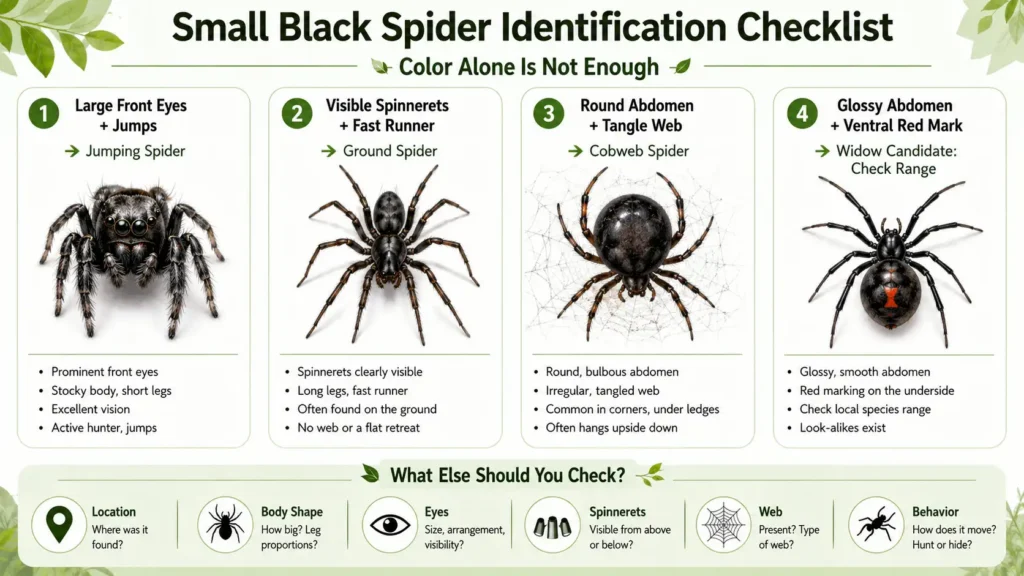
A small black spider is not one species. Common possibilities include jumping spiders, ground spiders, parson spiders, dark cobweb spiders and, depending on location, widow or black house spiders. A spider cannot usually be identified reliably from color alone or from one blurry photograph. For useful small black spider identification, combine location, body shape, size, legs, eyes, spinnerets, web, habitat and behavior.
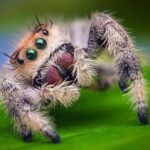
- Compact body, very large front eyes, short jumps: check jumping spiders (Salticidae).
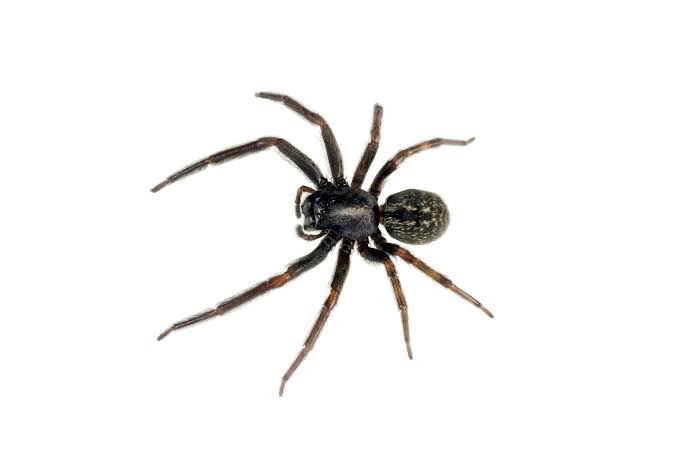
- Fast runner on the floor or ground, no capture web, visible rear spinnerets: check ground spiders (Gnaphosidae).
- Dark spider with a pale stripe or band running quickly indoors in North America: a parson spider or another ground spider may be possible.
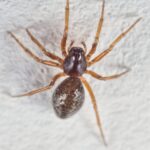
- Rounded or bulbous abdomen in an irregular tangled web: check cobweb spiders (Theridiidae), including Steatoda.
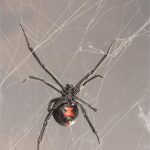
- Glossy dark, rounded spider with a red or orange ventral marking: a widow should be considered only if anatomy and geographic range also fit.
How to Identify a Small Black Spider
“Small and black” is a useful starting description, but it is not a diagnosis. Dark coloration occurs in many unrelated spider families. Lighting also matters: a spider that looks jet black indoors may prove to be dark brown, charcoal, reddish brown or patterned when photographed in daylight.
A better approach is to work through the same kinds of clues used in a broader spider identification guide: first establish geographic location, then compare structure, web type and behavior before relying on color.
1. Record exactly where you found it
Country and region can eliminate impossible matches immediately. Also record the microhabitat. A spider running across a kitchen floor presents a different set of possibilities from one sitting in a tangled garage web, hunting on a sunny window frame or hiding beneath garden debris.
This is especially important when using common names. A name such as “house spider” or “black spider” can refer to unrelated animals in different countries.
2. Look at the overall body shape
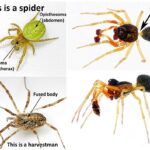
Ask whether the spider is compact and stocky, elongated and ground-running, or equipped with a large rounded abdomen and comparatively slender legs.
Jumping spiders often look compact, with a relatively high front body region. Ground spiders tend to look more streamlined for running. Cobweb spiders commonly have a softer, rounded or bulbous abdomen.
3. Check the eyes if your photograph is sharp enough
Eye arrangement is far more informative than black coloration. Jumping spiders are especially recognizable because the central front eyes are conspicuously large. They may appear to turn toward you and visually track movement.
If large eyes are the main clue in your photograph, compare the complete arrangement rather than only the most obvious pair. Spiderpedia’s guide to spiders with large eyes explains why jumping spiders and wolf spiders should not be separated by color alone.
4. Look for spinnerets at the rear of the abdomen
Ground spiders in the family Gnaphosidae can often be narrowed down by the spinnerets. In many members of this family, the front spinnerets are conspicuous from above and may look like two short projections at the rear of the abdomen.
This clue is particularly useful when a small dark spider is found running on the floor, through leaf litter or beneath rocks rather than sitting in a prey-catching web.
5. Identify the web—or the absence of one
A web can be more informative than color.
- No capture web and deliberate daytime jumping: jumping spider is a strong family-level possibility.
- No capture web and rapid running at ground level: consider ground spiders and other wandering hunters.
- Irregular three-dimensional tangle web: consider cobweb spiders in Theridiidae, including false widows and true widows where geographically appropriate.
- Silken retreat but no obvious prey-catching web: do not assume the spider is a web-building species; many hunting spiders still use silk for shelter, egg sacs and safety lines.
Common Small Black Spider Possibilities
| Possible group | Useful clues | Web or behavior | Best next check |
|---|---|---|---|
| Jumping spiders Salticidae | Compact body; conspicuous large front eyes; often hairy; some species are predominantly dark | Visual hunters; stalk and jump; no permanent prey-catching web | Get a clear frontal photograph showing the eyes |
| Ground spiders Gnaphosidae | Dark or earth-toned; running body form; conspicuous posterior spinnerets in many species | Usually active hunters on the ground rather than capture-web builders | Photograph the spider from above and behind |
| Parson spiders Herpyllus | Dark body with contrasting pale markings in familiar North American species | Fast-running ground spiders that may wander indoors | Compare pattern and geographic location together |
| False widows Steatoda | Brown to nearly black; rounded abdomen; markings may be obvious, faint or absent | Irregular tangled cobweb in a sheltered site | Check abdomen shape, markings, web and region |
| Widow spiders Latrodectus | Some adult females are glossy black with a large rounded abdomen; markings vary with species, sex and life stage | Strong irregular cobweb, usually in sheltered sites | Check geographic range and photograph the underside without handling the spider |
| Black house spider Badumna insignis | A regional species, not a universal name for any black spider found indoors | House-associated web-building spider | Consider only where geographic distribution fits |
For readers in the United States and Canada, Spiderpedia’s common North American spider identification guide provides a wider comparison of these and other groups.
Small black jumping spiders
Jumping spiders are among the first groups to consider when a small dark spider is active in daylight, notices movement and makes short controlled jumps. Members of Salticidae have a characteristic visual system dominated from the front by a pair of unusually large central eyes.
One familiar North American example is the bold jumping spider, Phidippus audax. The current World Spider Catalog accepts the species in the family Salticidae and records it from Canada, the United States and Mexico, with introductions elsewhere. A likely bold jumper should be evaluated by its stout, hairy build, prominent front eyes, behavior and range—not simply because it looks black.
Small black ground spiders
Ground spiders in Gnaphosidae are another strong possibility when the animal is found running rather than sitting in a web. Many are active at night and spend the day beneath debris, bark, stones or in silk retreats.
A particularly useful family-level clue is the pair of prominent cylindrical spinnerets visible at the rear in many gnaphosids. Utah State University Extension specifically uses these spinnerets, together with ground-running behavior and the absence of a prey-catching web, as identification clues.
Black spider with a white stripe: could it be a parson spider?
In North America, a dark spider with a contrasting pale stripe may suggest a parson spider. The eastern parson spider, Herpyllus ecclesiasticus, is an accepted member of Gnaphosidae. University of Minnesota Extension describes it as dark-colored with a light stripe on the cephalothorax and a pale, somewhat arrow-shaped abdominal band.
However, a white stripe does not by itself confirm H. ecclesiasticus. Other ground spiders can carry contrasting markings, and closely related Herpyllus species can be difficult to separate from ordinary photographs. Location and detailed morphology still matter.
Small dark cobweb spiders and false widows
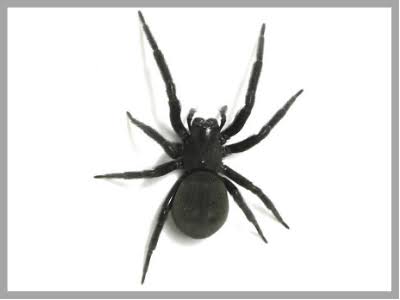
If the spider has a rounded abdomen and spends most of its time in an irregular tangle web, look at the cobweb-spider family Theridiidae. This large family contains both true widows and many other spiders that can look superficially similar.
False widows in the genus Steatoda can range from brown to very dark brown or nearly black. One widespread example is Steatoda grossa, an accepted theridiid species with a broad distribution that includes both native and introduced populations.
Do not identify a false widow—or a true widow—from a round dark abdomen alone. The web, markings, leg proportions, geographic location, sex and life stage all contribute to a defensible identification.
Is every shiny black spider a black widow?
No. A black spider is not automatically a black widow.
For example, the typical adult female western black widow, Latrodectus hesperus, has a glossy black body, slender legs and a large rounded abdomen. A red or orange hourglass-like marking on the underside is an important clue. Juveniles and males can look substantially different from the familiar adult female.
Even these traits must be interpreted geographically. Widow species differ across regions, and several unrelated cobweb spiders can produce a similar dark, rounded silhouette.
What about the “black house spider”?
“Black house spider” should not be used as a generic identification for every dark spider found indoors. It is also a common name associated with Badumna insignis, an accepted species in the family Desidae.
The World Spider Catalog records B. insignis from Australia, with introduced populations in Japan and New Zealand. Therefore, geographic location is essential. A person in North America should not label an unknown dark indoor spider Badumna insignis simply because an image search returned the words “black house spider.”
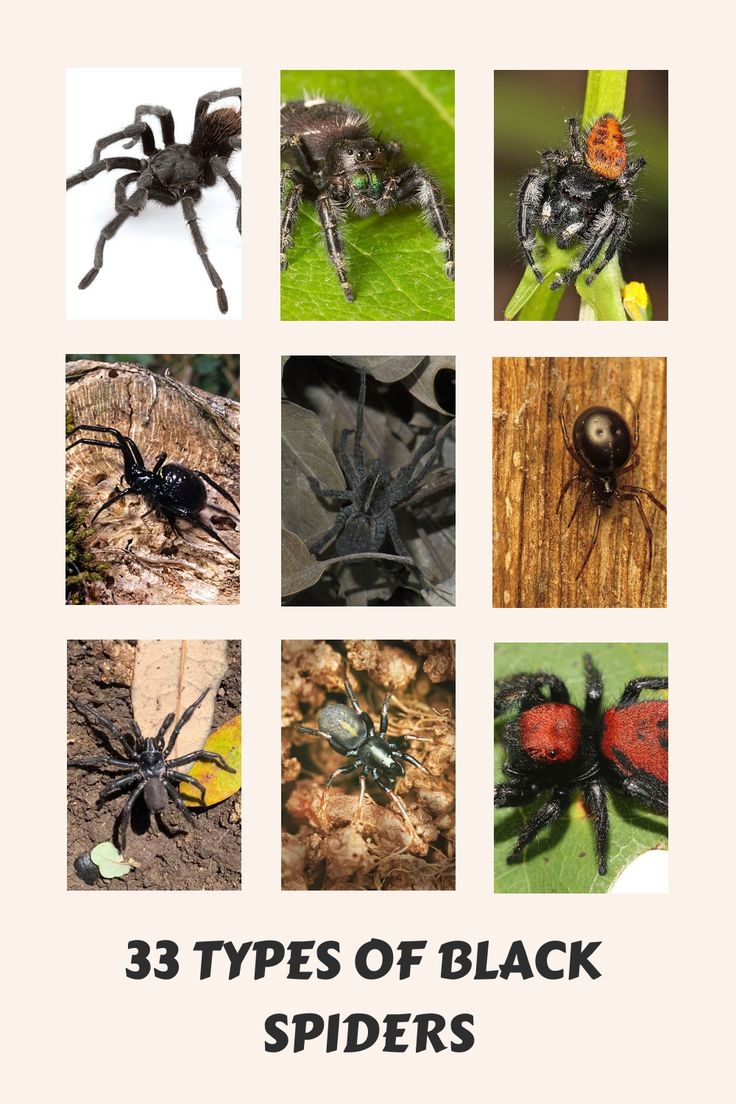
Why Color Alone Fails for Small Black Spider Identification
Color is unusually easy to misread in spiders. A flash can make a brown abdomen appear black and glossy. Dark hairs can conceal underlying markings. Juveniles may have patterns that fade or change as they mature. Males and females of the same species may also differ substantially.
That is why a useful identification should combine several independent clues. A compact black spider that jumps toward movement is biologically very different from a rounded black spider hanging beneath an irregular web, even though both may be described online as a “tiny black spider.”
The same caution applies to indoor sightings. Spiderpedia’s house spider identification guide explains why the fact that a spider was found in a home does not make “house spider” a species-level identification.
Can You Identify a Small Black Spider From One Photo?
Sometimes you can narrow it to a family or recognizable group. Species-level confirmation is a different matter.
A sharp photograph of a jumping spider’s face may strongly support Salticidae. A clear view of a ground spider’s spinnerets may support Gnaphosidae. A visible web, abdomen shape and geographic location may narrow a cobweb spider to a useful group.
But many closely related spiders cannot be reliably separated from one dorsal photograph. Depending on the group, accurate species identification may require an adult specimen, magnification, a regional taxonomic key, microscopic examination of reproductive structures or review by an experienced arachnologist.
It is better to report a confident family or genus identification than to attach an unsupported species name.
How to Take Better Photos for Identification
- Record the country, state/province or region. Do not rely on the photograph alone.
- Photograph the spider from above. This captures the cephalothorax, abdomen and dorsal markings.
- Get a side view if possible. It can show abdomen shape and leg proportions.
- Photograph the face from a safe distance. Eye arrangement is particularly valuable for jumping and wolf spiders.
- Include the rear of the abdomen. Spinnerets may be diagnostic at family level.
- Photograph the web and surrounding habitat. Do not remove the spider before documenting its context.
- Record behavior. Note whether it jumped, ran rapidly, remained in a web, hung upside down or hid in a retreat.
- Include a scale reference nearby. Do not put a ruler against an unknown spider or handle it to obtain a measurement.
Are Small Black Spiders Dangerous?
Dark coloration does not predict medical significance. Many small dark spiders encountered around homes are not considered medically important, while certain widow spiders deserve more caution.
When discussing spiders that inject venom, venomous is the appropriate term rather than poisonous. “Venomous,” “dangerous” and “medically significant” also do not mean the same thing.
An unknown spider should not be declared safe—or dangerous—because it is black, tiny, hairy, glossy or found indoors.
Likewise, redness, swelling, itching, blistering or a skin lesion cannot establish that a spider caused an injury. Skin lesions have many possible causes, and spider bites are often difficult to confirm without seeing or identifying the spider involved.
If a suspected bite causes severe pain, rapidly worsening symptoms, difficulty breathing, marked muscle cramping, faintness or other systemic symptoms, seek appropriate local medical care rather than attempting an online diagnosis.
Small Black Spider Identification FAQ
What is the tiny black spider in my house?
There is no single “tiny black house spider.” Depending on your region and what the spider is doing, possibilities include jumping spiders, ground spiders, parson spiders, cobweb spiders and other small indoor wanderers. Start with location, body shape, web and behavior.
What small black spider jumps?
A compact dark spider with conspicuous forward-facing eyes that stalks and makes controlled jumps is likely worth comparing with jumping spiders in the family Salticidae. Color alone cannot confirm the family or species.
What small black spider runs very fast across the floor?
A rapidly running spider without a capture web may be a ground spider or another wandering hunter. If two conspicuous cylindrical spinnerets are visible at the rear, Gnaphosidae becomes a stronger possibility.
Is a small shiny black spider a black widow?
Not necessarily. False widows and other cobweb spiders can also look dark and glossy. A widow identification should consider geographic range, abdomen shape, ventral markings, web structure, sex and life stage together.
Can I identify a spider by a white spot or stripe on a black body?
A pale stripe can narrow the possibilities but is not enough for a species identification. In North America, parson spiders are one possibility, but other ground spiders and unrelated species also have contrasting pale markings.
Why does my spider look black in one photo and brown in another?
Lighting, flash, exposure, reflections, hairs and viewing angle can change apparent color substantially. Use structural features and behavior before treating color as an identification clue.
References and Further Reading
- World Spider Catalog. Phidippus audax (Hentz, 1845), accepted species record, family Salticidae and distribution. World Spider Catalog species record.
- World Spider Catalog. Herpyllus ecclesiasticus Hentz, 1832, accepted species record, family Gnaphosidae and distribution. World Spider Catalog species record.
- World Spider Catalog. Steatoda grossa (C. L. Koch, 1838), accepted species record, family Theridiidae and distribution. World Spider Catalog species record.
- World Spider Catalog. Badumna insignis (L. Koch, 1872), accepted species record, family Desidae and distribution. World Spider Catalog species record.
- University of California Statewide Integrated Pest Management Program. Spiders: identification of jumping spiders, cobweb spiders, wolf spiders and western black widows. UC IPM: Spiders.
- University of Minnesota Extension. Parson spider, Herpyllus ecclesiasticus: identification and occurrence around homes. University of Minnesota Extension: Parson Spider.